

84
sources such as wind or solar (Lee et al. 2012)
and for helping peak-load power stations functioning in tandem with hydroelectric plants.
Natural gas burns more cleanly than other fuels,
such as oil and coal. Because burning natural gas
produces both water and carbon dioxide, it produces less carbon dioxide per unit of energy
released than coal, which produces mostly carbon dioxide. Burning natural gas produces only
about half the carbon dioxide per kilowatt-hour
(kWh) that coal does (de Gouw et al. 2014; EIA
2018). Because of this higher carbon efficiency
of power generation using natural gas the fuel
mix in the US was changed to reducing the use of
coal and increasing that of natural gas. Natural
gas generated power has increased from 740 TWh
in 1973 to 5140 TWh in 2012, generating 22% of
the world’s total electricity. Approximately half
as much as generated with coal (IEA 2014).
Of course carbon dioxide production by burning natural gas, oil or coal is not everything, especially today when most of the produced carbon
dioxide can be captured in the process of burning.
Natural gas is mainly composed of methane.
When it is released into the atmosphere it is
removed by gradual oxidation as the lifetime of
atmospheric methane is relatively short compared to carbon dioxide. Although the half-life of
methane in the atmosphere is about 7 years, it is
more efficient in trapping heat in the atmosphere;
therefore, a given quantity of methane has 84
times the global warming potential of the same
amount of carbon dioxide over a period of
20 years and 28 times more potent on a 100-year
time horizon (Myhre et al. 2013). Natural gas is
thus a more potent greenhouse gas than carbon
dioxide due to the greater global warming potential of methane. During extraction, storage, transportation and distribution natural gas may leak
into the atmosphere, particularly in the course of
the extraction process. Due to the leak rate of
methane its ostensible global warming advantage
over coal could be eliminated (Peischl et al.
2015).
Since Middle East countries has increased
their share of natural gas production since the
2000s and undisturbed consumption in North
America was thought to be doubtful, the USA
and Canada turned to unconventional domestic
gas reserves like shale gas.
Shale gas is natural gas produced from shale.
Since the permeability of shale is too low to allow
gas to flow in economical quantities, production
of unconventional reserves is difficult and thus
more expensive. Shale gas wells depend on fractures to allow the gas to flow. Early shale gas
wells depended on natural fractures through
which gas flowed; almost all shale gas wells
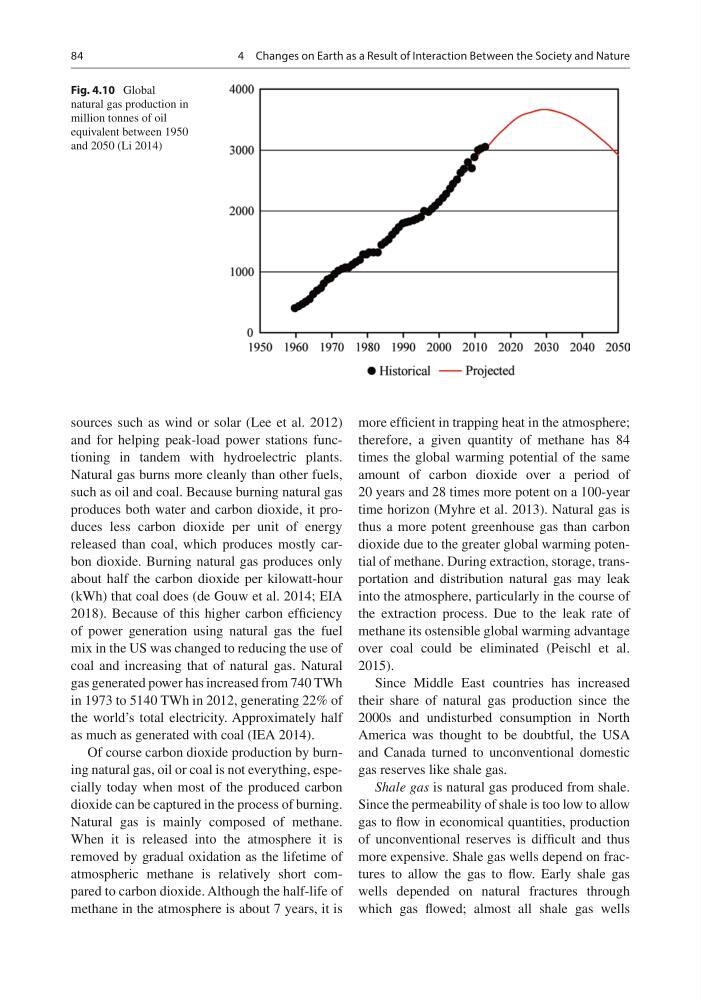
Fig. 4.10 Global
natural gas production in
million tonnes of oil
equivalent between 1950
and 2050 (Li 2014)
4 Changes on Earth as a Result of Interaction Between the Society and Nature
sources such as wind or solar (Lee et al. 2012)
and for helping peak-load power stations functioning in tandem with hydroelectric plants.
Natural gas burns more cleanly than other fuels,
such as oil and coal. Because burning natural gas
produces both water and carbon dioxide, it produces less carbon dioxide per unit of energy
released than coal, which produces mostly carbon dioxide. Burning natural gas produces only
about half the carbon dioxide per kilowatt-hour
(kWh) that coal does (de Gouw et al. 2014; EIA
2018). Because of this higher carbon efficiency
of power generation using natural gas the fuel
mix in the US was changed to reducing the use of
coal and increasing that of natural gas. Natural
gas generated power has increased from 740 TWh
in 1973 to 5140 TWh in 2012, generating 22% of
the world’s total electricity. Approximately half
as much as generated with coal (IEA 2014).
Of course carbon dioxide production by burning natural gas, oil or coal is not everything, especially today when most of the produced carbon
dioxide can be captured in the process of burning.
Natural gas is mainly composed of methane.
When it is released into the atmosphere it is
removed by gradual oxidation as the lifetime of
atmospheric methane is relatively short compared to carbon dioxide. Although the half-life of
methane in the atmosphere is about 7 years, it is
more efficient in trapping heat in the atmosphere;
therefore, a given quantity of methane has 84
times the global warming potential of the same
amount of carbon dioxide over a period of
20 years and 28 times more potent on a 100-year
time horizon (Myhre et al. 2013). Natural gas is
thus a more potent greenhouse gas than carbon
dioxide due to the greater global warming potential of methane. During extraction, storage, transportation and distribution natural gas may leak
into the atmosphere, particularly in the course of
the extraction process. Due to the leak rate of
methane its ostensible global warming advantage
over coal could be eliminated (Peischl et al.
2015).
Since Middle East countries has increased
their share of natural gas production since the
2000s and undisturbed consumption in North
America was thought to be doubtful, the USA
and Canada turned to unconventional domestic
gas reserves like shale gas.
Shale gas is natural gas produced from shale.
Since the permeability of shale is too low to allow
gas to flow in economical quantities, production
of unconventional reserves is difficult and thus
more expensive. Shale gas wells depend on fractures to allow the gas to flow. Early shale gas
wells depended on natural fractures through
which gas flowed; almost all shale gas wells
Fig. 4.10 Global
natural gas production in
million tonnes of oil
equivalent between 1950
and 2050 (Li 2014)
4 Changes on Earth as a Result of Interaction Between the Society and Nature