

86
4.1.1.3 Uranium Mining and Nuclear
Energy
The Atomic Energy Act of 1946 allowed uranium
mining in the USA provided the finished product
ended up in government control. Uranium mining
advanced in one of the natural wonders of Arizona,
the Grand Canyon where radioactive areas were
mined that would later be named Orphan Mine in
Grand Canyon National Park. In the 1950s attention turned to the peaceful use of nuclear fission
controlling it for power generation.
Uranium is mostly found naturally in the form
of uraninite (UO 2 ) which is generally mixed with
uranium trioxide to give a general formula of
U 3 O 8 which is the target product of ore processing. Generally the isotope U-235 has the highest
radioactivity; however, U-238 is the most abundant while U-234 is generally the least abundant
in natural uraninite.
Uranium is an extremely powerful fuel since a
7-g piece of uranium fuel produces as much
energy as 550 L of oil and 800 kg of coal (GSNL
2007).
Nuclear power plants are in operation in more
than 30 countries worldwide while even more
countries depend in part on nuclear generated
power via regional transmission networks. In
2016 around 11% of electricity was generated in
about 450 nuclear power reactors around the
world and further 60 reactors are under construction. In 2016 nuclear power plants supplied
2477 TWh of electricity with Europe and North
America dominating the market as shown in
Fig. 4.12.
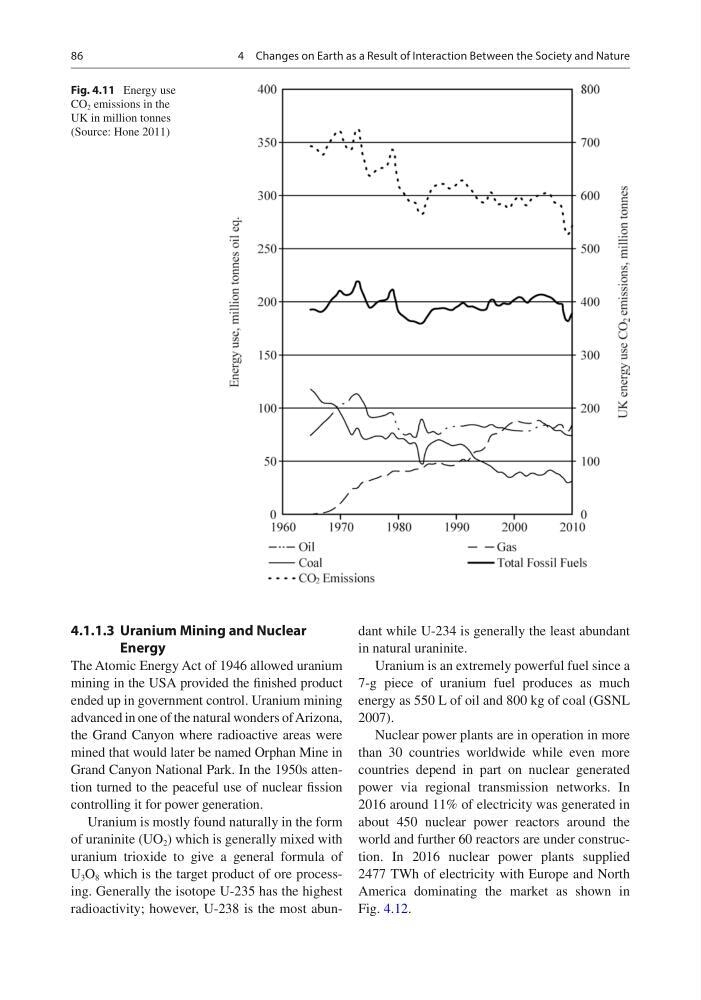
Fig. 4.11 Energy use
CO 2 emissions in the
UK in million tonnes
(Source: Hone 2011)
4 Changes on Earth as a Result of Interaction Between the Society and Nature
4.1.1.3 Uranium Mining and Nuclear
Energy
The Atomic Energy Act of 1946 allowed uranium
mining in the USA provided the finished product
ended up in government control. Uranium mining
advanced in one of the natural wonders of Arizona,
the Grand Canyon where radioactive areas were
mined that would later be named Orphan Mine in
Grand Canyon National Park. In the 1950s attention turned to the peaceful use of nuclear fission
controlling it for power generation.
Uranium is mostly found naturally in the form
of uraninite (UO 2 ) which is generally mixed with
uranium trioxide to give a general formula of
U 3 O 8 which is the target product of ore processing. Generally the isotope U-235 has the highest
radioactivity; however, U-238 is the most abundant while U-234 is generally the least abundant
in natural uraninite.
Uranium is an extremely powerful fuel since a
7-g piece of uranium fuel produces as much
energy as 550 L of oil and 800 kg of coal (GSNL
2007).
Nuclear power plants are in operation in more
than 30 countries worldwide while even more
countries depend in part on nuclear generated
power via regional transmission networks. In
2016 around 11% of electricity was generated in
about 450 nuclear power reactors around the
world and further 60 reactors are under construction. In 2016 nuclear power plants supplied
2477 TWh of electricity with Europe and North
America dominating the market as shown in
Fig. 4.12.
Fig. 4.11 Energy use
CO 2 emissions in the
UK in million tonnes
(Source: Hone 2011)
4 Changes on Earth as a Result of Interaction Between the Society and Nature