

84
Modern Food Microbiology
following manner:
decarboxylase
Lysine − −−−−−−−− → H 2 N(CH 2 ) 5 NH 2
Cadaverine
decarboxylase
Ornithine or arginine − −−−−−−−− → H 2 N(CH 2 ) 5 NH 2
Putrescine
Their use as quality indicators of vacuum-packaged beef that was stored at 1
◦ C for up to 8 weeks
has been investigated.
46 Cadaverine increased more than putrescine in vacuum-packaged meats, the
reverse of findings for aerobically stored samples. Cadaverine levels attained over the incubation
period were tenfold higher than the initial levels at total viable counts of 10
6 /cm
2 , whereas there was
little change in putrescine at this level. Overall, the findings suggested that these diamines could be
of value for vacuum-packaged meats. In fresh beef, pork, and lamb, putrescine occurred at levels
from 0.4 to 2.3 ppm and cadaverine from 0.1 to 1.3 ppm.
47,132,185 Putrescine is the major diamine
produced by pseudomonads, whereas cadaverine is produced more by Enterobacteriaceae.
162 It may
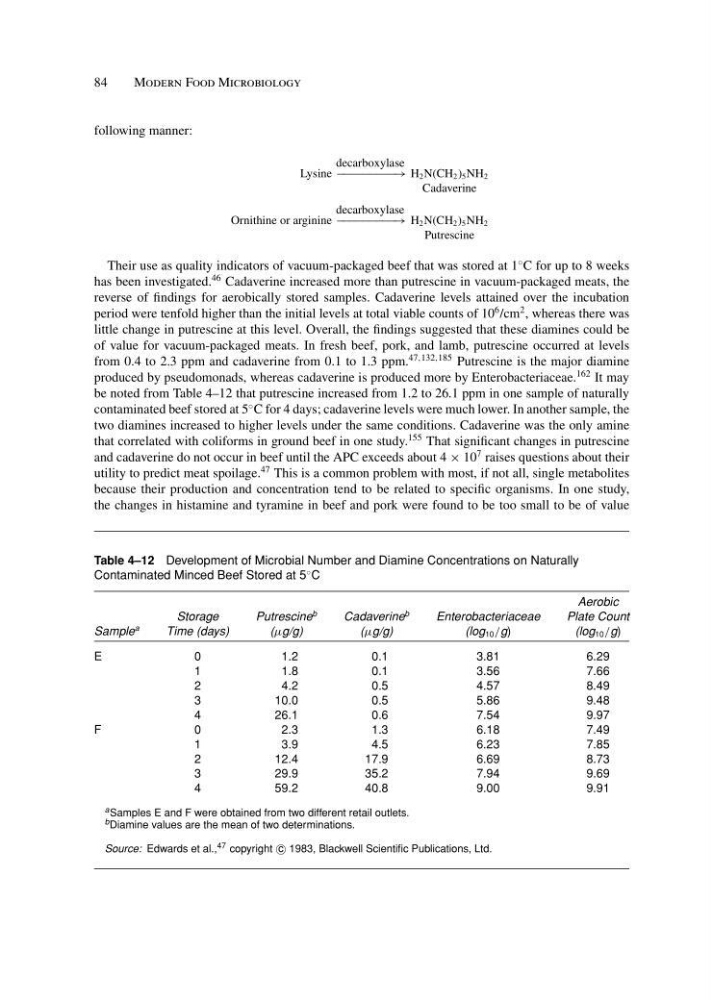
be noted from Table 4–12 that putrescine increased from 1.2 to 26.1 ppm in one sample of naturally
contaminated beef stored at 5
◦ C for 4 days; cadaverine levels were much lower. In another sample, the
two diamines increased to higher levels under the same conditions. Cadaverine was the only amine
that correlated with coliforms in ground beef in one study.
155 That significant changes in putrescine
and cadaverine do not occur in beef until the APC exceeds about 4 × 10
7 raises questions about their
utility to predict meat spoilage.
47 This is a common problem with most, if not all, single metabolites
because their production and concentration tend to be related to specific organisms. In one study,
the changes in histamine and tyramine in beef and pork were found to be too small to be of value
Table 4–12 Development of Microbial Number and Diamine Concentrations on Naturally
Contaminated Minced Beef Stored at 5
◦ C
Aerobic
Storage
Putrescine
b
Cadaverine
b
Enterobacteriaceae
Plate Count
Sample
a
Time (days)
(µg/g)
(µg/g)
(log 10 /g)
(log 10 /g)
E
0
1.2
0.1
3.81
6.29
1
1.8
0.1
3.56
7.66
2
4.2
0.5
4.57
8.49
3
10.0
0.5
5.86
9.48
4
26.1
0.6
7.54
9.97
F
0
2.3
1.3
6.18
7.49
1
3.9
4.5
6.23
7.85
2
12.4
17.9
6.69
8.73
3
29.9
35.2
7.94
9.69
4
59.2
40.8
9.00
9.91
a Samples E and F were obtained from two different retail outlets.
b Diamine values are the mean of two determinations.
Source: Edwards et al., 47 copyright c
1983, Blackwell Scientific Publications, Ltd.
Modern Food Microbiology
following manner:
decarboxylase
Lysine − −−−−−−−− → H 2 N(CH 2 ) 5 NH 2
Cadaverine
decarboxylase
Ornithine or arginine − −−−−−−−− → H 2 N(CH 2 ) 5 NH 2
Putrescine
Their use as quality indicators of vacuum-packaged beef that was stored at 1
◦ C for up to 8 weeks
has been investigated.
46 Cadaverine increased more than putrescine in vacuum-packaged meats, the
reverse of findings for aerobically stored samples. Cadaverine levels attained over the incubation
period were tenfold higher than the initial levels at total viable counts of 10
6 /cm
2 , whereas there was
little change in putrescine at this level. Overall, the findings suggested that these diamines could be
of value for vacuum-packaged meats. In fresh beef, pork, and lamb, putrescine occurred at levels
from 0.4 to 2.3 ppm and cadaverine from 0.1 to 1.3 ppm.
47,132,185 Putrescine is the major diamine
produced by pseudomonads, whereas cadaverine is produced more by Enterobacteriaceae.
162 It may
be noted from Table 4–12 that putrescine increased from 1.2 to 26.1 ppm in one sample of naturally
contaminated beef stored at 5
◦ C for 4 days; cadaverine levels were much lower. In another sample, the
two diamines increased to higher levels under the same conditions. Cadaverine was the only amine
that correlated with coliforms in ground beef in one study.
155 That significant changes in putrescine
and cadaverine do not occur in beef until the APC exceeds about 4 × 10
7 raises questions about their
utility to predict meat spoilage.
47 This is a common problem with most, if not all, single metabolites
because their production and concentration tend to be related to specific organisms. In one study,
the changes in histamine and tyramine in beef and pork were found to be too small to be of value
Table 4–12 Development of Microbial Number and Diamine Concentrations on Naturally
Contaminated Minced Beef Stored at 5
◦ C
Aerobic
Storage
Putrescine
b
Cadaverine
b
Enterobacteriaceae
Plate Count
Sample
a
Time (days)
(µg/g)
(µg/g)
(log 10 /g)
(log 10 /g)
E
0
1.2
0.1
3.81
6.29
1
1.8
0.1
3.56
7.66
2
4.2
0.5
4.57
8.49
3
10.0
0.5
5.86
9.48
4
26.1
0.6
7.54
9.97
F
0
2.3
1.3
6.18
7.49
1
3.9
4.5
6.23
7.85
2
12.4
17.9
6.69
8.73
3
29.9
35.2
7.94
9.69
4
59.2
40.8
9.00
9.91
a Samples E and F were obtained from two different retail outlets.
b Diamine values are the mean of two determinations.
Source: Edwards et al., 47 copyright c
1983, Blackwell Scientific Publications, Ltd.