

Fresh Meats and Poultry
85
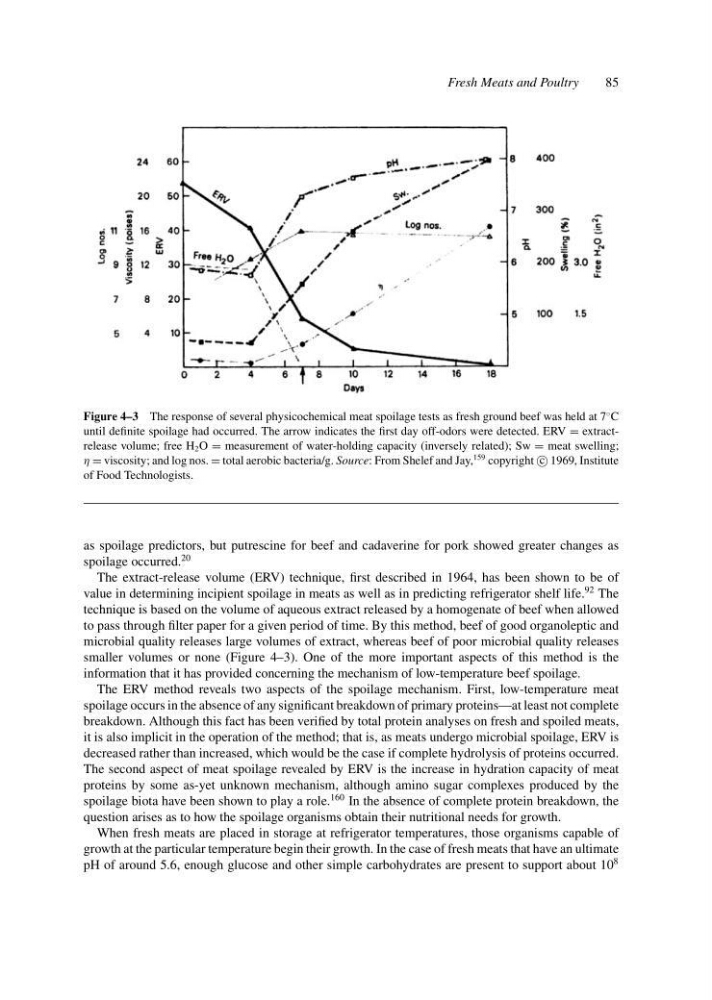
Figure 4–3 The response of several physicochemical meat spoilage tests as fresh ground beef was held at 7
◦ C
until definite spoilage had occurred. The arrow indicates the first day off-odors were detected. ERV = extractrelease volume; free H 2 O = measurement of water-holding capacity (inversely related); Sw = meat swelling;
η = viscosity; and log nos. = total aerobic bacteria/g. Source: From Shelef and Jay,
159 copyright c
1969, Institute
of Food Technologists.
as spoilage predictors, but putrescine for beef and cadaverine for pork showed greater changes as
spoilage occurred.
20
The extract-release volume (ERV) technique, first described in 1964, has been shown to be of
value in determining incipient spoilage in meats as well as in predicting refrigerator shelf life.
92 The
technique is based on the volume of aqueous extract released by a homogenate of beef when allowed
to pass through filter paper for a given period of time. By this method, beef of good organoleptic and
microbial quality releases large volumes of extract, whereas beef of poor microbial quality releases
smaller volumes or none (Figure 4–3). One of the more important aspects of this method is the
information that it has provided concerning the mechanism of low-temperature beef spoilage.
The ERV method reveals two aspects of the spoilage mechanism. First, low-temperature meat
spoilage occurs in the absence of any significant breakdown of primary proteins—at least not complete
breakdown. Although this fact has been verified by total protein analyses on fresh and spoiled meats,
it is also implicit in the operation of the method; that is, as meats undergo microbial spoilage, ERV is
decreased rather than increased, which would be the case if complete hydrolysis of proteins occurred.
The second aspect of meat spoilage revealed by ERV is the increase in hydration capacity of meat
proteins by some as-yet unknown mechanism, although amino sugar complexes produced by the
spoilage biota have been shown to play a role.
160 In the absence of complete protein breakdown, the
question arises as to how the spoilage organisms obtain their nutritional needs for growth.
When fresh meats are placed in storage at refrigerator temperatures, those organisms capable of
growth at the particular temperature begin their growth. In the case of fresh meats that have an ultimate
pH of around 5.6, enough glucose and other simple carbohydrates are present to support about 10
8
85
Figure 4–3 The response of several physicochemical meat spoilage tests as fresh ground beef was held at 7
◦ C
until definite spoilage had occurred. The arrow indicates the first day off-odors were detected. ERV = extractrelease volume; free H 2 O = measurement of water-holding capacity (inversely related); Sw = meat swelling;
η = viscosity; and log nos. = total aerobic bacteria/g. Source: From Shelef and Jay,
159 copyright c
1969, Institute
of Food Technologists.
as spoilage predictors, but putrescine for beef and cadaverine for pork showed greater changes as
spoilage occurred.
20
The extract-release volume (ERV) technique, first described in 1964, has been shown to be of
value in determining incipient spoilage in meats as well as in predicting refrigerator shelf life.
92 The
technique is based on the volume of aqueous extract released by a homogenate of beef when allowed
to pass through filter paper for a given period of time. By this method, beef of good organoleptic and
microbial quality releases large volumes of extract, whereas beef of poor microbial quality releases
smaller volumes or none (Figure 4–3). One of the more important aspects of this method is the
information that it has provided concerning the mechanism of low-temperature beef spoilage.
The ERV method reveals two aspects of the spoilage mechanism. First, low-temperature meat
spoilage occurs in the absence of any significant breakdown of primary proteins—at least not complete
breakdown. Although this fact has been verified by total protein analyses on fresh and spoiled meats,
it is also implicit in the operation of the method; that is, as meats undergo microbial spoilage, ERV is
decreased rather than increased, which would be the case if complete hydrolysis of proteins occurred.
The second aspect of meat spoilage revealed by ERV is the increase in hydration capacity of meat
proteins by some as-yet unknown mechanism, although amino sugar complexes produced by the
spoilage biota have been shown to play a role.
160 In the absence of complete protein breakdown, the
question arises as to how the spoilage organisms obtain their nutritional needs for growth.
When fresh meats are placed in storage at refrigerator temperatures, those organisms capable of
growth at the particular temperature begin their growth. In the case of fresh meats that have an ultimate
pH of around 5.6, enough glucose and other simple carbohydrates are present to support about 10
8