

78
Modern Food Microbiology
MICROBIAL SPOILAGE OF FRESH RED MEATS
Most studies dealing with the spoilage of meats have been done with beef, and most of the discussion
in this section is based on beef studies. Pork, lamb, veal, and similar meats, are presumed to spoil in
a similar way.
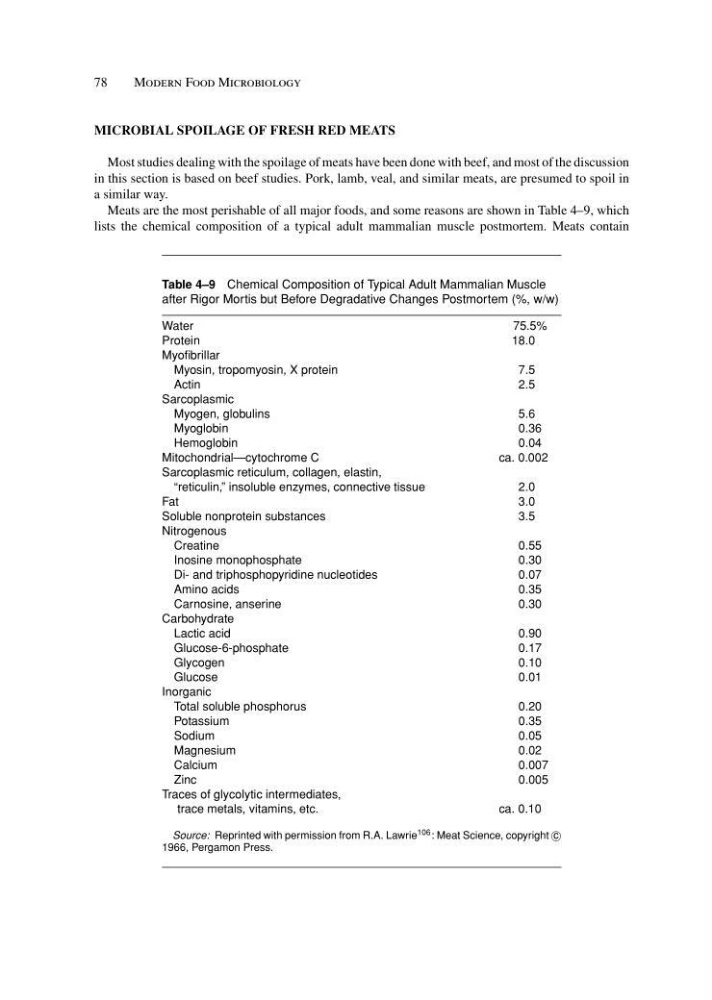
Meats are the most perishable of all major foods, and some reasons are shown in Table 4–9, which
lists the chemical composition of a typical adult mammalian muscle postmortem. Meats contain
Table 4–9 Chemical Composition of Typical Adult Mammalian Muscle
after Rigor Mortis but Before Degradative Changes Postmortem (%, w/w)
Water
75.5%
Protein
18.0
Myofibrillar
Myosin, tropomyosin, X protein
7.5
Actin
2.5
Sarcoplasmic
Myogen, globulins
5.6
Myoglobin
0.36
Hemoglobin
0.04
Mitochondrial—cytochrome C
ca. 0.002
Sarcoplasmic reticulum, collagen, elastin,
“reticulin,” insoluble enzymes, connective tissue
2.0
Fat
3.0
Soluble nonprotein substances
3.5
Nitrogenous
Creatine
0.55
Inosine monophosphate
0.30
Di- and triphosphopyridine nucleotides
0.07
Amino acids
0.35
Carnosine, anserine
0.30
Carbohydrate
Lactic acid
0.90
Glucose-6-phosphate
0.17
Glycogen
0.10
Glucose
0.01
Inorganic
Total soluble phosphorus
0.20
Potassium
0.35
Sodium
0.05
Magnesium
0.02
Calcium
0.007
Zinc
0.005
Traces of glycolytic intermediates,
trace metals, vitamins, etc.
ca. 0.10
Source: Reprinted with permission from R.A. Lawrie 106 : Meat Science, copyright c
1966, Pergamon Press.
Modern Food Microbiology
MICROBIAL SPOILAGE OF FRESH RED MEATS
Most studies dealing with the spoilage of meats have been done with beef, and most of the discussion
in this section is based on beef studies. Pork, lamb, veal, and similar meats, are presumed to spoil in
a similar way.
Meats are the most perishable of all major foods, and some reasons are shown in Table 4–9, which
lists the chemical composition of a typical adult mammalian muscle postmortem. Meats contain
Table 4–9 Chemical Composition of Typical Adult Mammalian Muscle
after Rigor Mortis but Before Degradative Changes Postmortem (%, w/w)
Water
75.5%
Protein
18.0
Myofibrillar
Myosin, tropomyosin, X protein
7.5
Actin
2.5
Sarcoplasmic
Myogen, globulins
5.6
Myoglobin
0.36
Hemoglobin
0.04
Mitochondrial—cytochrome C
ca. 0.002
Sarcoplasmic reticulum, collagen, elastin,
“reticulin,” insoluble enzymes, connective tissue
2.0
Fat
3.0
Soluble nonprotein substances
3.5
Nitrogenous
Creatine
0.55
Inosine monophosphate
0.30
Di- and triphosphopyridine nucleotides
0.07
Amino acids
0.35
Carnosine, anserine
0.30
Carbohydrate
Lactic acid
0.90
Glucose-6-phosphate
0.17
Glycogen
0.10
Glucose
0.01
Inorganic
Total soluble phosphorus
0.20
Potassium
0.35
Sodium
0.05
Magnesium
0.02
Calcium
0.007
Zinc
0.005
Traces of glycolytic intermediates,
trace metals, vitamins, etc.
ca. 0.10
Source: Reprinted with permission from R.A. Lawrie 106 : Meat Science, copyright c
1966, Pergamon Press.