

Fresh Meats and Poultry
79
Table 4–10 Meat and Meat Products: Approximate Percentage Chemical
Composition
Meats
Water
Carbohydrates
Proteins
Fat
Ash
Beef, hamburger
55.0
0
16.0
28.0
0.8
Beef, round
69.0
0
19.5
11.0
1.0
Bologna
62.4
3.6
14.8
15.9
3.3
Chicken (broiler)
71.2
0
20.2
7.2
1.1
Frankfurters
60.0
2.7
14.2
20.5
2.7
Lamb
66.3
0
17.1
14.8
0.9
Liver (beef)
69.7
6.0
19.7
3.2
1.4
Pork, medium
42.0
0
11.9
45.0
0.6
Turkey, medium fat
58.3
0
20.1
20.2
1.0
Source: Watt and Merrill. 184
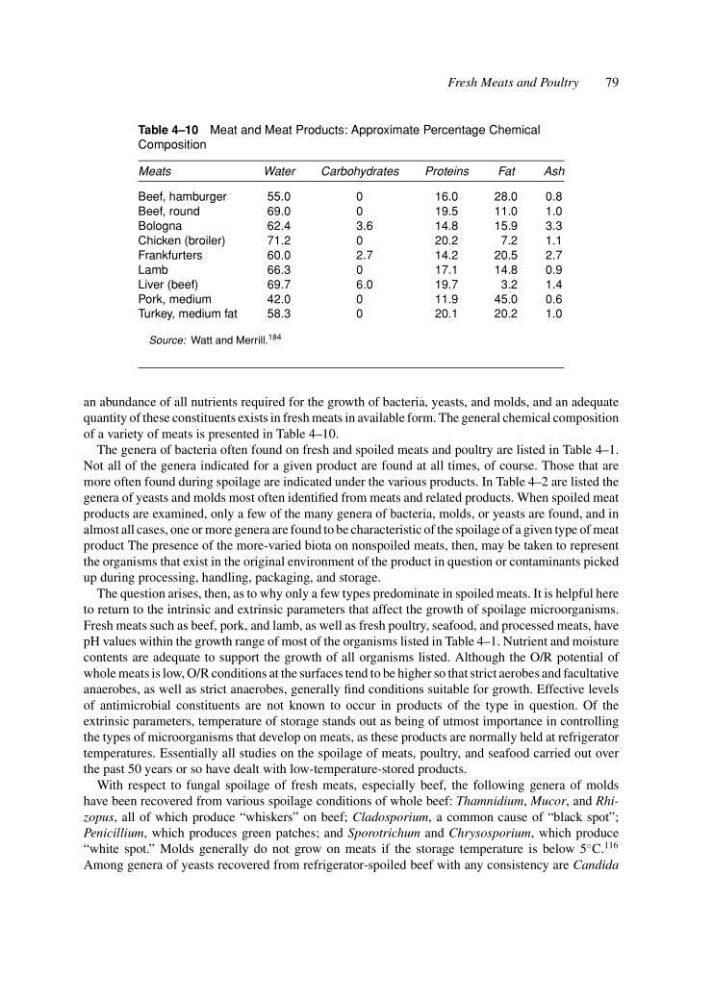
an abundance of all nutrients required for the growth of bacteria, yeasts, and molds, and an adequate
quantity of these constituents exists in fresh meats in available form. The general chemical composition
of a variety of meats is presented in Table 4–10.
The genera of bacteria often found on fresh and spoiled meats and poultry are listed in Table 4–1.
Not all of the genera indicated for a given product are found at all times, of course. Those that are
more often found during spoilage are indicated under the various products. In Table 4–2 are listed the
genera of yeasts and molds most often identified from meats and related products. When spoiled meat
products are examined, only a few of the many genera of bacteria, molds, or yeasts are found, and in
almost all cases, one or more genera are found to be characteristic of the spoilage of a given type of meat
product The presence of the more-varied biota on nonspoiled meats, then, may be taken to represent
the organisms that exist in the original environment of the product in question or contaminants picked
up during processing, handling, packaging, and storage.
The question arises, then, as to why only a few types predominate in spoiled meats. It is helpful here
to return to the intrinsic and extrinsic parameters that affect the growth of spoilage microorganisms.
Fresh meats such as beef, pork, and lamb, as well as fresh poultry, seafood, and processed meats, have
pH values within the growth range of most of the organisms listed in Table 4–1. Nutrient and moisture
contents are adequate to support the growth of all organisms listed. Although the O/R potential of
whole meats is low, O/R conditions at the surfaces tend to be higher so that strict aerobes and facultative
anaerobes, as well as strict anaerobes, generally find conditions suitable for growth. Effective levels
of antimicrobial constituents are not known to occur in products of the type in question. Of the
extrinsic parameters, temperature of storage stands out as being of utmost importance in controlling
the types of microorganisms that develop on meats, as these products are normally held at refrigerator
temperatures. Essentially all studies on the spoilage of meats, poultry, and seafood carried out over
the past 50 years or so have dealt with low-temperature-stored products.
With respect to fungal spoilage of fresh meats, especially beef, the following genera of molds
have been recovered from various spoilage conditions of whole beef: Thamnidium, Mucor, and Rhizopus, all of which produce “whiskers” on beef; Cladosporium, a common cause of “black spot”;
Penicillium, which produces green patches; and Sporotrichum and Chrysosporium, which produce
“white spot.” Molds generally do not grow on meats if the storage temperature is below 5
◦ C.
116
Among genera of yeasts recovered from refrigerator-spoiled beef with any consistency are Candida
79
Table 4–10 Meat and Meat Products: Approximate Percentage Chemical
Composition
Meats
Water
Carbohydrates
Proteins
Fat
Ash
Beef, hamburger
55.0
0
16.0
28.0
0.8
Beef, round
69.0
0
19.5
11.0
1.0
Bologna
62.4
3.6
14.8
15.9
3.3
Chicken (broiler)
71.2
0
20.2
7.2
1.1
Frankfurters
60.0
2.7
14.2
20.5
2.7
Lamb
66.3
0
17.1
14.8
0.9
Liver (beef)
69.7
6.0
19.7
3.2
1.4
Pork, medium
42.0
0
11.9
45.0
0.6
Turkey, medium fat
58.3
0
20.1
20.2
1.0
Source: Watt and Merrill. 184
an abundance of all nutrients required for the growth of bacteria, yeasts, and molds, and an adequate
quantity of these constituents exists in fresh meats in available form. The general chemical composition
of a variety of meats is presented in Table 4–10.
The genera of bacteria often found on fresh and spoiled meats and poultry are listed in Table 4–1.
Not all of the genera indicated for a given product are found at all times, of course. Those that are
more often found during spoilage are indicated under the various products. In Table 4–2 are listed the
genera of yeasts and molds most often identified from meats and related products. When spoiled meat
products are examined, only a few of the many genera of bacteria, molds, or yeasts are found, and in
almost all cases, one or more genera are found to be characteristic of the spoilage of a given type of meat
product The presence of the more-varied biota on nonspoiled meats, then, may be taken to represent
the organisms that exist in the original environment of the product in question or contaminants picked
up during processing, handling, packaging, and storage.
The question arises, then, as to why only a few types predominate in spoiled meats. It is helpful here
to return to the intrinsic and extrinsic parameters that affect the growth of spoilage microorganisms.
Fresh meats such as beef, pork, and lamb, as well as fresh poultry, seafood, and processed meats, have
pH values within the growth range of most of the organisms listed in Table 4–1. Nutrient and moisture
contents are adequate to support the growth of all organisms listed. Although the O/R potential of
whole meats is low, O/R conditions at the surfaces tend to be higher so that strict aerobes and facultative
anaerobes, as well as strict anaerobes, generally find conditions suitable for growth. Effective levels
of antimicrobial constituents are not known to occur in products of the type in question. Of the
extrinsic parameters, temperature of storage stands out as being of utmost importance in controlling
the types of microorganisms that develop on meats, as these products are normally held at refrigerator
temperatures. Essentially all studies on the spoilage of meats, poultry, and seafood carried out over
the past 50 years or so have dealt with low-temperature-stored products.
With respect to fungal spoilage of fresh meats, especially beef, the following genera of molds
have been recovered from various spoilage conditions of whole beef: Thamnidium, Mucor, and Rhizopus, all of which produce “whiskers” on beef; Cladosporium, a common cause of “black spot”;
Penicillium, which produces green patches; and Sporotrichum and Chrysosporium, which produce
“white spot.” Molds generally do not grow on meats if the storage temperature is below 5
◦ C.
116
Among genera of yeasts recovered from refrigerator-spoiled beef with any consistency are Candida