

Fresh Meats and Poultry
77
stimulation of meats is presumed to be, at least in part, the result of lysosomal destruction.
45 In one
study, no significant reduction in surface organisms was observed, whereas significant reduction was
found to occur on the muscle above the aitch bone of beef carcasses.
113 These workers exposed meatborne bacteria to electrical stimulation on culture media and found that Gram-positive bacteria were
the most sensitive to electrical stimulation, followed by Gram negatives and sporeformers. When exposed to a 30-V, 5-minute treatment in saline or phosphate-buffered saline, a five log-cycle reduction
occurred with E. coli, Shewanella putrefaciens, and Pseudomonas fragi, whereas in 0.1% peptone or
2.5 M sucrose solutions, essentially no changes occurred. It appears that electrical stimulation per se
does not exert measurable effects on the microbial biota of hot-boned meats.
Prerigor meat can be tenderized by high-pressure treatments such as the application of about 15,000
lb/in.
2 for several minutes, or by a process called Hydrodyne. The latter tenderizes beef by employing
a small amount of explosive to generate a hydrodynamic shock wave in water.
164 It is not clear if this
treatment affects the bacterial biota, but when applied at 55 to 60 megaPascal (MPa), it did not destroy
the infectivity of Trichinella spiralis in pork.
63
Organ and Variety Meats
The meats discussed in this section are livers, kidneys, hearts, and tongues (and others) of bovine,
porcine, and ovine origins. They differ from the skeletal muscle parts of the respective animals in
having both higher pH and glycogen levels, especially in the case of liver. The pH of fresh beef
and pork liver ranges from 6.1 to 6.5 and that of kidneys from 6.5 to 7.0. Most investigators have
found generally low numbers of microorganisms on these products, with surface numbers ranging
from log 10 1.69 to 4.20/cm
2 for fresh livers, kidneys, hearts, and tongues. The initial biota has been
reported to consist largely of Gram-positive cocci, coryneforms, aerobic sporeformers, MoraxellaAcinetobacter, and Pseudomonas spp. In detailed studies by Hanna et al.,
79 micrococci, “streptococci”,
and coryneforms were clearly the three most dominant groups on fresh livers, kidneys, and hearts. In one
study, coagulase-positive staphylococci, coliforms, and C. perfringens counts ranged from log 10 0.9
to log 10 1.37/cm
2 , but no salmonellae were found.
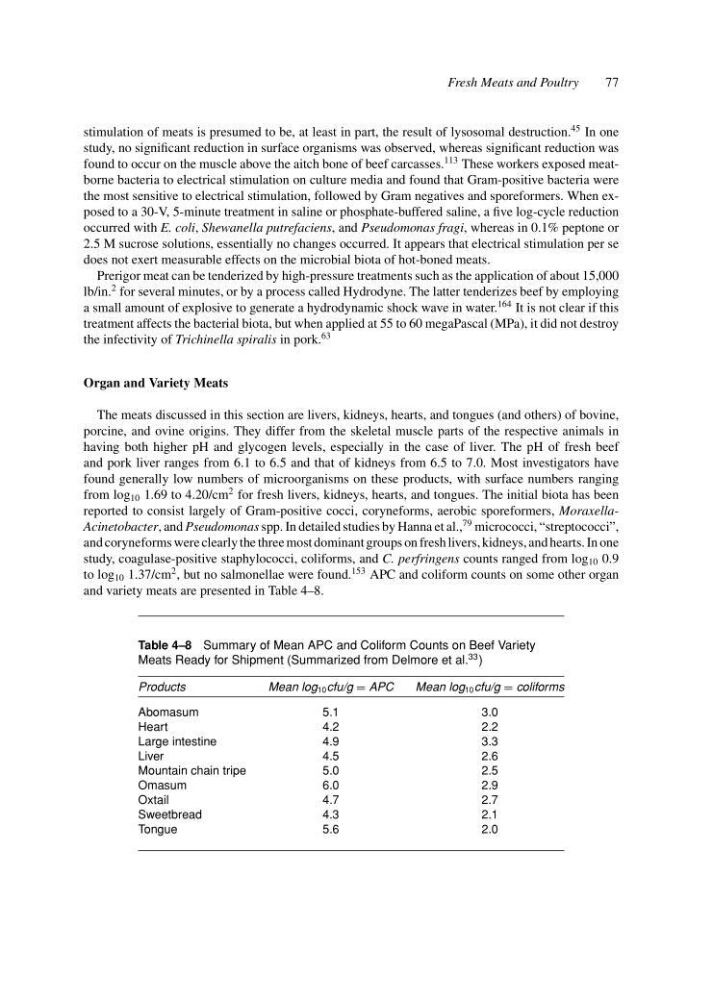
153 APC and coliform counts on some other organ
and variety meats are presented in Table 4–8.
Table 4–8 Summary of Mean APC and Coliform Counts on Beef Variety
Meats Ready for Shipment (Summarized from Delmore et al.
33 )
Products
Mean log 10 cfu/g = APC
Mean log 10 cfu/g = coliforms
Abomasum
5.1
3.0
Heart
4.2
2.2
Large intestine
4.9
3.3
Liver
4.5
2.6
Mountain chain tripe
5.0
2.5
Omasum
6.0
2.9
Oxtail
4.7
2.7
Sweetbread
4.3
2.1
Tongue
5.6
2.0
77
stimulation of meats is presumed to be, at least in part, the result of lysosomal destruction.
45 In one
study, no significant reduction in surface organisms was observed, whereas significant reduction was
found to occur on the muscle above the aitch bone of beef carcasses.
113 These workers exposed meatborne bacteria to electrical stimulation on culture media and found that Gram-positive bacteria were
the most sensitive to electrical stimulation, followed by Gram negatives and sporeformers. When exposed to a 30-V, 5-minute treatment in saline or phosphate-buffered saline, a five log-cycle reduction
occurred with E. coli, Shewanella putrefaciens, and Pseudomonas fragi, whereas in 0.1% peptone or
2.5 M sucrose solutions, essentially no changes occurred. It appears that electrical stimulation per se
does not exert measurable effects on the microbial biota of hot-boned meats.
Prerigor meat can be tenderized by high-pressure treatments such as the application of about 15,000
lb/in.
2 for several minutes, or by a process called Hydrodyne. The latter tenderizes beef by employing
a small amount of explosive to generate a hydrodynamic shock wave in water.
164 It is not clear if this
treatment affects the bacterial biota, but when applied at 55 to 60 megaPascal (MPa), it did not destroy
the infectivity of Trichinella spiralis in pork.
63
Organ and Variety Meats
The meats discussed in this section are livers, kidneys, hearts, and tongues (and others) of bovine,
porcine, and ovine origins. They differ from the skeletal muscle parts of the respective animals in
having both higher pH and glycogen levels, especially in the case of liver. The pH of fresh beef
and pork liver ranges from 6.1 to 6.5 and that of kidneys from 6.5 to 7.0. Most investigators have
found generally low numbers of microorganisms on these products, with surface numbers ranging
from log 10 1.69 to 4.20/cm
2 for fresh livers, kidneys, hearts, and tongues. The initial biota has been
reported to consist largely of Gram-positive cocci, coryneforms, aerobic sporeformers, MoraxellaAcinetobacter, and Pseudomonas spp. In detailed studies by Hanna et al.,
79 micrococci, “streptococci”,
and coryneforms were clearly the three most dominant groups on fresh livers, kidneys, and hearts. In one
study, coagulase-positive staphylococci, coliforms, and C. perfringens counts ranged from log 10 0.9
to log 10 1.37/cm
2 , but no salmonellae were found.
153 APC and coliform counts on some other organ
and variety meats are presented in Table 4–8.
Table 4–8 Summary of Mean APC and Coliform Counts on Beef Variety
Meats Ready for Shipment (Summarized from Delmore et al.
33 )
Products
Mean log 10 cfu/g = APC
Mean log 10 cfu/g = coliforms
Abomasum
5.1
3.0
Heart
4.2
2.2
Large intestine
4.9
3.3
Liver
4.5
2.6
Mountain chain tripe
5.0
2.5
Omasum
6.0
2.9
Oxtail
4.7
2.7
Sweetbread
4.3
2.1
Tongue
5.6
2.0