

740 Modern Food Microbiology
later spreads over the face, scalp, and neck; and to the fingertips and toes. The mortality rate is variously
reported to range from 1 to 22%.
Between 1793 and 1958, some 792 cases were recorded, with 173 (22%) deaths.
71 In the 15-year
period 1973–1987, 19 outbreaks (with a mean of 8 cases) were reported by state health departments to
the CDC. In 1990, there were 19 cases from two outbreaks in the states of Massachusetts and Alaska
alone. In the former, six fishermen became ill after eating boiled mussels that contained 4,280 µg/100 g
saxitoxin.
23 The raw mussels contained 24,400 µg/100 g. The 13 cases in Alaska resulted in 1 death,
and gastric contents from the victim who died contained 370 µg/100 g of PSP toxin, whereas a sample
of the butterclam that was consumed contained 2,650 µg/100 g.
23 The maximum safe level of PSP
toxin is 80 µg/100 g.
23
Outbreaks of PSP seem to occur between the months of May and October on the United States West
Coast and between August and October on the East Coast. Mollusks may become toxic in the absence
of red tides. Detoxification of mollusks can be achieved by their transfer to clean water, and a month
or more may be required.
Ciguatera Poisoning
This syndrome is contracted from the ingestion of any one of over 300 fish species (barracuda,
grouper, sea bass, etc.) that feed on herbivorous or reef fishes, which in turn feed on phytoplankton,
especially the dinoflagellates. The responsible dinoflagellate is Gambierdiscus toxicus, which produces
ciguatoxin. This toxin is concentrated more in fish organs such as the liver than in muscle tissue.
Upon ingestion of toxic fish, symptoms occur within 3–6 hours (about the same as for staphylococcal
food poisoning), and consist of nausea and paresthesia about the mouth, tongue, and throat. In general,
the symptoms are quite similar to those for paralytic shellfish poisoning. Respiratory paralysis is the
consequence in the absence of appropriate therapy. The disease has been associated with farm-raised
salmon fish. For a review, see reference 68.
For the years 1983–1992, 129 outbreaks were reported to the CDC involving 508 persons with no
deaths.
18 An outbreak in Texas in 1997 involved 17 crewmembers of a cargo ship, and the vehicle
food was barracuda.
18
Domoic Acid
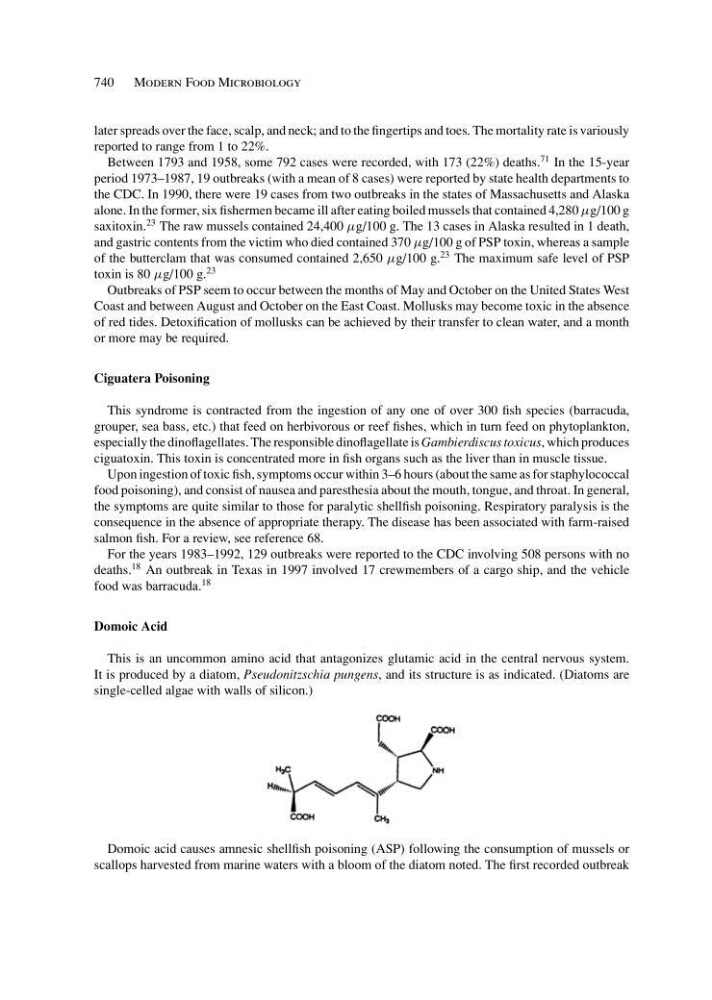
This is an uncommon amino acid that antagonizes glutamic acid in the central nervous system.
It is produced by a diatom, Pseudonitzschia pungens, and its structure is as indicated. (Diatoms are
single-celled algae with walls of silicon.)
Domoic acid causes amnesic shellfish poisoning (ASP) following the consumption of mussels or
scallops harvested from marine waters with a bloom of the diatom noted. The first recorded outbreak