

Viruses and Some Other Proven and Suspected Foodborne Biohazards 739
technologies such that high-temperature short-time treatments can be carried out in order to render
products free of prions.
15 For more information, see references 9, 31, 101.
Chronic wasting disease (CWD)
This is a prion or TSE disease first detected in captive mule deer in 1967 in the state of Colorado.
It has been diagnosed in wild deer and elk in the states of Wyoming, Colorado, Nebraska, and in
the Saskatchewan Province of Canada. It has been seen on elk farms in other states. It appears to be
transmitted through saliva or feces. It is estimated that 4–6% of mule deer and <1% of free-ranging
elk are infected in the endemic areas. The primary symptoms in elk are emaciation and drooling. In
December 2003, the U.S. Department of Agriculture put in place a herd certification program along
with restrictions on the interstate movement of captive deer and elk. At least two tests for postmortem
testing of central nervous system tissues have been developed and used.
TOXIGENIC PHYTOPLANKTONS
Paralytic Shellfish Poisoning
This syndrome is contracted by eating toxic mussels, clams, oysters, scallops, or cockles. These
bivalves become toxic after feeding on certain dinoflagellates of which Gonyaulax catenella is representative of the United States Pacific Coast biota. Along the North Atlantic Coast of the United
States and over to northern Europe, G. tamarensis is found, and its poison is more toxic than that of
G. catenella. G. acatenella is found along the coast of British Columbia. Masses or blooms of these
toxic dinoflagellates give rise to the red tide condition of seas. In 1996, about 150 manatees were killed
during a red tide off the coast of Florida. Another dinoflagellate, Karenia brevis (= Gymnodinium
breve), produces brevetoxin, which can cause respiratory distress and food poisoning in humans.
45 It
has caused massive fish kills along the east coast of the United States, and has been implicated in the
death of bottlenose dolphins and manatees (see reference 45).
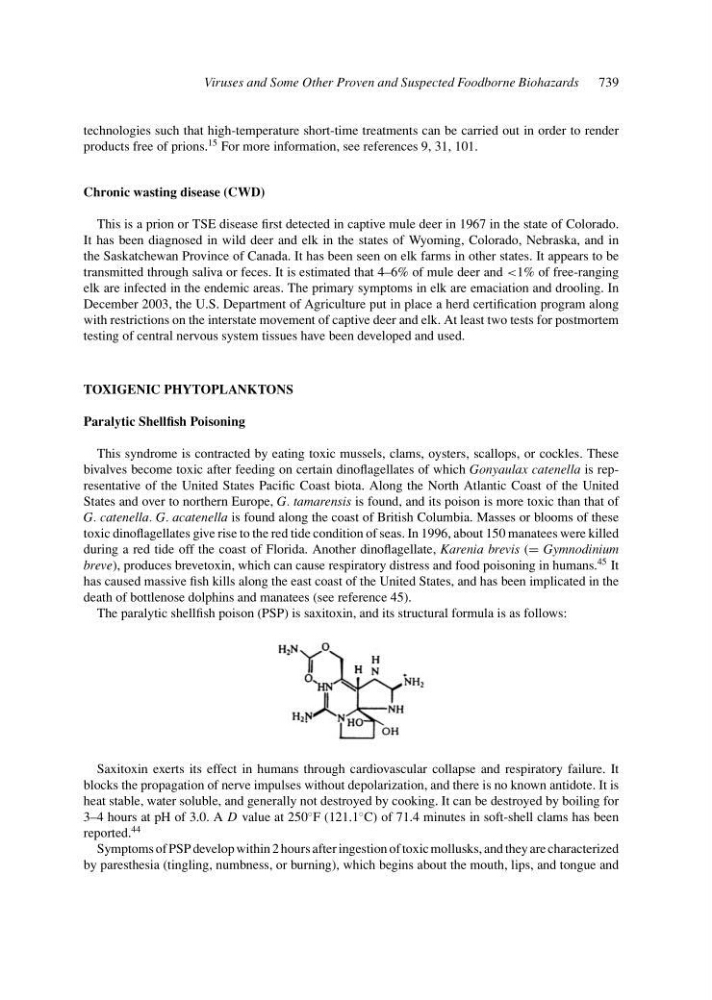
The paralytic shellfish poison (PSP) is saxitoxin, and its structural formula is as follows:
Saxitoxin exerts its effect in humans through cardiovascular collapse and respiratory failure. It
blocks the propagation of nerve impulses without depolarization, and there is no known antidote. It is
heat stable, water soluble, and generally not destroyed by cooking. It can be destroyed by boiling for
3–4 hours at pH of 3.0. A D value at 250
◦ F (121.1
◦ C) of 71.4 minutes in soft-shell clams has been
reported.
44
Symptoms of PSP develop within 2 hours after ingestion of toxic mollusks, and they are characterized
by paresthesia (tingling, numbness, or burning), which begins about the mouth, lips, and tongue and