

722 Modern Food Microbiology
Sambutoxin causes hemorrhage in the stomach and intestines of rats, and the animals refuse feed
and lose weight.
45 Rats died within 4 days when their diets contained 0.1% sambutoxin. It is toxic to
chick embryos with an LD 50 of 29.6 µg/egg.
45
ZEARALENONE
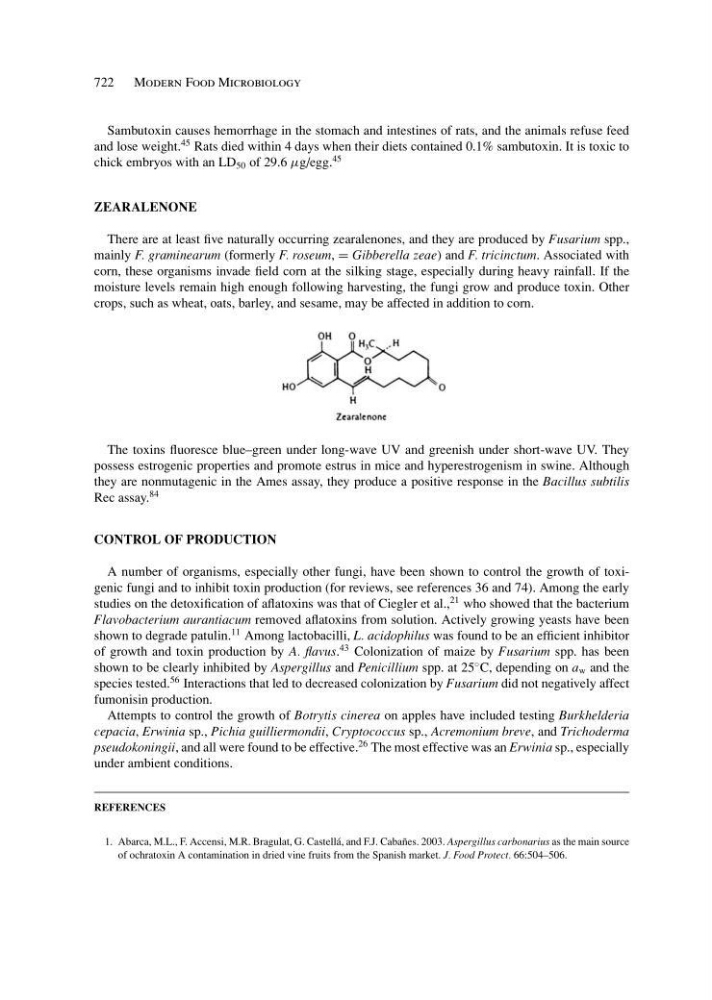
There are at least five naturally occurring zearalenones, and they are produced by Fusarium spp.,
mainly F. graminearum (formerly F. roseum, = Gibberella zeae) and F. tricinctum. Associated with
corn, these organisms invade field corn at the silking stage, especially during heavy rainfall. If the
moisture levels remain high enough following harvesting, the fungi grow and produce toxin. Other
crops, such as wheat, oats, barley, and sesame, may be affected in addition to corn.
The toxins fluoresce blue–green under long-wave UV and greenish under short-wave UV. They
possess estrogenic properties and promote estrus in mice and hyperestrogenism in swine. Although
they are nonmutagenic in the Ames assay, they produce a positive response in the Bacillus subtilis
Rec assay.
84
CONTROL OF PRODUCTION
A number of organisms, especially other fungi, have been shown to control the growth of toxigenic fungi and to inhibit toxin production (for reviews, see references 36 and 74). Among the early
studies on the detoxification of aflatoxins was that of Ciegler et al.,
21 who showed that the bacterium
Flavobacterium aurantiacum removed aflatoxins from solution. Actively growing yeasts have been
shown to degrade patulin.
11 Among lactobacilli, L. acidophilus was found to be an efficient inhibitor
of growth and toxin production by A. flavus.
43 Colonization of maize by Fusarium spp. has been
shown to be clearly inhibited by Aspergillus and Penicillium spp. at 25
◦ C, depending on a w and the
species tested.
56 Interactions that led to decreased colonization by Fusarium did not negatively affect
fumonisin production.
Attempts to control the growth of Botrytis cinerea on apples have included testing Burkhelderia
cepacia, Erwinia sp., Pichia guilliermondii, Cryptococcus sp., Acremonium breve, and Trichoderma
pseudokoningii, and all were found to be effective.
26 The most effective was an Erwinia sp., especially
under ambient conditions.
REFERENCES
1. Abarca, M.L., F. Accensi, M.R. Bragulat, G. Castell´ a, and F.J. Caba˜ nes. 2003. Aspergillus carbonarius as the main source
of ochratoxin A contamination in dried vine fruits from the Spanish market. J. Food Protect. 66:504–506.