

Mycotoxins
721
In another study, the thermal stability of these toxins at a level of 5 µg/g of FB 1 in processed corn
products was assessed.
16 No significant loss was found upon baking at 204
◦ C for 30 minutes. Almost
complete loss occurred upon roasting corn meal samples at 218
◦ C for 15 minutes. Significant but not total reduction was noted in cornbread at 232
◦ C for 20 minutes. In regard to the thermal stability in canned
foods, 5 µg/g were added to canned foods and then recanned. No significant loss occurred in creamed
corn for infants and canned dog food, but significant reductions occurred in cream-style corn and
whole-kernal corn, although it was not eliminated.
16 Overall, roasting was more effective than baking.
Pathology
In experimental animals, the liver is the primary target of FB 1 . In a study using rats over a 26month period, all animals that either died or were killed after 18 months had micro- and macronodular
cirrhosis and large expansile nodules of cholangiofibrosis at the hilus of the liver.
34 (Cholangiofibrosis
is considered to be a precursor lesion for cholangiocarcinoma in rats.) Of 15 rats that died or were killed
between 18 and 26 months, 66% developed primary hepatocellular carcinoma. Some involvement of
the kidneys occurred but only toward the end of this study. No esophageal lesions were noted in test
animals, and no neoplastic changes were noted in the 25 controls.
34 The hepatocarcinogenic activity
of FB 1 in rats was demonstrated by adding 50,000 ng/g in food rations over a 26-month period.
34
In an earlier study, FB 1 was shown to possess cancer-promoting activity by its capacity to elevate
γ -glutamyltranspeptidase activity in rats.
2
Leukoencephalomalacia (LEM) was reproduced in a horse by the intravenous (i.v.) injection of
seven daily doses of FB 1 at a level of 0.125 mg/g live mass spread over 10 days (see reference 73). LEM
was produced in two horses via the oral administration of FB 1 at a level of 1.25–4 mg/g body weight,
and symptoms occurred in around 25 days (see reference 81). Pulmonary edema was produced in a pig
after daily injections of 0.4 mg FB 1 /g body weight for 4 days.
92 The prevalence of human esophageal
cancer in the Transkei, South Africa, is statistically correlated with high levels of FB 1 and FB 2 in corn.
90
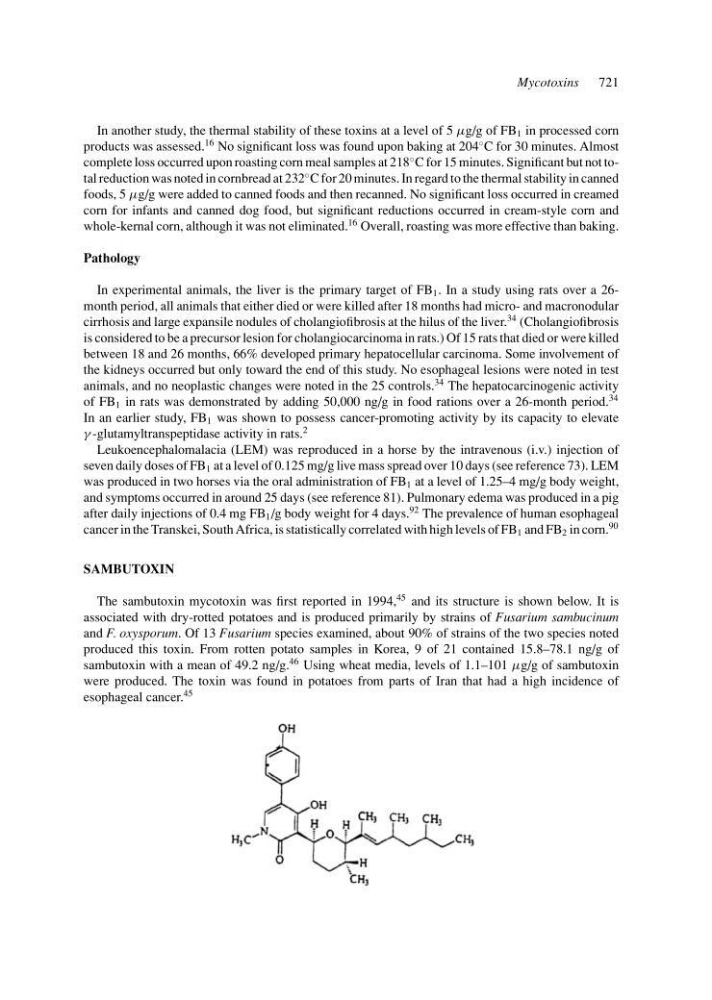
SAMBUTOXIN
The sambutoxin mycotoxin was first reported in 1994,
45 and its structure is shown below. It is
associated with dry-rotted potatoes and is produced primarily by strains of Fusarium sambucinum
and F. oxysporum. Of 13 Fusarium species examined, about 90% of strains of the two species noted
produced this toxin. From rotten potato samples in Korea, 9 of 21 contained 15.8–78.1 ng/g of
sambutoxin with a mean of 49.2 ng/g.
46 Using wheat media, levels of 1.1–101 µg/g of sambutoxin
were produced. The toxin was found in potatoes from parts of Iran that had a high incidence of
esophageal cancer.
45