

716 Modern Food Microbiology
OCHRATOXINS
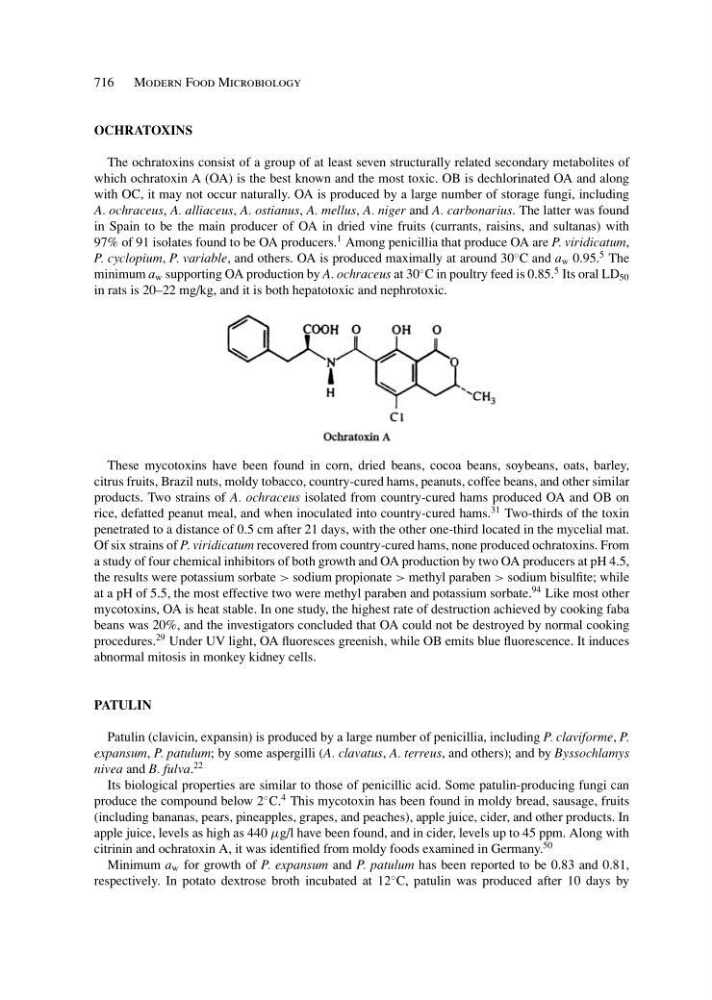
The ochratoxins consist of a group of at least seven structurally related secondary metabolites of
which ochratoxin A (OA) is the best known and the most toxic. OB is dechlorinated OA and along
with OC, it may not occur naturally. OA is produced by a large number of storage fungi, including
A. ochraceus, A. alliaceus, A. ostianus, A. mellus, A. niger and A. carbonarius. The latter was found
in Spain to be the main producer of OA in dried vine fruits (currants, raisins, and sultanas) with
97% of 91 isolates found to be OA producers.
1 Among penicillia that produce OA are P. viridicatum,
P. cyclopium, P. variable, and others. OA is produced maximally at around 30
◦ C and a w 0.95.
5 The
minimum a w supporting OA production by A. ochraceus at 30
◦ C in poultry feed is 0.85.
5 Its oral LD 50
in rats is 20–22 mg/kg, and it is both hepatotoxic and nephrotoxic.
These mycotoxins have been found in corn, dried beans, cocoa beans, soybeans, oats, barley,
citrus fruits, Brazil nuts, moldy tobacco, country-cured hams, peanuts, coffee beans, and other similar
products. Two strains of A. ochraceus isolated from country-cured hams produced OA and OB on
rice, defatted peanut meal, and when inoculated into country-cured hams.
31 Two-thirds of the toxin
penetrated to a distance of 0.5 cm after 21 days, with the other one-third located in the mycelial mat.
Of six strains of P. viridicatum recovered from country-cured hams, none produced ochratoxins. From
a study of four chemical inhibitors of both growth and OA production by two OA producers at pH 4.5,
the results were potassium sorbate > sodium propionate > methyl paraben > sodium bisulfite; while
at a pH of 5.5, the most effective two were methyl paraben and potassium sorbate.
94 Like most other
mycotoxins, OA is heat stable. In one study, the highest rate of destruction achieved by cooking faba
beans was 20%, and the investigators concluded that OA could not be destroyed by normal cooking
procedures.
29 Under UV light, OA fluoresces greenish, while OB emits blue fluorescence. It induces
abnormal mitosis in monkey kidney cells.
PATULIN
Patulin (clavicin, expansin) is produced by a large number of penicillia, including P. claviforme, P.
expansum, P. patulum; by some aspergilli (A. clavatus, A. terreus, and others); and by Byssochlamys
nivea and B. fulva.
22
Its biological properties are similar to those of penicillic acid. Some patulin-producing fungi can
produce the compound below 2
◦ C.
4 This mycotoxin has been found in moldy bread, sausage, fruits
(including bananas, pears, pineapples, grapes, and peaches), apple juice, cider, and other products. In
apple juice, levels as high as 440 µg/l have been found, and in cider, levels up to 45 ppm. Along with
citrinin and ochratoxin A, it was identified from moldy foods examined in Germany.
50
Minimum a w for growth of P. expansum and P. patulum has been reported to be 0.83 and 0.81,
respectively. In potato dextrose broth incubated at 12
◦ C, patulin was produced after 10 days by