

Mycotoxins
715
form against other fungi and possibly some bacteria. Findings from this study suggest that some of
the myxomycetes (slime molds) may be effective in destroying mycotoxigenic fungi.
ALTERNARIA TOXINS
Several species of Alternaria (including A. citri, A. alternata, A. solani, and A. tenuissima) produce
toxic substances that have been found in apples, tomatoes, blueberries, grains, and other foods.
85,86
The toxins produced include alternariol, alternariol monomethyl ether, altenuene, tenuazonic acid, and
altertoxin-I.
85 On slices of apples, tomatoes, or crushed blueberries incubated for 21 days at 21
◦ C, several Alternaria produced each of the toxins noted at levels up to 137 mg/100 g.
85 In another study, tenuazonic acid was the main toxin produced in tomatoes, with levels as high as 13.9 mg/100 g; on oranges
and lemons, A. citri produced tenuazonic acid, alternariol, and alternariol monomethyl ether at a mean
concentration of 1.15–2.66 mg/100 g.
86 The fruits were incubated at room temperature for 21–28 days.
In a study of 150 sunflower seed samples in Argentina, 85% contained alternariol (mean of 187
µg/kg), 47% contained alternariol monomethyl ether (mean of 194 µg/kg), and 65% contained tenuazonic acid (mean of 6692 µg/kg).
19 Following fermentation for 28 days by A. alternata and separation
into oil and meal, no alternariol, 1.6–2.3% of tenuazonic, and 44–45% alternariol monomethyl ether
were found in oil, but none of these toxins were in the meal.
19 An A. alternata strain produced stemphyltoxin III, which was mutagenic by the Ames assay.
23 More information on the alternaria toxins
can be found in reference 17.
CITRININ
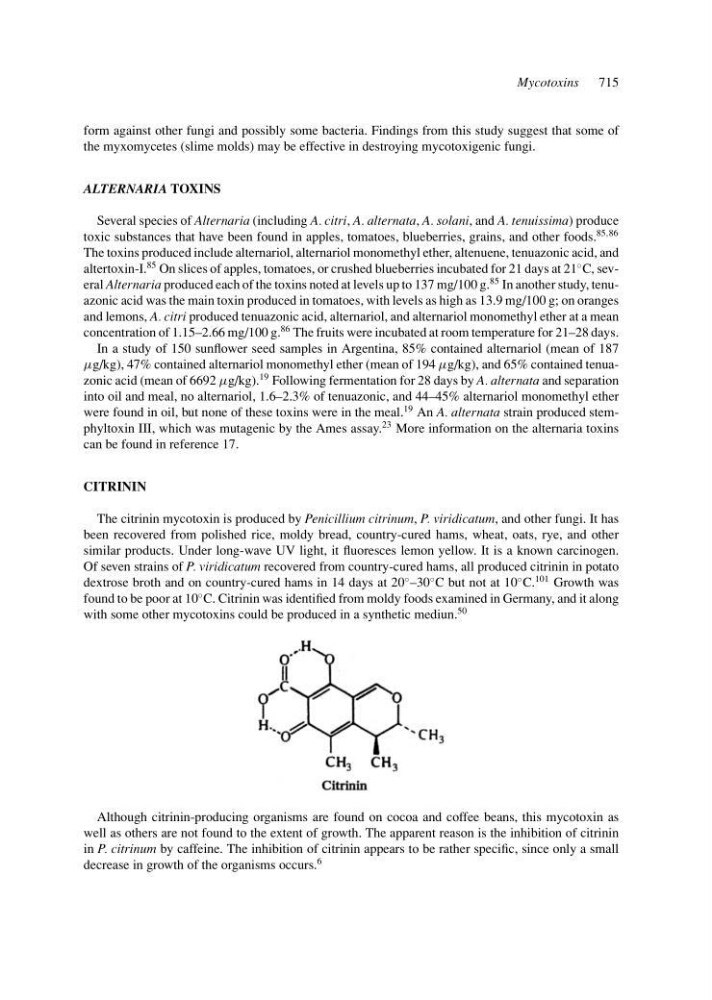
The citrinin mycotoxin is produced by Penicillium citrinum, P. viridicatum, and other fungi. It has
been recovered from polished rice, moldy bread, country-cured hams, wheat, oats, rye, and other
similar products. Under long-wave UV light, it fluoresces lemon yellow. It is a known carcinogen.
Of seven strains of P. viridicatum recovered from country-cured hams, all produced citrinin in potato
dextrose broth and on country-cured hams in 14 days at 20
◦ –30
◦ C but not at 10
◦ C.
101 Growth was
found to be poor at 10
◦ C. Citrinin was identified from moldy foods examined in Germany, and it along
with some other mycotoxins could be produced in a synthetic mediun.
50
Although citrinin-producing organisms are found on cocoa and coffee beans, this mycotoxin as
well as others are not found to the extent of growth. The apparent reason is the inhibition of citrinin
in P. citrinum by caffeine. The inhibition of citrinin appears to be rather specific, since only a small
decrease in growth of the organisms occurs.
6