

Mycotoxins
717
P. patulum and P. roquefortii, with the former organism producing up to 1033 ppm.
8 Patulin was
produced in apple juice also at 12
◦ C by B. nivea, but the highest concentration was attained after 20
days at 21
◦ C after a 9-day lag.
71 The next highest amount was produced at 30
◦ C, with much less
at 37
◦ C. These investigators confirmed that patulin production is favored at temperatures below the
growth optimum, as was previously found by Sommer et al.
82 The latter investigators used P. expansum
and found production over the range 5
◦ –20
◦ C, with only small amounts produced at 30
◦ C. In five
commercial samples in Georgia, patulin levels from 244 to 3993 µg/l were found, with a mean of 1902
µg/l.
99 The overall incidence of patulin in apple juice has been reviewed.
38 Atmospheres of CO 2 and
N 2 reduced production compared to that in air. To inhibit production, SO 2 was found more effective
than potassium sorbate or sodium benzoate.
71
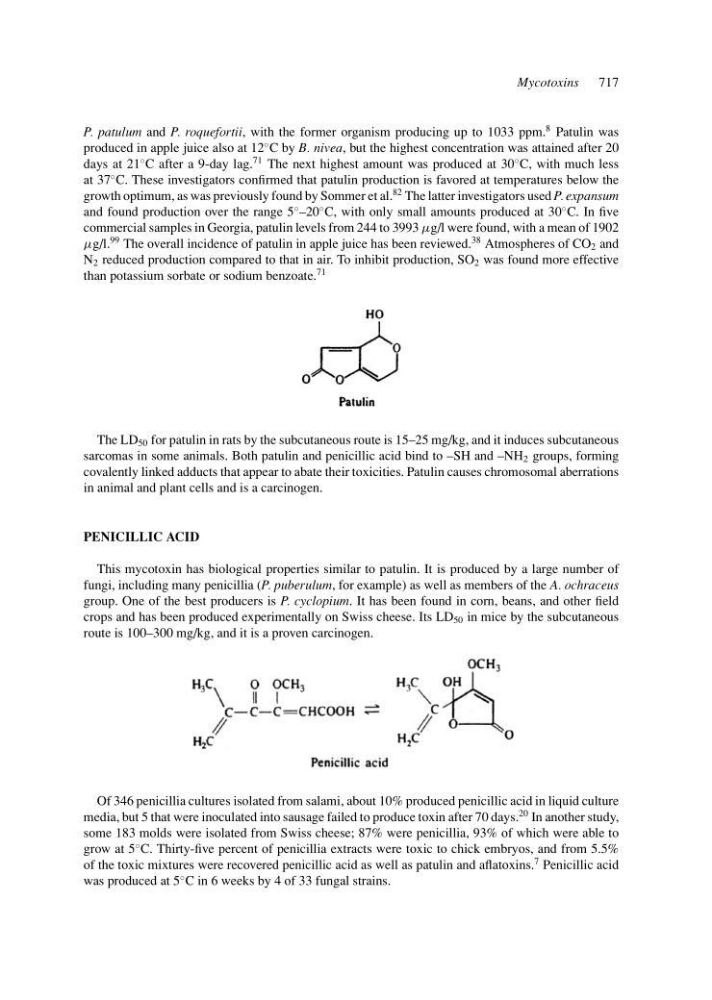
The LD 50 for patulin in rats by the subcutaneous route is 15–25 mg/kg, and it induces subcutaneous
sarcomas in some animals. Both patulin and penicillic acid bind to –SH and –NH 2 groups, forming
covalently linked adducts that appear to abate their toxicities. Patulin causes chromosomal aberrations
in animal and plant cells and is a carcinogen.
PENICILLIC ACID
This mycotoxin has biological properties similar to patulin. It is produced by a large number of
fungi, including many penicillia (P. puberulum, for example) as well as members of the A. ochraceus
group. One of the best producers is P. cyclopium. It has been found in corn, beans, and other field
crops and has been produced experimentally on Swiss cheese. Its LD 50 in mice by the subcutaneous
route is 100–300 mg/kg, and it is a proven carcinogen.
Of 346 penicillia cultures isolated from salami, about 10% produced penicillic acid in liquid culture
media, but 5 that were inoculated into sausage failed to produce toxin after 70 days.
20 In another study,
some 183 molds were isolated from Swiss cheese; 87% were penicillia, 93% of which were able to
grow at 5
◦ C. Thirty-five percent of penicillia extracts were toxic to chick embryos, and from 5.5%
of the toxic mixtures were recovered penicillic acid as well as patulin and aflatoxins.
7 Penicillic acid
was produced at 5
◦ C in 6 weeks by 4 of 33 fungal strains.