

Intrinsic and Extrinsic Parameters of Foods That Affect Microbial Growth
43
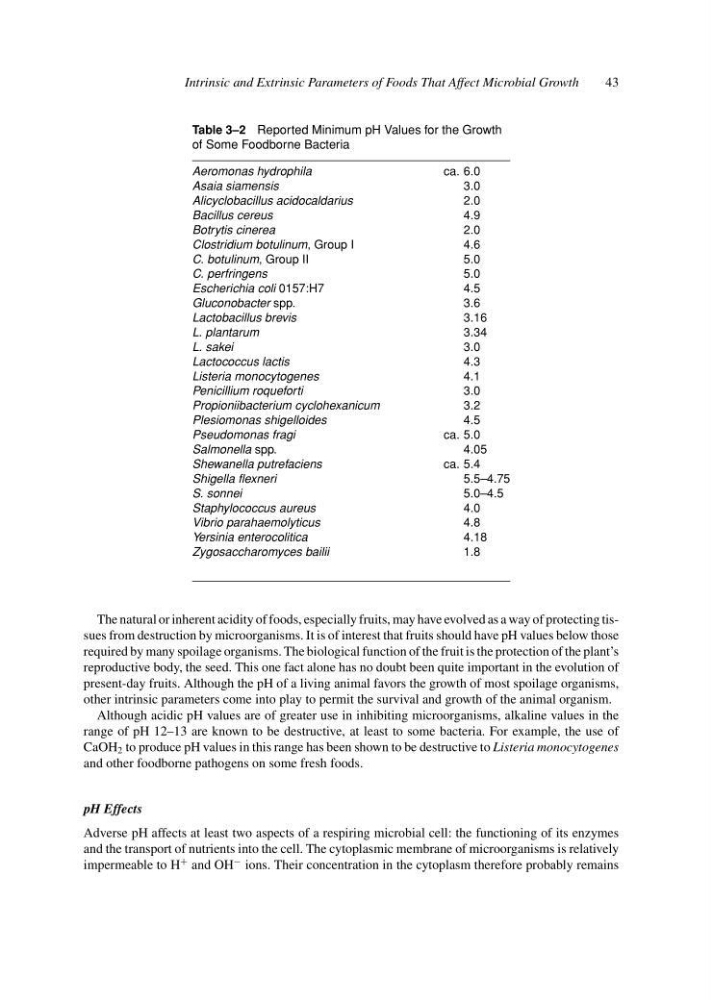
Table 3–2 Reported Minimum pH Values for the Growth
of Some Foodborne Bacteria
Aeromonas hydrophila
ca. 6.0
Asaia siamensis
3.0
Alicyclobacillus acidocaldarius
2.0
Bacillus cereus
4.9
Botrytis cinerea
2.0
Clostridium botulinum, Group I
4.6
C. botulinum, Group II
5.0
C. perfringens
5.0
Escherichia coli 0157:H7
4.5
Gluconobacter spp.
3.6
Lactobacillus brevis
3.16
L. plantarum
3.34
L. sakei
3.0
Lactococcus lactis
4.3
Listeria monocytogenes
4.1
Penicillium roqueforti
3.0
Propioniibacterium cyclohexanicum
3.2
Plesiomonas shigelloides
4.5
Pseudomonas fragi
ca. 5.0
Salmonella spp.
4.05
Shewanella putrefaciens
ca. 5.4
Shigella flexneri
5.5–4.75
S. sonnei
5.0–4.5
Staphylococcus aureus
4.0
Vibrio parahaemolyticus
4.8
Yersinia enterocolitica
4.18
Zygosaccharomyces bailii
1.8
The natural or inherent acidity of foods, especially fruits, may have evolved as a way of protecting tissues from destruction by microorganisms. It is of interest that fruits should have pH values below those
required by many spoilage organisms. The biological function of the fruit is the protection of the plant’s
reproductive body, the seed. This one fact alone has no doubt been quite important in the evolution of
present-day fruits. Although the pH of a living animal favors the growth of most spoilage organisms,
other intrinsic parameters come into play to permit the survival and growth of the animal organism.
Although acidic pH values are of greater use in inhibiting microorganisms, alkaline values in the
range of pH 12–13 are known to be destructive, at least to some bacteria. For example, the use of
CaOH 2 to produce pH values in this range has been shown to be destructive to Listeria monocytogenes
and other foodborne pathogens on some fresh foods.
pH Effects
Adverse pH affects at least two aspects of a respiring microbial cell: the functioning of its enzymes
and the transport of nutrients into the cell. The cytoplasmic membrane of microorganisms is relatively
impermeable to H
+ and OH
− ions. Their concentration in the cytoplasm therefore probably remains
43
Table 3–2 Reported Minimum pH Values for the Growth
of Some Foodborne Bacteria
Aeromonas hydrophila
ca. 6.0
Asaia siamensis
3.0
Alicyclobacillus acidocaldarius
2.0
Bacillus cereus
4.9
Botrytis cinerea
2.0
Clostridium botulinum, Group I
4.6
C. botulinum, Group II
5.0
C. perfringens
5.0
Escherichia coli 0157:H7
4.5
Gluconobacter spp.
3.6
Lactobacillus brevis
3.16
L. plantarum
3.34
L. sakei
3.0
Lactococcus lactis
4.3
Listeria monocytogenes
4.1
Penicillium roqueforti
3.0
Propioniibacterium cyclohexanicum
3.2
Plesiomonas shigelloides
4.5
Pseudomonas fragi
ca. 5.0
Salmonella spp.
4.05
Shewanella putrefaciens
ca. 5.4
Shigella flexneri
5.5–4.75
S. sonnei
5.0–4.5
Staphylococcus aureus
4.0
Vibrio parahaemolyticus
4.8
Yersinia enterocolitica
4.18
Zygosaccharomyces bailii
1.8
The natural or inherent acidity of foods, especially fruits, may have evolved as a way of protecting tissues from destruction by microorganisms. It is of interest that fruits should have pH values below those
required by many spoilage organisms. The biological function of the fruit is the protection of the plant’s
reproductive body, the seed. This one fact alone has no doubt been quite important in the evolution of
present-day fruits. Although the pH of a living animal favors the growth of most spoilage organisms,
other intrinsic parameters come into play to permit the survival and growth of the animal organism.
Although acidic pH values are of greater use in inhibiting microorganisms, alkaline values in the
range of pH 12–13 are known to be destructive, at least to some bacteria. For example, the use of
CaOH 2 to produce pH values in this range has been shown to be destructive to Listeria monocytogenes
and other foodborne pathogens on some fresh foods.
pH Effects
Adverse pH affects at least two aspects of a respiring microbial cell: the functioning of its enzymes
and the transport of nutrients into the cell. The cytoplasmic membrane of microorganisms is relatively
impermeable to H
+ and OH
− ions. Their concentration in the cytoplasm therefore probably remains