

Staphylococcal Gastroenteritis 561
Table 23–9 Leading Factors that Led to the Outbreaks of Staphylococcal
Foodborne Gastroenteritis in the United States, 1973–1987
Causes
Number of Outbreaks
Improper holding temperatures
98
Poor personal hygiene
71
Contaminated equipment
43
Inadequate cooking
22
Food from unsafe source
12
Others
24
Source: From Bean and Griffin. 10
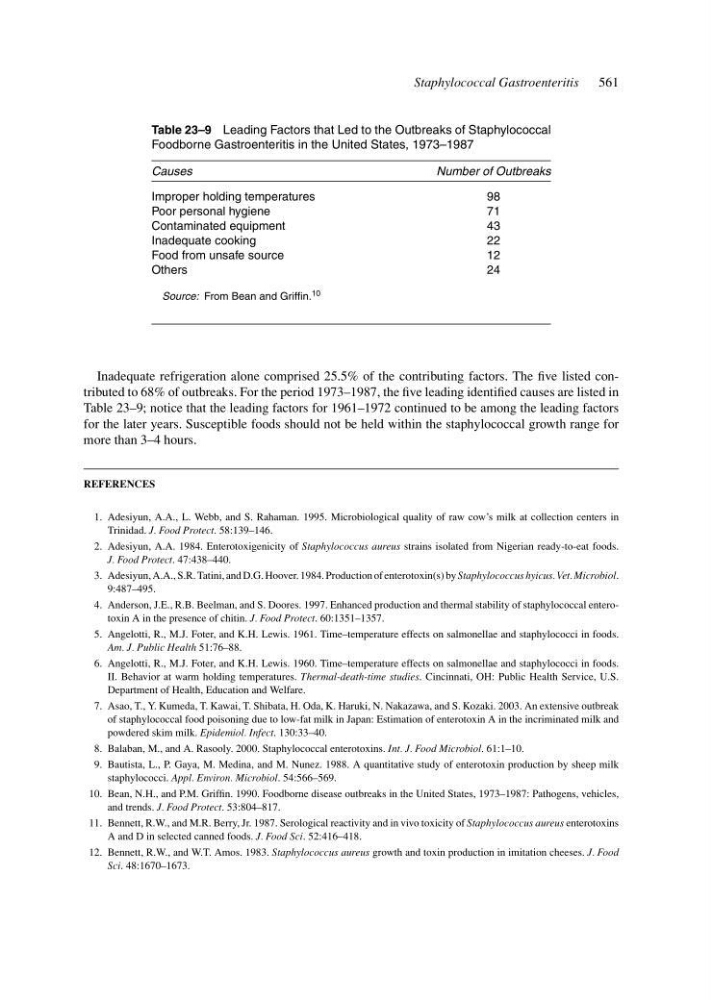
Inadequate refrigeration alone comprised 25.5% of the contributing factors. The five listed contributed to 68% of outbreaks. For the period 1973–1987, the five leading identified causes are listed in
Table 23–9; notice that the leading factors for 1961–1972 continued to be among the leading factors
for the later years. Susceptible foods should not be held within the staphylococcal growth range for
more than 3–4 hours.
REFERENCES
1. Adesiyun, A.A., L. Webb, and S. Rahaman. 1995. Microbiological quality of raw cow’s milk at collection centers in
Trinidad. J. Food Protect. 58:139–146.
2. Adesiyun, A.A. 1984. Enterotoxigenicity of Staphylococcus aureus strains isolated from Nigerian ready-to-eat foods.
J. Food Protect. 47:438–440.
3. Adesiyun, A.A., S.R. Tatini, and D.G. Hoover. 1984. Production of enterotoxin(s) by Staphylococcus hyicus. Vet. Microbiol.
9:487–495.
4. Anderson, J.E., R.B. Beelman, and S. Doores. 1997. Enhanced production and thermal stability of staphylococcal enterotoxin A in the presence of chitin. J. Food Protect. 60:1351–1357.
5. Angelotti, R., M.J. Foter, and K.H. Lewis. 1961. Time–temperature effects on salmonellae and staphylococci in foods.
Am. J. Public Health 51:76–88.
6. Angelotti, R., M.J. Foter, and K.H. Lewis. 1960. Time–temperature effects on salmonellae and staphylococci in foods.
II. Behavior at warm holding temperatures. Thermal-death-time studies. Cincinnati, OH: Public Health Service, U.S.
Department of Health, Education and Welfare.
7. Asao, T., Y. Kumeda, T. Kawai, T. Shibata, H. Oda, K. Haruki, N. Nakazawa, and S. Kozaki. 2003. An extensive outbreak
of staphylococcal food poisoning due to low-fat milk in Japan: Estimation of enterotoxin A in the incriminated milk and
powdered skim milk. Epidemiol. Infect. 130:33–40.
8. Balaban, M., and A. Rasooly. 2000. Staphylococcal enterotoxins. Int. J. Food Microbiol. 61:1–10.
9. Bautista, L., P. Gaya, M. Medina, and M. Nunez. 1988. A quantitative study of enterotoxin production by sheep milk
staphylococci. Appl. Environ. Microbiol. 54:566–569.
10. Bean, N.H., and P.M. Griffin. 1990. Foodborne disease outbreaks in the United States, 1973–1987: Pathogens, vehicles,
and trends. J. Food Protect. 53:804–817.
11. Bennett, R.W., and M.R. Berry, Jr. 1987. Serological reactivity and in vivo toxicity of Staphylococcus aureus enterotoxins
A and D in selected canned foods. J. Food Sci. 52:416–418.
12. Bennett, R.W., and W.T. Amos. 1983. Staphylococcus aureus growth and toxin production in imitation cheeses. J. Food
Sci. 48:1670–1673.