

Introduction to Foodborne Pathogens
539
Table 22–3 The Most Recently Recognized Primary Foodborne
Pathogens
Pathogen/Syndrome
First Recognized
Infant botulism
1976
Yersinia enterocolitica
1976
Cyclospora cayetanensis
1977
Norwalk and related viruses
1978
Vibrio cholerae non-01
1979
Listeria monocytogenes
1981
Enterohemorrhagic E. coli
1982
New variant-Creutzfeldt-Jakob disease (vCJD)
1996
finding that nontyphoid salmonellae and Stx-producing E. coli strains exhibit high levels of mutability
suggests that the emergence of new enteropathogenic variants may be expected among these groups.
The first requirement that an intestinal invasive pathogen must meet is that of intestinal adhesion.
Recent findings have confirmed the importance of mobile genetic elements in the transfer of this
property between avirulent and virulent strains. The degree to which avirulent strains of pathogenic
species or phylogenetically related species can acquire, maintain, and express adherence/adhesive
genes may be a crucial factor in the possible emergence of new enteropathogens.
In Table 22–2 are listed eight Gram-negative bacteria that possess at least one property or factor that
is often associated with foodborne pathogens. It may be assumed that they are not primary foodborne
pathogens due to a lack of other virulence properties such as the capacity to adhere to and enter
epithelial cells. Aeromonas hydrophila and Plesiomonas shigelloides have been on the “watch list” of
food microbiologists for at least two decades but neither has been demonstrated to cause foodborne
gastroenteritis in the absence of another enteropathogen.
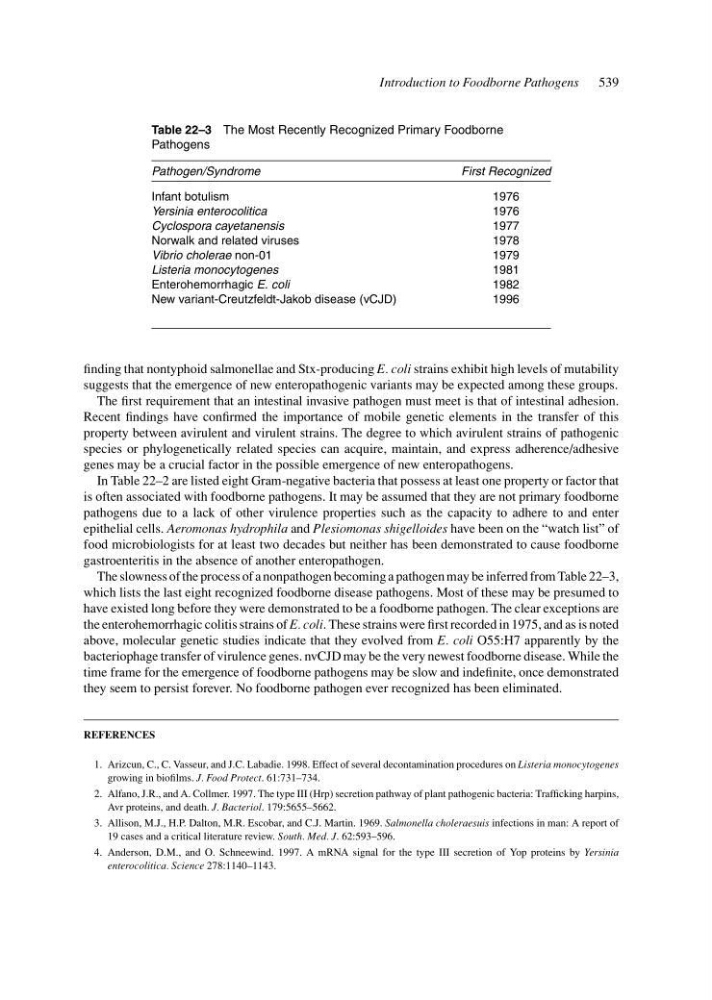
The slowness of the process of a nonpathogen becoming a pathogen may be inferred from Table 22–3,
which lists the last eight recognized foodborne disease pathogens. Most of these may be presumed to
have existed long before they were demonstrated to be a foodborne pathogen. The clear exceptions are
the enterohemorrhagic colitis strains of E. coli. These strains were first recorded in 1975, and as is noted
above, molecular genetic studies indicate that they evolved from E. coli O55:H7 apparently by the
bacteriophage transfer of virulence genes. nvCJD may be the very newest foodborne disease. While the
time frame for the emergence of foodborne pathogens may be slow and indefinite, once demonstrated
they seem to persist forever. No foodborne pathogen ever recognized has been eliminated.
REFERENCES
1. Arizcun, C., C. Vasseur, and J.C. Labadie. 1998. Effect of several decontamination procedures on Listeria monocytogenes
growing in biofilms. J. Food Protect. 61:731–734.
2. Alfano, J.R., and A. Collmer. 1997. The type III (Hrp) secretion pathway of plant pathogenic bacteria: Trafficking harpins,
Avr proteins, and death. J. Bacteriol. 179:5655–5662.
3. Allison, M.J., H.P. Dalton, M.R. Escobar, and C.J. Martin. 1969. Salmonella choleraesuis infections in man: A report of
19 cases and a critical literature review. South. Med. J. 62:593–596.
4. Anderson, D.M., and O. Schneewind. 1997. A mRNA signal for the type III secretion of Yop proteins by Yersinia
enterocolitica. Science 278:1140–1143.