

486 Modern Food Microbiology
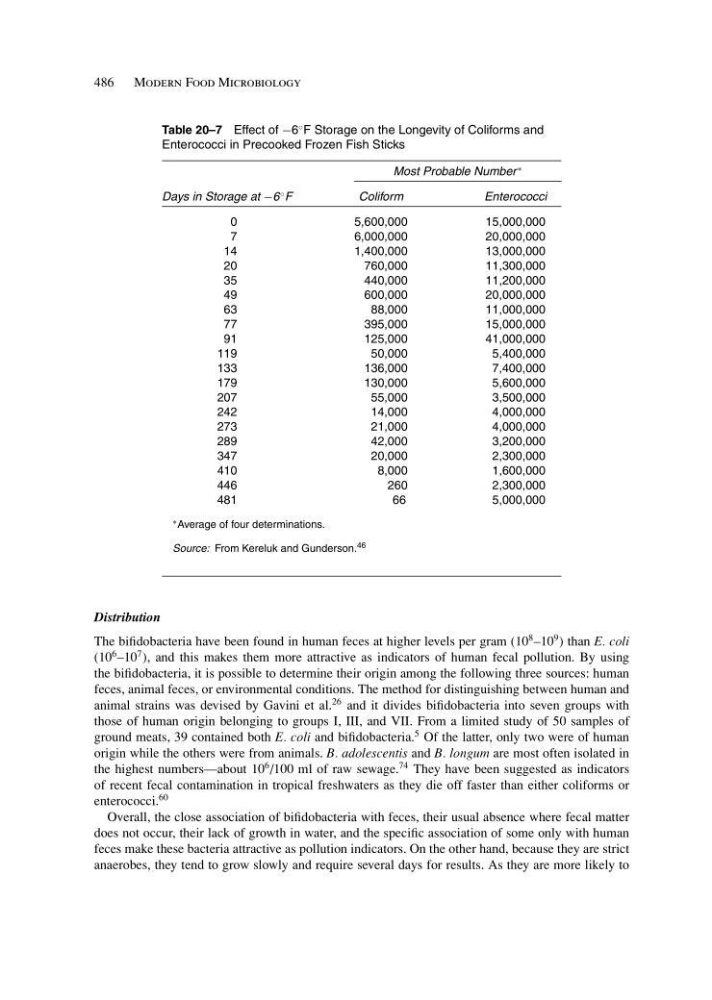
Table 20–7 Effect of −6
◦ F Storage on the Longevity of Coliforms and
Enterococci in Precooked Frozen Fish Sticks
Most Probable Number
∗
Days in Storage at −6
◦ F
Coliform
Enterococci
0
5,600,000
15,000,000
7
6,000,000
20,000,000
14
1,400,000
13,000,000
20
760,000
11,300,000
35
440,000
11,200,000
49
600,000
20,000,000
63
88,000
11,000,000
77
395,000
15,000,000
91
125,000
41,000,000
119
50,000
5,400,000
133
136,000
7,400,000
179
130,000
5,600,000
207
55,000
3,500,000
242
14,000
4,000,000
273
21,000
4,000,000
289
42,000
3,200,000
347
20,000
2,300,000
410
8,000
1,600,000
446
260
2,300,000
481
66
5,000,000
∗ Average of four determinations.
Source: From Kereluk and Gunderson. 46
Distribution
The bifidobacteria have been found in human feces at higher levels per gram (10
8 –10
9 ) than E. coli
(10
6 –10
7 ), and this makes them more attractive as indicators of human fecal pollution. By using
the bifidobacteria, it is possible to determine their origin among the following three sources: human
feces, animal feces, or environmental conditions. The method for distinguishing between human and
animal strains was devised by Gavini et al.
26 and it divides bifidobacteria into seven groups with
those of human origin belonging to groups I, III, and VII. From a limited study of 50 samples of
ground meats, 39 contained both E. coli and bifidobacteria.
5 Of the latter, only two were of human
origin while the others were from animals. B. adolescentis and B. longum are most often isolated in
the highest numbers—about 10
6 /100 ml of raw sewage.
74 They have been suggested as indicators
of recent fecal contamination in tropical freshwaters as they die off faster than either coliforms or
enterococci.
60
Overall, the close association of bifidobacteria with feces, their usual absence where fecal matter
does not occur, their lack of growth in water, and the specific association of some only with human
feces make these bacteria attractive as pollution indicators. On the other hand, because they are strict
anaerobes, they tend to grow slowly and require several days for results. As they are more likely to
Table 20–7 Effect of −6
◦ F Storage on the Longevity of Coliforms and
Enterococci in Precooked Frozen Fish Sticks
Most Probable Number
∗
Days in Storage at −6
◦ F
Coliform
Enterococci
0
5,600,000
15,000,000
7
6,000,000
20,000,000
14
1,400,000
13,000,000
20
760,000
11,300,000
35
440,000
11,200,000
49
600,000
20,000,000
63
88,000
11,000,000
77
395,000
15,000,000
91
125,000
41,000,000
119
50,000
5,400,000
133
136,000
7,400,000
179
130,000
5,600,000
207
55,000
3,500,000
242
14,000
4,000,000
273
21,000
4,000,000
289
42,000
3,200,000
347
20,000
2,300,000
410
8,000
1,600,000
446
260
2,300,000
481
66
5,000,000
∗ Average of four determinations.
Source: From Kereluk and Gunderson. 46
Distribution
The bifidobacteria have been found in human feces at higher levels per gram (10
8 –10
9 ) than E. coli
(10
6 –10
7 ), and this makes them more attractive as indicators of human fecal pollution. By using
the bifidobacteria, it is possible to determine their origin among the following three sources: human
feces, animal feces, or environmental conditions. The method for distinguishing between human and
animal strains was devised by Gavini et al.
26 and it divides bifidobacteria into seven groups with
those of human origin belonging to groups I, III, and VII. From a limited study of 50 samples of
ground meats, 39 contained both E. coli and bifidobacteria.
5 Of the latter, only two were of human
origin while the others were from animals. B. adolescentis and B. longum are most often isolated in
the highest numbers—about 10
6 /100 ml of raw sewage.
74 They have been suggested as indicators
of recent fecal contamination in tropical freshwaters as they die off faster than either coliforms or
enterococci.
60
Overall, the close association of bifidobacteria with feces, their usual absence where fecal matter
does not occur, their lack of growth in water, and the specific association of some only with human
feces make these bacteria attractive as pollution indicators. On the other hand, because they are strict
anaerobes, they tend to grow slowly and require several days for results. As they are more likely to