

Indicators of Food Microbial Quality and Safety
487
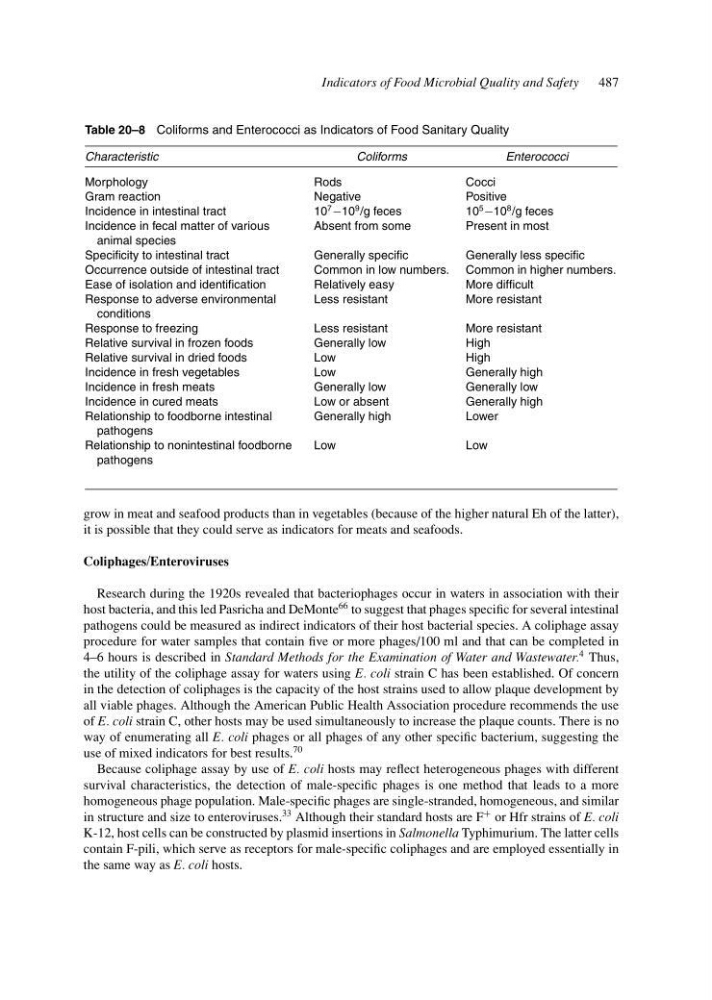
Table 20–8 Coliforms and Enterococci as Indicators of Food Sanitary Quality
Characteristic
Coliforms
Enterococci
Morphology
Rods
Cocci
Gram reaction
Negative
Positive
Incidence in intestinal tract
10
7
−10
9 /g feces
10
5
−10
8 /g feces
Incidence in fecal matter of various
animal species
Absent from some
Present in most
Specificity to intestinal tract
Generally specific
Generally less specific
Occurrence outside of intestinal tract
Common in low numbers. Common in higher numbers.
Ease of isolation and identification
Relatively easy
More difficult
Response to adverse environmental
conditions
Less resistant
More resistant
Response to freezing
Less resistant
More resistant
Relative survival in frozen foods
Generally low
High
Relative survival in dried foods
Low
High
Incidence in fresh vegetables
Low
Generally high
Incidence in fresh meats
Generally low
Generally low
Incidence in cured meats
Low or absent
Generally high
Relationship to foodborne intestinal
pathogens
Generally high
Lower
Relationship to nonintestinal foodborne
pathogens
Low
Low
grow in meat and seafood products than in vegetables (because of the higher natural Eh of the latter),
it is possible that they could serve as indicators for meats and seafoods.
Coliphages/Enteroviruses
Research during the 1920s revealed that bacteriophages occur in waters in association with their
host bacteria, and this led Pasricha and DeMonte
66 to suggest that phages specific for several intestinal
pathogens could be measured as indirect indicators of their host bacterial species. A coliphage assay
procedure for water samples that contain five or more phages/100 ml and that can be completed in
4–6 hours is described in Standard Methods for the Examination of Water and Wastewater.
4 Thus,
the utility of the coliphage assay for waters using E. coli strain C has been established. Of concern
in the detection of coliphages is the capacity of the host strains used to allow plaque development by
all viable phages. Although the American Public Health Association procedure recommends the use
of E. coli strain C, other hosts may be used simultaneously to increase the plaque counts. There is no
way of enumerating all E. coli phages or all phages of any other specific bacterium, suggesting the
use of mixed indicators for best results.
70
Because coliphage assay by use of E. coli hosts may reflect heterogeneous phages with different
survival characteristics, the detection of male-specific phages is one method that leads to a more
homogeneous phage population. Male-specific phages are single-stranded, homogeneous, and similar
in structure and size to enteroviruses.
33 Although their standard hosts are F
+ or Hfr strains of E. coli
K-12, host cells can be constructed by plasmid insertions in Salmonella Typhimurium. The latter cells
contain F-pili, which serve as receptors for male-specific coliphages and are employed essentially in
the same way as E. coli hosts.
487
Table 20–8 Coliforms and Enterococci as Indicators of Food Sanitary Quality
Characteristic
Coliforms
Enterococci
Morphology
Rods
Cocci
Gram reaction
Negative
Positive
Incidence in intestinal tract
10
7
−10
9 /g feces
10
5
−10
8 /g feces
Incidence in fecal matter of various
animal species
Absent from some
Present in most
Specificity to intestinal tract
Generally specific
Generally less specific
Occurrence outside of intestinal tract
Common in low numbers. Common in higher numbers.
Ease of isolation and identification
Relatively easy
More difficult
Response to adverse environmental
conditions
Less resistant
More resistant
Response to freezing
Less resistant
More resistant
Relative survival in frozen foods
Generally low
High
Relative survival in dried foods
Low
High
Incidence in fresh vegetables
Low
Generally high
Incidence in fresh meats
Generally low
Generally low
Incidence in cured meats
Low or absent
Generally high
Relationship to foodborne intestinal
pathogens
Generally high
Lower
Relationship to nonintestinal foodborne
pathogens
Low
Low
grow in meat and seafood products than in vegetables (because of the higher natural Eh of the latter),
it is possible that they could serve as indicators for meats and seafoods.
Coliphages/Enteroviruses
Research during the 1920s revealed that bacteriophages occur in waters in association with their
host bacteria, and this led Pasricha and DeMonte
66 to suggest that phages specific for several intestinal
pathogens could be measured as indirect indicators of their host bacterial species. A coliphage assay
procedure for water samples that contain five or more phages/100 ml and that can be completed in
4–6 hours is described in Standard Methods for the Examination of Water and Wastewater.
4 Thus,
the utility of the coliphage assay for waters using E. coli strain C has been established. Of concern
in the detection of coliphages is the capacity of the host strains used to allow plaque development by
all viable phages. Although the American Public Health Association procedure recommends the use
of E. coli strain C, other hosts may be used simultaneously to increase the plaque counts. There is no
way of enumerating all E. coli phages or all phages of any other specific bacterium, suggesting the
use of mixed indicators for best results.
70
Because coliphage assay by use of E. coli hosts may reflect heterogeneous phages with different
survival characteristics, the detection of male-specific phages is one method that leads to a more
homogeneous phage population. Male-specific phages are single-stranded, homogeneous, and similar
in structure and size to enteroviruses.
33 Although their standard hosts are F
+ or Hfr strains of E. coli
K-12, host cells can be constructed by plasmid insertions in Salmonella Typhimurium. The latter cells
contain F-pili, which serve as receptors for male-specific coliphages and are employed essentially in
the same way as E. coli hosts.