

464 Modern Food Microbiology
free radical formation. The use of PEF dates back to the mid-1960s. The pulses used may be of the
square-wave or the exponentially decaying types, and the former are more lethal than the latter. In one
study, a 99% decrease in E. coli numbers was produced by a square wave after 100 microseconds at
7
◦ C compared to 93% by the exponentially decaying method.
46
Among the general properties and features of PEF as applied to foods are the following:
1. Gram-negative bacterial cells are more sensitive than Gram positives or yeasts.
2. Vegetative cells are more sensitive than spores.
3. Microbial cells are more sensitive in the log phase of growth than in the stationary phase.
4. Cell death by PEF appears to be due to disruption of cell membrane function and by electroporation (production of pores in membranes by the electric current). It has been suggested that
bacterial inactivation by PEF may be an “all or nothing” event since sublethal injury could not
be detected.
55
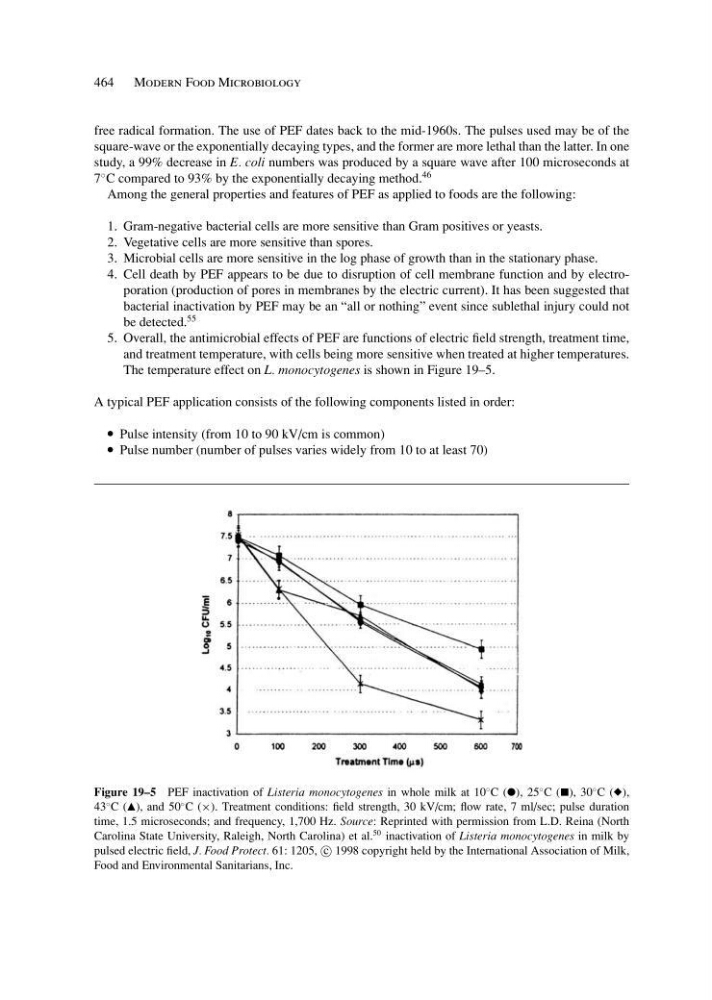
5. Overall, the antimicrobial effects of PEF are functions of electric field strength, treatment time,
and treatment temperature, with cells being more sensitive when treated at higher temperatures.
The temperature effect on L. monocytogenes is shown in Figure 19–5.
A typical PEF application consists of the following components listed in order:
• Pulse intensity (from 10 to 90 kV/cm is common)
• Pulse number (number of pulses varies widely from 10 to at least 70)
Figure 19–5 PEF inactivation of Listeria monocytogenes in whole milk at 10
◦ C (᭹), 25
◦ C (), 30
◦ C (᭜),
43
◦ C (᭡), and 50
◦ C (×). Treatment conditions: field strength, 30 kV/cm; flow rate, 7 ml/sec; pulse duration
time, 1.5 microseconds; and frequency, 1,700 Hz. Source: Reprinted with permission from L.D. Reina (North
Carolina State University, Raleigh, North Carolina) et al.
50 inactivation of Listeria monocytogenes in milk by
pulsed electric field, J. Food Protect. 61: 1205, c
1998 copyright held by the International Association of Milk,
Food and Environmental Sanitarians, Inc.
free radical formation. The use of PEF dates back to the mid-1960s. The pulses used may be of the
square-wave or the exponentially decaying types, and the former are more lethal than the latter. In one
study, a 99% decrease in E. coli numbers was produced by a square wave after 100 microseconds at
7
◦ C compared to 93% by the exponentially decaying method.
46
Among the general properties and features of PEF as applied to foods are the following:
1. Gram-negative bacterial cells are more sensitive than Gram positives or yeasts.
2. Vegetative cells are more sensitive than spores.
3. Microbial cells are more sensitive in the log phase of growth than in the stationary phase.
4. Cell death by PEF appears to be due to disruption of cell membrane function and by electroporation (production of pores in membranes by the electric current). It has been suggested that
bacterial inactivation by PEF may be an “all or nothing” event since sublethal injury could not
be detected.
55
5. Overall, the antimicrobial effects of PEF are functions of electric field strength, treatment time,
and treatment temperature, with cells being more sensitive when treated at higher temperatures.
The temperature effect on L. monocytogenes is shown in Figure 19–5.
A typical PEF application consists of the following components listed in order:
• Pulse intensity (from 10 to 90 kV/cm is common)
• Pulse number (number of pulses varies widely from 10 to at least 70)
Figure 19–5 PEF inactivation of Listeria monocytogenes in whole milk at 10
◦ C (᭹), 25
◦ C (), 30
◦ C (᭜),
43
◦ C (᭡), and 50
◦ C (×). Treatment conditions: field strength, 30 kV/cm; flow rate, 7 ml/sec; pulse duration
time, 1.5 microseconds; and frequency, 1,700 Hz. Source: Reprinted with permission from L.D. Reina (North
Carolina State University, Raleigh, North Carolina) et al.
50 inactivation of Listeria monocytogenes in milk by
pulsed electric field, J. Food Protect. 61: 1205, c
1998 copyright held by the International Association of Milk,
Food and Environmental Sanitarians, Inc.