

Food Protection with High Temperatures
427
Table 17–11 D 70 ◦ C Values of a Six-Serotype
∗ Mixture of Salmonella
enterica Serotypes and Listeria innocua Determined in Five Food
Products (Extracted from Murphy et al.
40 )
Food Specimen
Salmonella
L. innocua
Chicken patties
0.32
0.21
Chicken tenders
0.32
0.29
Frankfurters
0.39
0.36
Beef patties
0.25
0.29
Beef-turkey patties
0.37
0.18
∗ S. California, Heidelberg, Mission, Montevideo, Senftenberg, and Typhimurium.
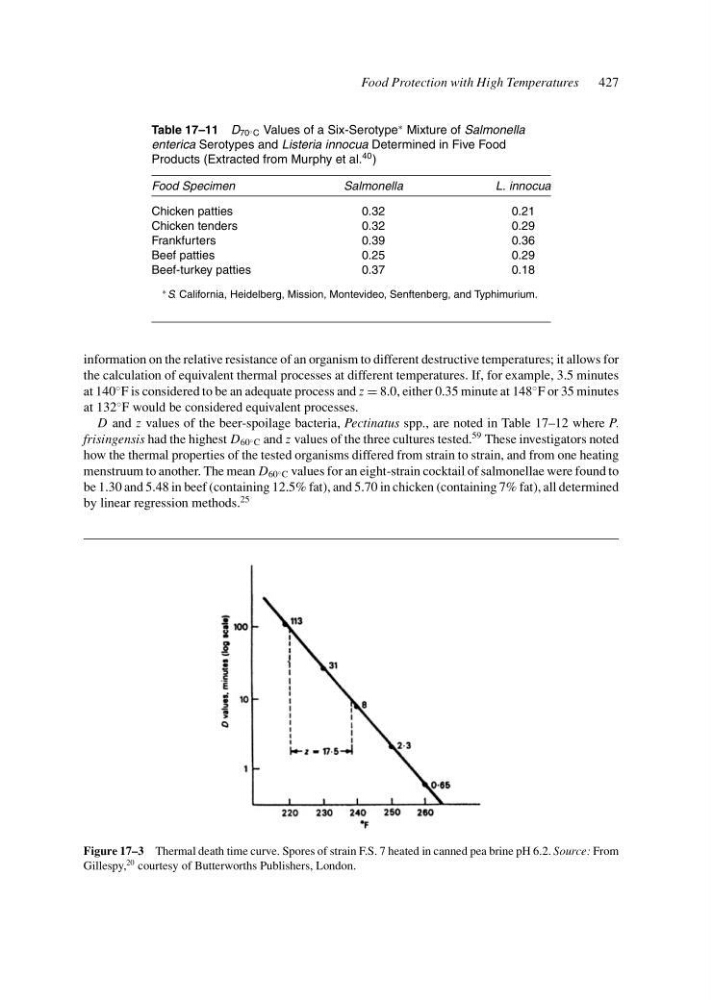
information on the relative resistance of an organism to different destructive temperatures; it allows for
the calculation of equivalent thermal processes at different temperatures. If, for example, 3.5 minutes
at 140
◦ F is considered to be an adequate process and z = 8.0, either 0.35 minute at 148
◦ F or 35 minutes
at 132
◦ F would be considered equivalent processes.
D and z values of the beer-spoilage bacteria, Pectinatus spp., are noted in Table 17–12 where P.
frisingensis had the highest D 60 ◦ C and z values of the three cultures tested.
59 These investigators noted
how the thermal properties of the tested organisms differed from strain to strain, and from one heating
menstruum to another. The mean D 60 ◦ C values for an eight-strain cocktail of salmonellae were found to
be 1.30 and 5.48 in beef (containing 12.5% fat), and 5.70 in chicken (containing 7% fat), all determined
by linear regression methods.
25
Figure 17–3 Thermal death time curve. Spores of strain F.S. 7 heated in canned pea brine pH 6.2. Source: From
Gillespy,
20 courtesy of Butterworths Publishers, London.
427
Table 17–11 D 70 ◦ C Values of a Six-Serotype
∗ Mixture of Salmonella
enterica Serotypes and Listeria innocua Determined in Five Food
Products (Extracted from Murphy et al.
40 )
Food Specimen
Salmonella
L. innocua
Chicken patties
0.32
0.21
Chicken tenders
0.32
0.29
Frankfurters
0.39
0.36
Beef patties
0.25
0.29
Beef-turkey patties
0.37
0.18
∗ S. California, Heidelberg, Mission, Montevideo, Senftenberg, and Typhimurium.
information on the relative resistance of an organism to different destructive temperatures; it allows for
the calculation of equivalent thermal processes at different temperatures. If, for example, 3.5 minutes
at 140
◦ F is considered to be an adequate process and z = 8.0, either 0.35 minute at 148
◦ F or 35 minutes
at 132
◦ F would be considered equivalent processes.
D and z values of the beer-spoilage bacteria, Pectinatus spp., are noted in Table 17–12 where P.
frisingensis had the highest D 60 ◦ C and z values of the three cultures tested.
59 These investigators noted
how the thermal properties of the tested organisms differed from strain to strain, and from one heating
menstruum to another. The mean D 60 ◦ C values for an eight-strain cocktail of salmonellae were found to
be 1.30 and 5.48 in beef (containing 12.5% fat), and 5.70 in chicken (containing 7% fat), all determined
by linear regression methods.
25
Figure 17–3 Thermal death time curve. Spores of strain F.S. 7 heated in canned pea brine pH 6.2. Source: From
Gillespy,
20 courtesy of Butterworths Publishers, London.