

428 Modern Food Microbiology
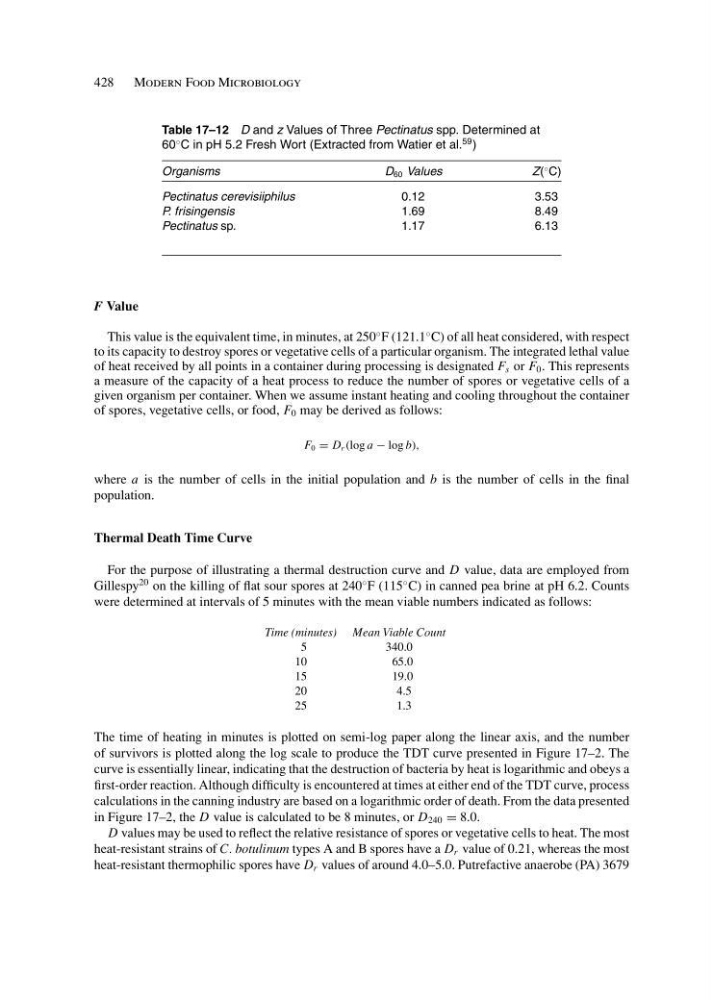
Table 17–12 D and z Values of Three Pectinatus spp. Determined at
60
◦ C in pH 5.2 Fresh Wort (Extracted from Watier et al.
59 )
Organisms
D 60 Values
Z(
◦ C)
Pectinatus cerevisiiphilus
0.12
3.53
P. frisingensis
1.69
8.49
Pectinatus sp.
1.17
6.13
F Value
This value is the equivalent time, in minutes, at 250
◦ F (121.1
◦ C) of all heat considered, with respect
to its capacity to destroy spores or vegetative cells of a particular organism. The integrated lethal value
of heat received by all points in a container during processing is designated F s or F 0 . This represents
a measure of the capacity of a heat process to reduce the number of spores or vegetative cells of a
given organism per container. When we assume instant heating and cooling throughout the container
of spores, vegetative cells, or food, F 0 may be derived as follows:
F 0 = D r (log a − log b),
where a is the number of cells in the initial population and b is the number of cells in the final
population.
Thermal Death Time Curve
For the purpose of illustrating a thermal destruction curve and D value, data are employed from
Gillespy
20 on the killing of flat sour spores at 240
◦ F (115
◦ C) in canned pea brine at pH 6.2. Counts
were determined at intervals of 5 minutes with the mean viable numbers indicated as follows:
Time (minutes) Mean Viable Count
5
340.0
10
65.0
15
19.0
20
4.5
25
1.3
The time of heating in minutes is plotted on semi-log paper along the linear axis, and the number
of survivors is plotted along the log scale to produce the TDT curve presented in Figure 17–2. The
curve is essentially linear, indicating that the destruction of bacteria by heat is logarithmic and obeys a
first-order reaction. Although difficulty is encountered at times at either end of the TDT curve, process
calculations in the canning industry are based on a logarithmic order of death. From the data presented
in Figure 17–2, the D value is calculated to be 8 minutes, or D 240 = 8.0.
D values may be used to reflect the relative resistance of spores or vegetative cells to heat. The most
heat-resistant strains of C. botulinum types A and B spores have a D r value of 0.21, whereas the most
heat-resistant thermophilic spores have D r values of around 4.0–5.0. Putrefactive anaerobe (PA) 3679
Table 17–12 D and z Values of Three Pectinatus spp. Determined at
60
◦ C in pH 5.2 Fresh Wort (Extracted from Watier et al.
59 )
Organisms
D 60 Values
Z(
◦ C)
Pectinatus cerevisiiphilus
0.12
3.53
P. frisingensis
1.69
8.49
Pectinatus sp.
1.17
6.13
F Value
This value is the equivalent time, in minutes, at 250
◦ F (121.1
◦ C) of all heat considered, with respect
to its capacity to destroy spores or vegetative cells of a particular organism. The integrated lethal value
of heat received by all points in a container during processing is designated F s or F 0 . This represents
a measure of the capacity of a heat process to reduce the number of spores or vegetative cells of a
given organism per container. When we assume instant heating and cooling throughout the container
of spores, vegetative cells, or food, F 0 may be derived as follows:
F 0 = D r (log a − log b),
where a is the number of cells in the initial population and b is the number of cells in the final
population.
Thermal Death Time Curve
For the purpose of illustrating a thermal destruction curve and D value, data are employed from
Gillespy
20 on the killing of flat sour spores at 240
◦ F (115
◦ C) in canned pea brine at pH 6.2. Counts
were determined at intervals of 5 minutes with the mean viable numbers indicated as follows:
Time (minutes) Mean Viable Count
5
340.0
10
65.0
15
19.0
20
4.5
25
1.3
The time of heating in minutes is plotted on semi-log paper along the linear axis, and the number
of survivors is plotted along the log scale to produce the TDT curve presented in Figure 17–2. The
curve is essentially linear, indicating that the destruction of bacteria by heat is logarithmic and obeys a
first-order reaction. Although difficulty is encountered at times at either end of the TDT curve, process
calculations in the canning industry are based on a logarithmic order of death. From the data presented
in Figure 17–2, the D value is calculated to be 8 minutes, or D 240 = 8.0.
D values may be used to reflect the relative resistance of spores or vegetative cells to heat. The most
heat-resistant strains of C. botulinum types A and B spores have a D r value of 0.21, whereas the most
heat-resistant thermophilic spores have D r values of around 4.0–5.0. Putrefactive anaerobe (PA) 3679