

Food Protection with High Temperatures
425
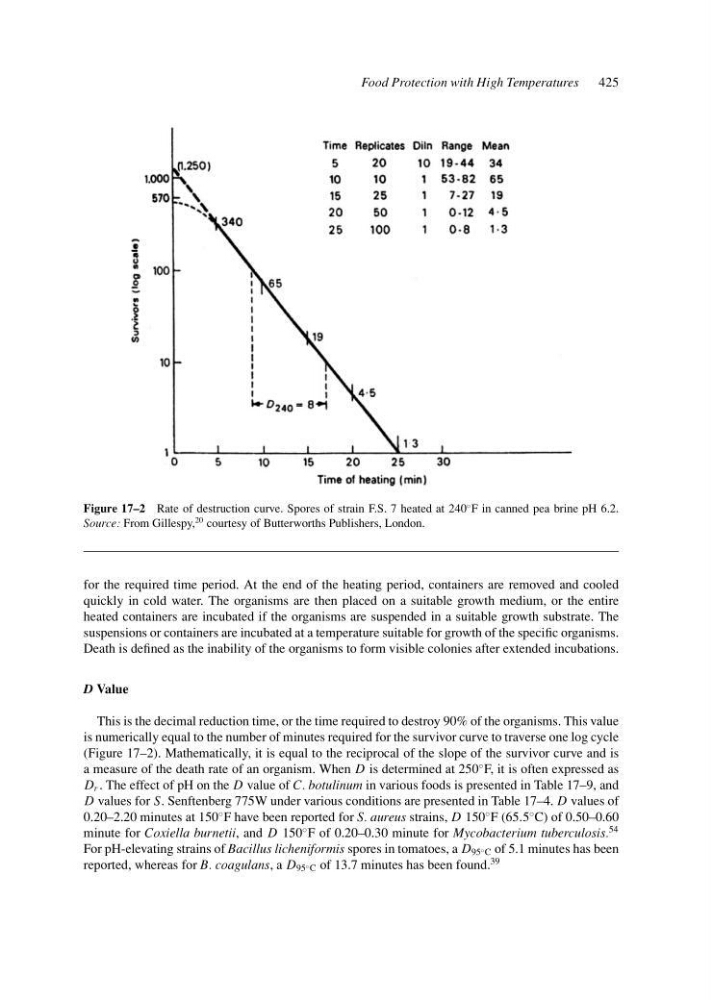
Figure 17–2 Rate of destruction curve. Spores of strain F.S. 7 heated at 240
◦ F in canned pea brine pH 6.2.
Source: From Gillespy,
20 courtesy of Butterworths Publishers, London.
for the required time period. At the end of the heating period, containers are removed and cooled
quickly in cold water. The organisms are then placed on a suitable growth medium, or the entire
heated containers are incubated if the organisms are suspended in a suitable growth substrate. The
suspensions or containers are incubated at a temperature suitable for growth of the specific organisms.
Death is defined as the inability of the organisms to form visible colonies after extended incubations.
D Value
This is the decimal reduction time, or the time required to destroy 90% of the organisms. This value
is numerically equal to the number of minutes required for the survivor curve to traverse one log cycle
(Figure 17–2). Mathematically, it is equal to the reciprocal of the slope of the survivor curve and is
a measure of the death rate of an organism. When D is determined at 250
◦ F, it is often expressed as
D r . The effect of pH on the D value of C. botulinum in various foods is presented in Table 17–9, and
D values for S. Senftenberg 775W under various conditions are presented in Table 17–4. D values of
0.20–2.20 minutes at 150
◦ F have been reported for S. aureus strains, D 150
◦ F (65.5
◦ C) of 0.50–0.60
minute for Coxiella burnetii, and D 150
◦ F of 0.20–0.30 minute for Mycobacterium tuberculosis.
54
For pH-elevating strains of Bacillus licheniformis spores in tomatoes, a D 95 ◦ C of 5.1 minutes has been
reported, whereas for B. coagulans, a D 95 ◦ C of 13.7 minutes has been found.
39
425
Figure 17–2 Rate of destruction curve. Spores of strain F.S. 7 heated at 240
◦ F in canned pea brine pH 6.2.
Source: From Gillespy,
20 courtesy of Butterworths Publishers, London.
for the required time period. At the end of the heating period, containers are removed and cooled
quickly in cold water. The organisms are then placed on a suitable growth medium, or the entire
heated containers are incubated if the organisms are suspended in a suitable growth substrate. The
suspensions or containers are incubated at a temperature suitable for growth of the specific organisms.
Death is defined as the inability of the organisms to form visible colonies after extended incubations.
D Value
This is the decimal reduction time, or the time required to destroy 90% of the organisms. This value
is numerically equal to the number of minutes required for the survivor curve to traverse one log cycle
(Figure 17–2). Mathematically, it is equal to the reciprocal of the slope of the survivor curve and is
a measure of the death rate of an organism. When D is determined at 250
◦ F, it is often expressed as
D r . The effect of pH on the D value of C. botulinum in various foods is presented in Table 17–9, and
D values for S. Senftenberg 775W under various conditions are presented in Table 17–4. D values of
0.20–2.20 minutes at 150
◦ F have been reported for S. aureus strains, D 150
◦ F (65.5
◦ C) of 0.50–0.60
minute for Coxiella burnetii, and D 150
◦ F of 0.20–0.30 minute for Mycobacterium tuberculosis.
54
For pH-elevating strains of Bacillus licheniformis spores in tomatoes, a D 95 ◦ C of 5.1 minutes has been
reported, whereas for B. coagulans, a D 95 ◦ C of 13.7 minutes has been found.
39