

Food Protection with High Temperatures
423
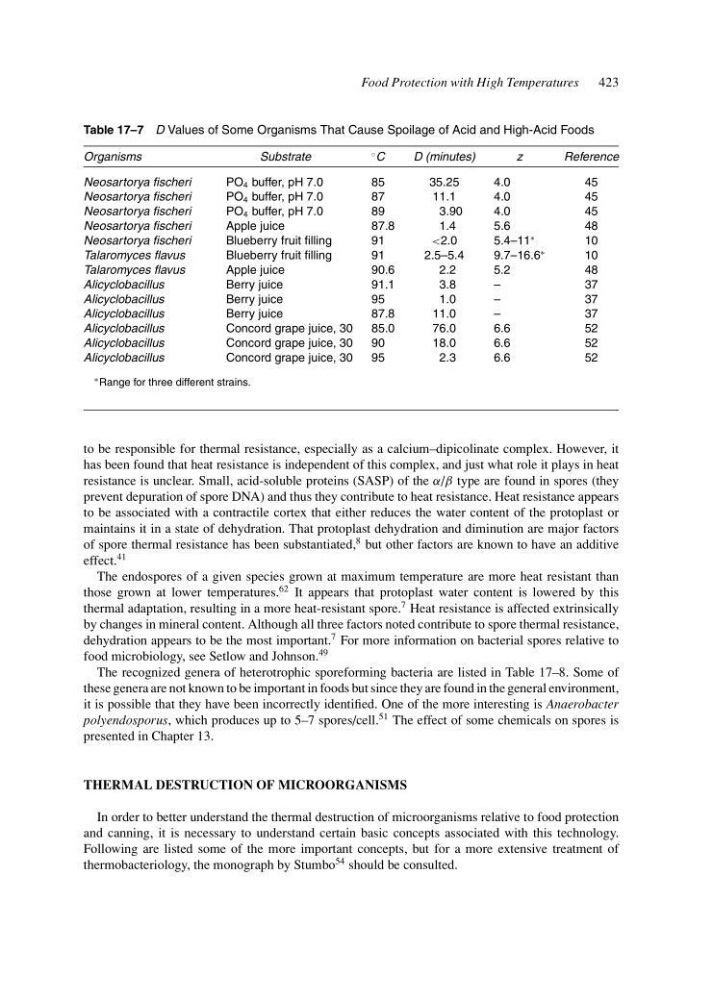
Table 17–7 D Values of Some Organisms That Cause Spoilage of Acid and High-Acid Foods
Organisms
Substrate
◦ C
D (minutes)
z
Reference
Neosartorya fischeri
PO 4 buffer, pH 7.0
85
35.25
4.0
45
Neosartorya fischeri
PO 4 buffer, pH 7.0
87
11.1
4.0
45
Neosartorya fischeri
PO 4 buffer, pH 7.0
89
3.90
4.0
45
Neosartorya fischeri
Apple juice
87.8
1.4
5.6
48
Neosartorya fischeri
Blueberry fruit filling
91
<2.0
5.4–11
∗
10
Talaromyces flavus
Blueberry fruit filling
91
2.5–5.4
9.7–16.6
∗
10
Talaromyces flavus
Apple juice
90.6
2.2
5.2
48
Alicyclobacillus
Berry juice
91.1
3.8
–
37
Alicyclobacillus
Berry juice
95
1.0
–
37
Alicyclobacillus
Berry juice
87.8
11.0
–
37
Alicyclobacillus
Concord grape juice, 30
85.0
76.0
6.6
52
Alicyclobacillus
Concord grape juice, 30
90
18.0
6.6
52
Alicyclobacillus
Concord grape juice, 30
95
2.3
6.6
52
∗ Range for three different strains.
to be responsible for thermal resistance, especially as a calcium–dipicolinate complex. However, it
has been found that heat resistance is independent of this complex, and just what role it plays in heat
resistance is unclear. Small, acid-soluble proteins (SASP) of the α/β type are found in spores (they
prevent depuration of spore DNA) and thus they contribute to heat resistance. Heat resistance appears
to be associated with a contractile cortex that either reduces the water content of the protoplast or
maintains it in a state of dehydration. That protoplast dehydration and diminution are major factors
of spore thermal resistance has been substantiated,
8 but other factors are known to have an additive
effect.
41
The endospores of a given species grown at maximum temperature are more heat resistant than
those grown at lower temperatures.
62 It appears that protoplast water content is lowered by this
thermal adaptation, resulting in a more heat-resistant spore.
7 Heat resistance is affected extrinsically
by changes in mineral content. Although all three factors noted contribute to spore thermal resistance,
dehydration appears to be the most important.
7 For more information on bacterial spores relative to
food microbiology, see Setlow and Johnson.
49
The recognized genera of heterotrophic sporeforming bacteria are listed in Table 17–8. Some of
these genera are not known to be important in foods but since they are found in the general environment,
it is possible that they have been incorrectly identified. One of the more interesting is Anaerobacter
polyendosporus, which produces up to 5–7 spores/cell.
51 The effect of some chemicals on spores is
presented in Chapter 13.
THERMAL DESTRUCTION OF MICROORGANISMS
In order to better understand the thermal destruction of microorganisms relative to food protection
and canning, it is necessary to understand certain basic concepts associated with this technology.
Following are listed some of the more important concepts, but for a more extensive treatment of
thermobacteriology, the monograph by Stumbo
54 should be consulted.
423
Table 17–7 D Values of Some Organisms That Cause Spoilage of Acid and High-Acid Foods
Organisms
Substrate
◦ C
D (minutes)
z
Reference
Neosartorya fischeri
PO 4 buffer, pH 7.0
85
35.25
4.0
45
Neosartorya fischeri
PO 4 buffer, pH 7.0
87
11.1
4.0
45
Neosartorya fischeri
PO 4 buffer, pH 7.0
89
3.90
4.0
45
Neosartorya fischeri
Apple juice
87.8
1.4
5.6
48
Neosartorya fischeri
Blueberry fruit filling
91
<2.0
5.4–11
∗
10
Talaromyces flavus
Blueberry fruit filling
91
2.5–5.4
9.7–16.6
∗
10
Talaromyces flavus
Apple juice
90.6
2.2
5.2
48
Alicyclobacillus
Berry juice
91.1
3.8
–
37
Alicyclobacillus
Berry juice
95
1.0
–
37
Alicyclobacillus
Berry juice
87.8
11.0
–
37
Alicyclobacillus
Concord grape juice, 30
85.0
76.0
6.6
52
Alicyclobacillus
Concord grape juice, 30
90
18.0
6.6
52
Alicyclobacillus
Concord grape juice, 30
95
2.3
6.6
52
∗ Range for three different strains.
to be responsible for thermal resistance, especially as a calcium–dipicolinate complex. However, it
has been found that heat resistance is independent of this complex, and just what role it plays in heat
resistance is unclear. Small, acid-soluble proteins (SASP) of the α/β type are found in spores (they
prevent depuration of spore DNA) and thus they contribute to heat resistance. Heat resistance appears
to be associated with a contractile cortex that either reduces the water content of the protoplast or
maintains it in a state of dehydration. That protoplast dehydration and diminution are major factors
of spore thermal resistance has been substantiated,
8 but other factors are known to have an additive
effect.
41
The endospores of a given species grown at maximum temperature are more heat resistant than
those grown at lower temperatures.
62 It appears that protoplast water content is lowered by this
thermal adaptation, resulting in a more heat-resistant spore.
7 Heat resistance is affected extrinsically
by changes in mineral content. Although all three factors noted contribute to spore thermal resistance,
dehydration appears to be the most important.
7 For more information on bacterial spores relative to
food microbiology, see Setlow and Johnson.
49
The recognized genera of heterotrophic sporeforming bacteria are listed in Table 17–8. Some of
these genera are not known to be important in foods but since they are found in the general environment,
it is possible that they have been incorrectly identified. One of the more interesting is Anaerobacter
polyendosporus, which produces up to 5–7 spores/cell.
51 The effect of some chemicals on spores is
presented in Chapter 13.
THERMAL DESTRUCTION OF MICROORGANISMS
In order to better understand the thermal destruction of microorganisms relative to food protection
and canning, it is necessary to understand certain basic concepts associated with this technology.
Following are listed some of the more important concepts, but for a more extensive treatment of
thermobacteriology, the monograph by Stumbo
54 should be consulted.