

422 Modern Food Microbiology
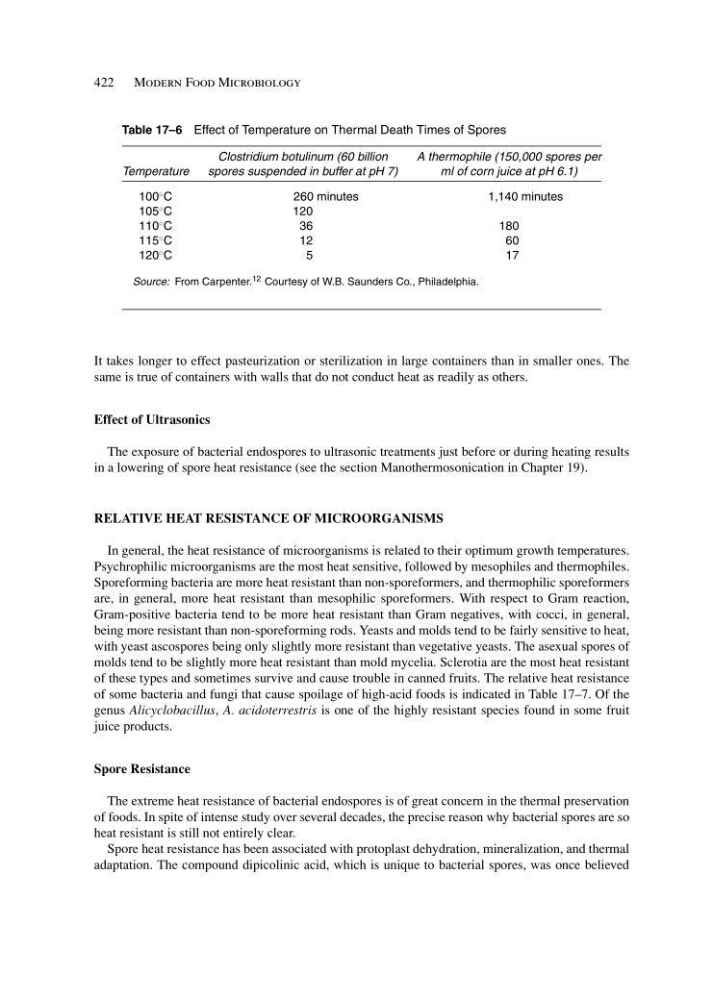
Table 17–6 Effect of Temperature on Thermal Death Times of Spores
Clostridium botulinum (60 billion
A thermophile (150,000 spores per
Temperature
spores suspended in buffer at pH 7)
ml of corn juice at pH 6.1)
100
◦ C
260 minutes
1,140 minutes
105
◦ C
120
110
◦ C
36
180
115
◦ C
1 2
6 0
120
◦ C
5
1 7
Source: From Carpenter. 12 Courtesy of W.B. Saunders Co., Philadelphia.
It takes longer to effect pasteurization or sterilization in large containers than in smaller ones. The
same is true of containers with walls that do not conduct heat as readily as others.
Effect of Ultrasonics
The exposure of bacterial endospores to ultrasonic treatments just before or during heating results
in a lowering of spore heat resistance (see the section Manothermosonication in Chapter 19).
RELATIVE HEAT RESISTANCE OF MICROORGANISMS
In general, the heat resistance of microorganisms is related to their optimum growth temperatures.
Psychrophilic microorganisms are the most heat sensitive, followed by mesophiles and thermophiles.
Sporeforming bacteria are more heat resistant than non-sporeformers, and thermophilic sporeformers
are, in general, more heat resistant than mesophilic sporeformers. With respect to Gram reaction,
Gram-positive bacteria tend to be more heat resistant than Gram negatives, with cocci, in general,
being more resistant than non-sporeforming rods. Yeasts and molds tend to be fairly sensitive to heat,
with yeast ascospores being only slightly more resistant than vegetative yeasts. The asexual spores of
molds tend to be slightly more heat resistant than mold mycelia. Sclerotia are the most heat resistant
of these types and sometimes survive and cause trouble in canned fruits. The relative heat resistance
of some bacteria and fungi that cause spoilage of high-acid foods is indicated in Table 17–7. Of the
genus Alicyclobacillus, A. acidoterrestris is one of the highly resistant species found in some fruit
juice products.
Spore Resistance
The extreme heat resistance of bacterial endospores is of great concern in the thermal preservation
of foods. In spite of intense study over several decades, the precise reason why bacterial spores are so
heat resistant is still not entirely clear.
Spore heat resistance has been associated with protoplast dehydration, mineralization, and thermal
adaptation. The compound dipicolinic acid, which is unique to bacterial spores, was once believed
Table 17–6 Effect of Temperature on Thermal Death Times of Spores
Clostridium botulinum (60 billion
A thermophile (150,000 spores per
Temperature
spores suspended in buffer at pH 7)
ml of corn juice at pH 6.1)
100
◦ C
260 minutes
1,140 minutes
105
◦ C
120
110
◦ C
36
180
115
◦ C
1 2
6 0
120
◦ C
5
1 7
Source: From Carpenter. 12 Courtesy of W.B. Saunders Co., Philadelphia.
It takes longer to effect pasteurization or sterilization in large containers than in smaller ones. The
same is true of containers with walls that do not conduct heat as readily as others.
Effect of Ultrasonics
The exposure of bacterial endospores to ultrasonic treatments just before or during heating results
in a lowering of spore heat resistance (see the section Manothermosonication in Chapter 19).
RELATIVE HEAT RESISTANCE OF MICROORGANISMS
In general, the heat resistance of microorganisms is related to their optimum growth temperatures.
Psychrophilic microorganisms are the most heat sensitive, followed by mesophiles and thermophiles.
Sporeforming bacteria are more heat resistant than non-sporeformers, and thermophilic sporeformers
are, in general, more heat resistant than mesophilic sporeformers. With respect to Gram reaction,
Gram-positive bacteria tend to be more heat resistant than Gram negatives, with cocci, in general,
being more resistant than non-sporeforming rods. Yeasts and molds tend to be fairly sensitive to heat,
with yeast ascospores being only slightly more resistant than vegetative yeasts. The asexual spores of
molds tend to be slightly more heat resistant than mold mycelia. Sclerotia are the most heat resistant
of these types and sometimes survive and cause trouble in canned fruits. The relative heat resistance
of some bacteria and fungi that cause spoilage of high-acid foods is indicated in Table 17–7. Of the
genus Alicyclobacillus, A. acidoterrestris is one of the highly resistant species found in some fruit
juice products.
Spore Resistance
The extreme heat resistance of bacterial endospores is of great concern in the thermal preservation
of foods. In spite of intense study over several decades, the precise reason why bacterial spores are so
heat resistant is still not entirely clear.
Spore heat resistance has been associated with protoplast dehydration, mineralization, and thermal
adaptation. The compound dipicolinic acid, which is unique to bacterial spores, was once believed