

418 Modern Food Microbiology
Table 17–3 D Values (60
◦ C) of Starved Listeria monocytogenes Cells
in Pork Slurry with NaCl and Sodium Pyrophosphate (SPP) Alone and in
Combinations (Summarized from Lihono et al.
32 )
%SPP
%NaCl
D Values (Standard Deviation)
0
0
1.18 (0.15)
0
3
1.56 (0.32)
0
6
3.50 (0.46)
0.5
0
1.46 (0.09)
0.5
3
1.80 (0.23)
0.5
6
3.07 (0.35)
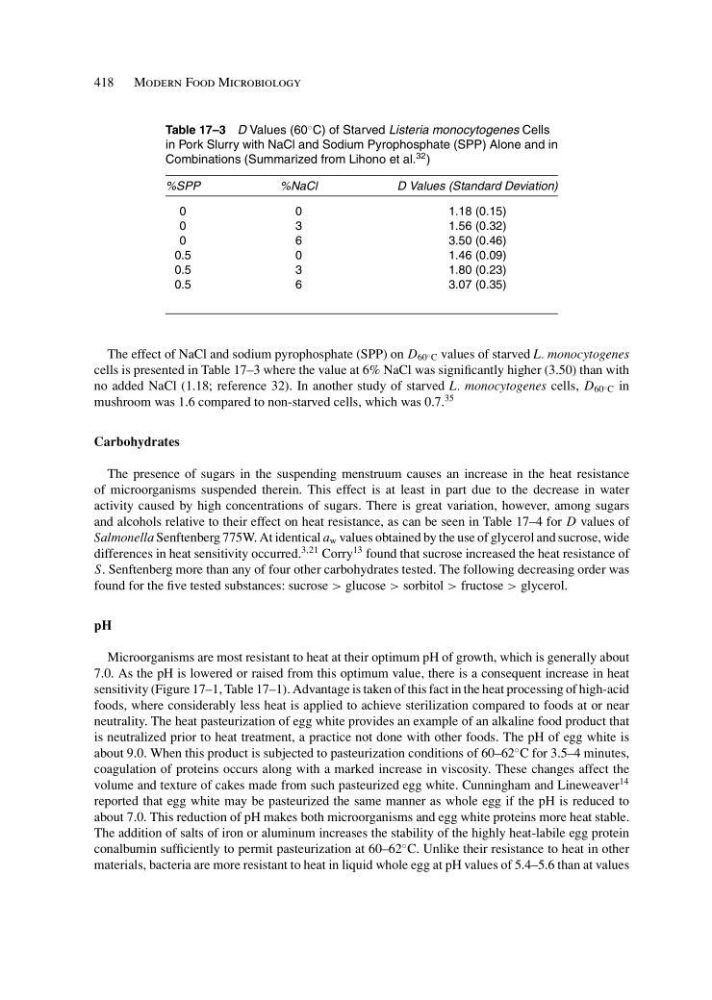
The effect of NaCl and sodium pyrophosphate (SPP) on D 60 ◦ C values of starved L. monocytogenes
cells is presented in Table 17–3 where the value at 6% NaCl was significantly higher (3.50) than with
no added NaCl (1.18; reference 32). In another study of starved L. monocytogenes cells, D 60 ◦ C in
mushroom was 1.6 compared to non-starved cells, which was 0.7.
35
Carbohydrates
The presence of sugars in the suspending menstruum causes an increase in the heat resistance
of microorganisms suspended therein. This effect is at least in part due to the decrease in water
activity caused by high concentrations of sugars. There is great variation, however, among sugars
and alcohols relative to their effect on heat resistance, as can be seen in Table 17–4 for D values of
Salmonella Senftenberg 775W. At identical a w values obtained by the use of glycerol and sucrose, wide
differences in heat sensitivity occurred.
3,21 Corry
13 found that sucrose increased the heat resistance of
S. Senftenberg more than any of four other carbohydrates tested. The following decreasing order was
found for the five tested substances: sucrose > glucose > sorbitol > fructose > glycerol.
pH
Microorganisms are most resistant to heat at their optimum pH of growth, which is generally about
7.0. As the pH is lowered or raised from this optimum value, there is a consequent increase in heat
sensitivity (Figure 17–1, Table 17–1). Advantage is taken of this fact in the heat processing of high-acid
foods, where considerably less heat is applied to achieve sterilization compared to foods at or near
neutrality. The heat pasteurization of egg white provides an example of an alkaline food product that
is neutralized prior to heat treatment, a practice not done with other foods. The pH of egg white is
about 9.0. When this product is subjected to pasteurization conditions of 60–62
◦ C for 3.5–4 minutes,
coagulation of proteins occurs along with a marked increase in viscosity. These changes affect the
volume and texture of cakes made from such pasteurized egg white. Cunningham and Lineweaver
14
reported that egg white may be pasteurized the same manner as whole egg if the pH is reduced to
about 7.0. This reduction of pH makes both microorganisms and egg white proteins more heat stable.
The addition of salts of iron or aluminum increases the stability of the highly heat-labile egg protein
conalbumin sufficiently to permit pasteurization at 60–62
◦ C. Unlike their resistance to heat in other
materials, bacteria are more resistant to heat in liquid whole egg at pH values of 5.4–5.6 than at values
Table 17–3 D Values (60
◦ C) of Starved Listeria monocytogenes Cells
in Pork Slurry with NaCl and Sodium Pyrophosphate (SPP) Alone and in
Combinations (Summarized from Lihono et al.
32 )
%SPP
%NaCl
D Values (Standard Deviation)
0
0
1.18 (0.15)
0
3
1.56 (0.32)
0
6
3.50 (0.46)
0.5
0
1.46 (0.09)
0.5
3
1.80 (0.23)
0.5
6
3.07 (0.35)
The effect of NaCl and sodium pyrophosphate (SPP) on D 60 ◦ C values of starved L. monocytogenes
cells is presented in Table 17–3 where the value at 6% NaCl was significantly higher (3.50) than with
no added NaCl (1.18; reference 32). In another study of starved L. monocytogenes cells, D 60 ◦ C in
mushroom was 1.6 compared to non-starved cells, which was 0.7.
35
Carbohydrates
The presence of sugars in the suspending menstruum causes an increase in the heat resistance
of microorganisms suspended therein. This effect is at least in part due to the decrease in water
activity caused by high concentrations of sugars. There is great variation, however, among sugars
and alcohols relative to their effect on heat resistance, as can be seen in Table 17–4 for D values of
Salmonella Senftenberg 775W. At identical a w values obtained by the use of glycerol and sucrose, wide
differences in heat sensitivity occurred.
3,21 Corry
13 found that sucrose increased the heat resistance of
S. Senftenberg more than any of four other carbohydrates tested. The following decreasing order was
found for the five tested substances: sucrose > glucose > sorbitol > fructose > glycerol.
pH
Microorganisms are most resistant to heat at their optimum pH of growth, which is generally about
7.0. As the pH is lowered or raised from this optimum value, there is a consequent increase in heat
sensitivity (Figure 17–1, Table 17–1). Advantage is taken of this fact in the heat processing of high-acid
foods, where considerably less heat is applied to achieve sterilization compared to foods at or near
neutrality. The heat pasteurization of egg white provides an example of an alkaline food product that
is neutralized prior to heat treatment, a practice not done with other foods. The pH of egg white is
about 9.0. When this product is subjected to pasteurization conditions of 60–62
◦ C for 3.5–4 minutes,
coagulation of proteins occurs along with a marked increase in viscosity. These changes affect the
volume and texture of cakes made from such pasteurized egg white. Cunningham and Lineweaver
14
reported that egg white may be pasteurized the same manner as whole egg if the pH is reduced to
about 7.0. This reduction of pH makes both microorganisms and egg white proteins more heat stable.
The addition of salts of iron or aluminum increases the stability of the highly heat-labile egg protein
conalbumin sufficiently to permit pasteurization at 60–62
◦ C. Unlike their resistance to heat in other
materials, bacteria are more resistant to heat in liquid whole egg at pH values of 5.4–5.6 than at values