

Food Protection with High Temperatures
417
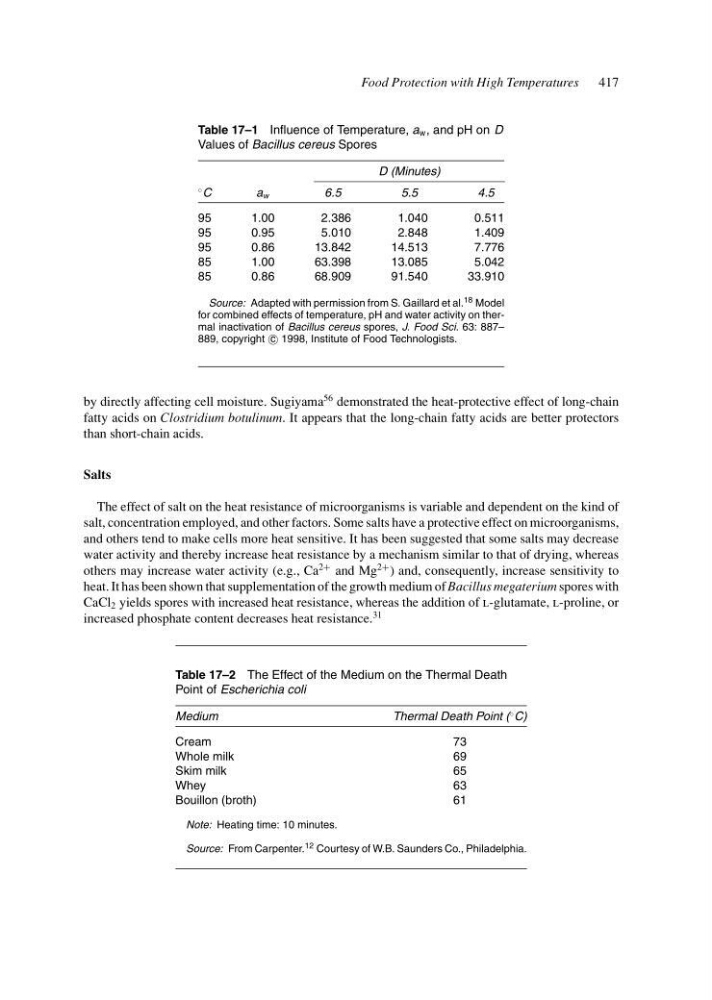
Table 17–1 Influence of Temperature, a w , and pH on D
Values of Bacillus cereus Spores
D (Minutes)
◦ C
a w
6.5
5.5
4.5
95
1.00
2.386
1.040
0.511
95
0.95
5.010
2.848
1.409
95
0.86
13.842
14.513
7.776
85
1.00
63.398
13.085
5.042
85
0.86
68.909
91.540
33.910
Source: Adapted with permission from S. Gaillard et al. 18 Model
for combined effects of temperature, pH and water activity on thermal inactivation of Bacillus cereus spores, J. Food Sci. 63: 887–
889, copyright c
1998, Institute of Food Technologists.
by directly affecting cell moisture. Sugiyama
56 demonstrated the heat-protective effect of long-chain
fatty acids on Clostridium botulinum. It appears that the long-chain fatty acids are better protectors
than short-chain acids.
Salts
The effect of salt on the heat resistance of microorganisms is variable and dependent on the kind of
salt, concentration employed, and other factors. Some salts have a protective effect on microorganisms,
and others tend to make cells more heat sensitive. It has been suggested that some salts may decrease
water activity and thereby increase heat resistance by a mechanism similar to that of drying, whereas
others may increase water activity (e.g., Ca
2+ and Mg
2+ ) and, consequently, increase sensitivity to
heat. It has been shown that supplementation of the growth medium of Bacillus megaterium spores with
CaCl 2 yields spores with increased heat resistance, whereas the addition of l-glutamate, l-proline, or
increased phosphate content decreases heat resistance.
31
Table 17–2 The Effect of the Medium on the Thermal Death
Point of Escherichia coli
Medium
Thermal Death Point (
◦ C)
Cream
73
Whole milk
69
Skim milk
65
Whey
63
Bouillon (broth)
61
Note: Heating time: 10 minutes.
Source: From Carpenter. 12 Courtesy of W.B. Saunders Co., Philadelphia.
417
Table 17–1 Influence of Temperature, a w , and pH on D
Values of Bacillus cereus Spores
D (Minutes)
◦ C
a w
6.5
5.5
4.5
95
1.00
2.386
1.040
0.511
95
0.95
5.010
2.848
1.409
95
0.86
13.842
14.513
7.776
85
1.00
63.398
13.085
5.042
85
0.86
68.909
91.540
33.910
Source: Adapted with permission from S. Gaillard et al. 18 Model
for combined effects of temperature, pH and water activity on thermal inactivation of Bacillus cereus spores, J. Food Sci. 63: 887–
889, copyright c
1998, Institute of Food Technologists.
by directly affecting cell moisture. Sugiyama
56 demonstrated the heat-protective effect of long-chain
fatty acids on Clostridium botulinum. It appears that the long-chain fatty acids are better protectors
than short-chain acids.
Salts
The effect of salt on the heat resistance of microorganisms is variable and dependent on the kind of
salt, concentration employed, and other factors. Some salts have a protective effect on microorganisms,
and others tend to make cells more heat sensitive. It has been suggested that some salts may decrease
water activity and thereby increase heat resistance by a mechanism similar to that of drying, whereas
others may increase water activity (e.g., Ca
2+ and Mg
2+ ) and, consequently, increase sensitivity to
heat. It has been shown that supplementation of the growth medium of Bacillus megaterium spores with
CaCl 2 yields spores with increased heat resistance, whereas the addition of l-glutamate, l-proline, or
increased phosphate content decreases heat resistance.
31
Table 17–2 The Effect of the Medium on the Thermal Death
Point of Escherichia coli
Medium
Thermal Death Point (
◦ C)
Cream
73
Whole milk
69
Skim milk
65
Whey
63
Bouillon (broth)
61
Note: Heating time: 10 minutes.
Source: From Carpenter. 12 Courtesy of W.B. Saunders Co., Philadelphia.