

332 Modern Food Microbiology
MISCELLANEOUS CHEMICAL PRESERVATIVES
Chitosans
These are cationic polysaccharides made from chitin by acid or enzymatic hydrolysis; they are
deacetylated derivatives of chitin. The latter may be achieved by use of chitosanase (see reference
106). O-carbomethylated (O-CM) chitosan is water soluble and has a broader antimicrobial spectrum
than some other preparations. Chitosans vary widely in molecular size with some having molecular
weights as low as 30 to over 1,000. These compounds appear to be more effective against Grampositive than Gram-negative bacteria, and they are being investigated as antimicrobial compounds for
use in packaging films (bioactive packaging). The polycationic chitosans bind to negatively charged
bacterial cells and interfere with membrane and transport functions.
Using an agar plate disk assay and six chitosan oligomers and six chitosans at 0.1% concentration,
they were tested against some tofu spoilage bacteria. The six chitosans completely inhibited Bacillus
spp. after 24 hours at 37
◦ C, and a 3- to 4-log reduction of Bacillus megaterium and B. cereus was
observed with chitosans.
140 A concentration of 0.04% of chitosans completely eliminated Enterobacter
sakazakii. From a study of chitosans in oil-in-water emulsions against levels of 10
7 cfu/ml of L.
monocytogenes and S. Typhimurium, the investigators found that 0.1% chitosan polysaccharide should
be sufficient to inhibit these two pathogens at either 10
◦ C or 25
◦ C with L. monocytogenes being more
sensitive than S. Typhimurium.
225
Dimethyl Dicarbonate
This compound is used as a yeast inhibitor in wine and in some fruit drinks at a level of 0.025%.
Upon hydrolysis, it yields methanol and CO 2 . With a concentration of 0.25% in apple cider stored
at 4
◦ C, a significant reduction (to <1 cfu/ml) of E. coli 0157:H7 occurred after 3 days compared
to controls with no DMDC or cider preserved with sodium bisulfite or sodium benzoate where this
pathogen survived for up to 15 days.
56
Ethanol
This alcohol is present in flavoring extracts and effects preservation by virtue of its desiccant and
denaturant properties. Ethanol vapors, produced by a vapor generator, can be produced within the
headspace of a package, and the vapors have been shown to be effective against some bacteria and
fungi. Ethanol has been shown to sensitize L. monocytogenes to low pH, organic acids, and osmotic
stress, and these effects can be demonstrated with 5% concentrations. At a pH of 3.0, >3-log killing
of the pathogen occurred after a 40-minute exposure to 5% but with a 10% concentration, the same
reduction occurred after 10 minutes.
12 The most potent combination was pH 3.0+50 mM formate
+5% ethanol, which produced a 5-log kill in 4 minutes. It appears that ethanol alters membrane
permeability and thus makes cells more susceptible to certain other agents. Spores of Bacillus subtilis
treated with either alkali or ethanol release their DPA. Spores treated with ethanol did not germinate
in nutrient and nonnutrient germinants, and they did not recover after lysozyme treatment.
174
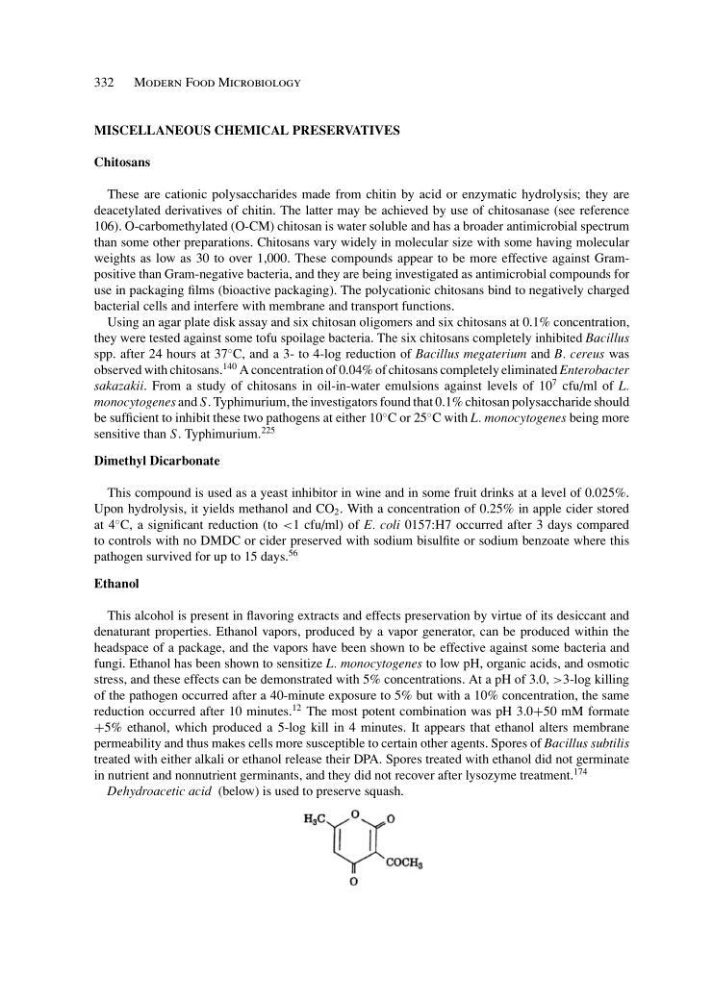
Dehydroacetic acid (below) is used to preserve squash.
MISCELLANEOUS CHEMICAL PRESERVATIVES
Chitosans
These are cationic polysaccharides made from chitin by acid or enzymatic hydrolysis; they are
deacetylated derivatives of chitin. The latter may be achieved by use of chitosanase (see reference
106). O-carbomethylated (O-CM) chitosan is water soluble and has a broader antimicrobial spectrum
than some other preparations. Chitosans vary widely in molecular size with some having molecular
weights as low as 30 to over 1,000. These compounds appear to be more effective against Grampositive than Gram-negative bacteria, and they are being investigated as antimicrobial compounds for
use in packaging films (bioactive packaging). The polycationic chitosans bind to negatively charged
bacterial cells and interfere with membrane and transport functions.
Using an agar plate disk assay and six chitosan oligomers and six chitosans at 0.1% concentration,
they were tested against some tofu spoilage bacteria. The six chitosans completely inhibited Bacillus
spp. after 24 hours at 37
◦ C, and a 3- to 4-log reduction of Bacillus megaterium and B. cereus was
observed with chitosans.
140 A concentration of 0.04% of chitosans completely eliminated Enterobacter
sakazakii. From a study of chitosans in oil-in-water emulsions against levels of 10
7 cfu/ml of L.
monocytogenes and S. Typhimurium, the investigators found that 0.1% chitosan polysaccharide should
be sufficient to inhibit these two pathogens at either 10
◦ C or 25
◦ C with L. monocytogenes being more
sensitive than S. Typhimurium.
225
Dimethyl Dicarbonate
This compound is used as a yeast inhibitor in wine and in some fruit drinks at a level of 0.025%.
Upon hydrolysis, it yields methanol and CO 2 . With a concentration of 0.25% in apple cider stored
at 4
◦ C, a significant reduction (to <1 cfu/ml) of E. coli 0157:H7 occurred after 3 days compared
to controls with no DMDC or cider preserved with sodium bisulfite or sodium benzoate where this
pathogen survived for up to 15 days.
56
Ethanol
This alcohol is present in flavoring extracts and effects preservation by virtue of its desiccant and
denaturant properties. Ethanol vapors, produced by a vapor generator, can be produced within the
headspace of a package, and the vapors have been shown to be effective against some bacteria and
fungi. Ethanol has been shown to sensitize L. monocytogenes to low pH, organic acids, and osmotic
stress, and these effects can be demonstrated with 5% concentrations. At a pH of 3.0, >3-log killing
of the pathogen occurred after a 40-minute exposure to 5% but with a 10% concentration, the same
reduction occurred after 10 minutes.
12 The most potent combination was pH 3.0+50 mM formate
+5% ethanol, which produced a 5-log kill in 4 minutes. It appears that ethanol alters membrane
permeability and thus makes cells more susceptible to certain other agents. Spores of Bacillus subtilis
treated with either alkali or ethanol release their DPA. Spores treated with ethanol did not germinate
in nutrient and nonnutrient germinants, and they did not recover after lysozyme treatment.
174
Dehydroacetic acid (below) is used to preserve squash.