

Food Protection with Chemicals, and by Biocontrol 331
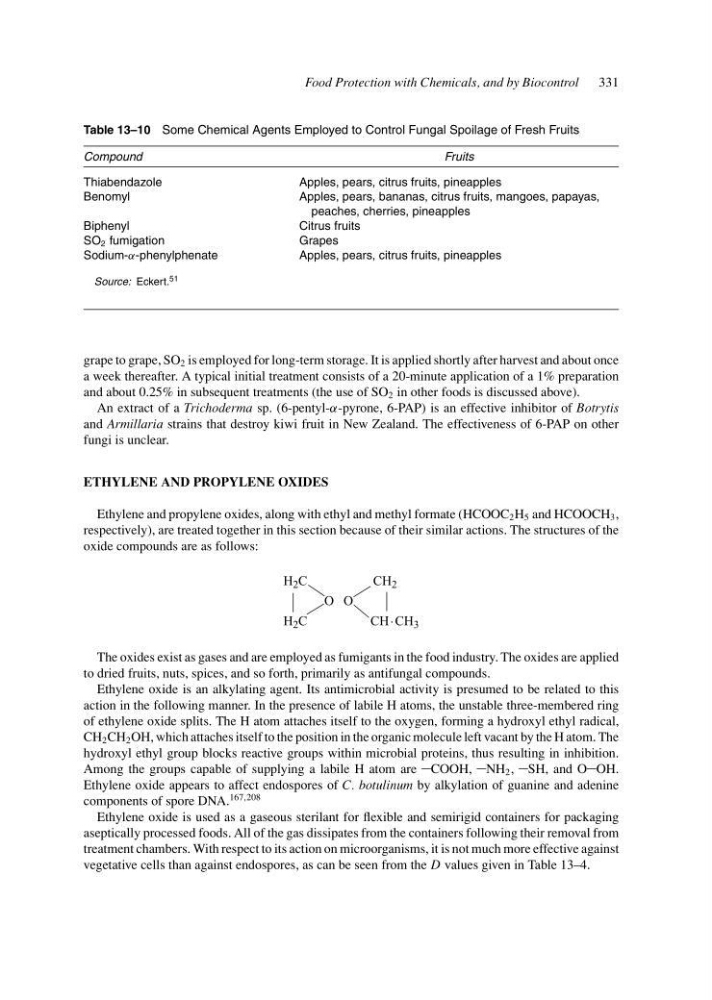
Table 13–10 Some Chemical Agents Employed to Control Fungal Spoilage of Fresh Fruits
Compound
Fruits
Thiabendazole
Apples, pears, citrus fruits, pineapples
Benomyl
Apples, pears, bananas, citrus fruits, mangoes, papayas,
peaches, cherries, pineapples
Biphenyl
Citrus fruits
SO 2 fumigation
Grapes
Sodium-α-phenylphenate
Apples, pears, citrus fruits, pineapples
Source: Eckert. 51
grape to grape, SO 2 is employed for long-term storage. It is applied shortly after harvest and about once
a week thereafter. A typical initial treatment consists of a 20-minute application of a 1% preparation
and about 0.25% in subsequent treatments (the use of SO 2 in other foods is discussed above).
An extract of a Trichoderma sp. (6-pentyl-α-pyrone, 6-PAP) is an effective inhibitor of Botrytis
and Armillaria strains that destroy kiwi fruit in New Zealand. The effectiveness of 6-PAP on other
fungi is unclear.
ETHYLENE AND PROPYLENE OXIDES
Ethylene and propylene oxides, along with ethyl and methyl formate (HCOOC 2 H 5 and HCOOCH 3 ,
respectively), are treated together in this section because of their similar actions. The structures of the
oxide compounds are as follows:
H 2 C
H 2 C
CH 2
CH . CH 3
O O
The oxides exist as gases and are employed as fumigants in the food industry. The oxides are applied
to dried fruits, nuts, spices, and so forth, primarily as antifungal compounds.
Ethylene oxide is an alkylating agent. Its antimicrobial activity is presumed to be related to this
action in the following manner. In the presence of labile H atoms, the unstable three-membered ring
of ethylene oxide splits. The H atom attaches itself to the oxygen, forming a hydroxyl ethyl radical,
CH 2 CH 2 OH, which attaches itself to the position in the organic molecule left vacant by the H atom. The
hydroxyl ethyl group blocks reactive groups within microbial proteins, thus resulting in inhibition.
Among the groups capable of supplying a labile H atom are COOH, NH 2 , SH, and O OH.
Ethylene oxide appears to affect endospores of C. botulinum by alkylation of guanine and adenine
components of spore DNA.
167,208
Ethylene oxide is used as a gaseous sterilant for flexible and semirigid containers for packaging
aseptically processed foods. All of the gas dissipates from the containers following their removal from
treatment chambers. With respect to its action on microorganisms, it is not much more effective against
vegetative cells than against endospores, as can be seen from the D values given in Table 13–4.
Table 13–10 Some Chemical Agents Employed to Control Fungal Spoilage of Fresh Fruits
Compound
Fruits
Thiabendazole
Apples, pears, citrus fruits, pineapples
Benomyl
Apples, pears, bananas, citrus fruits, mangoes, papayas,
peaches, cherries, pineapples
Biphenyl
Citrus fruits
SO 2 fumigation
Grapes
Sodium-α-phenylphenate
Apples, pears, citrus fruits, pineapples
Source: Eckert. 51
grape to grape, SO 2 is employed for long-term storage. It is applied shortly after harvest and about once
a week thereafter. A typical initial treatment consists of a 20-minute application of a 1% preparation
and about 0.25% in subsequent treatments (the use of SO 2 in other foods is discussed above).
An extract of a Trichoderma sp. (6-pentyl-α-pyrone, 6-PAP) is an effective inhibitor of Botrytis
and Armillaria strains that destroy kiwi fruit in New Zealand. The effectiveness of 6-PAP on other
fungi is unclear.
ETHYLENE AND PROPYLENE OXIDES
Ethylene and propylene oxides, along with ethyl and methyl formate (HCOOC 2 H 5 and HCOOCH 3 ,
respectively), are treated together in this section because of their similar actions. The structures of the
oxide compounds are as follows:
H 2 C
H 2 C
CH 2
CH . CH 3
O O
The oxides exist as gases and are employed as fumigants in the food industry. The oxides are applied
to dried fruits, nuts, spices, and so forth, primarily as antifungal compounds.
Ethylene oxide is an alkylating agent. Its antimicrobial activity is presumed to be related to this
action in the following manner. In the presence of labile H atoms, the unstable three-membered ring
of ethylene oxide splits. The H atom attaches itself to the oxygen, forming a hydroxyl ethyl radical,
CH 2 CH 2 OH, which attaches itself to the position in the organic molecule left vacant by the H atom. The
hydroxyl ethyl group blocks reactive groups within microbial proteins, thus resulting in inhibition.
Among the groups capable of supplying a labile H atom are COOH, NH 2 , SH, and O OH.
Ethylene oxide appears to affect endospores of C. botulinum by alkylation of guanine and adenine
components of spore DNA.
167,208
Ethylene oxide is used as a gaseous sterilant for flexible and semirigid containers for packaging
aseptically processed foods. All of the gas dissipates from the containers following their removal from
treatment chambers. With respect to its action on microorganisms, it is not much more effective against
vegetative cells than against endospores, as can be seen from the D values given in Table 13–4.