

Food Protection with Chemicals, and by Biocontrol 333
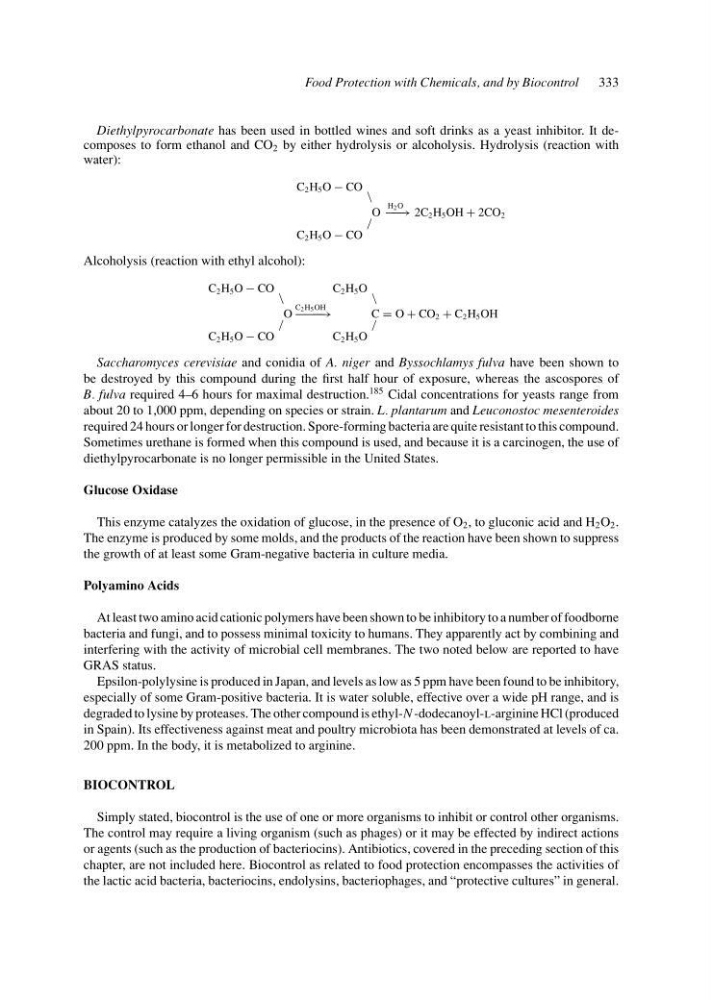
Diethylpyrocarbonate has been used in bottled wines and soft drinks as a yeast inhibitor. It decomposes to form ethanol and CO 2 by either hydrolysis or alcoholysis. Hydrolysis (reaction with
water):
C 2 H 5 O − CO \
O
H 2 O
−→ 2C 2 H 5 OH + 2CO 2
/
C 2 H 5 O − CO
Alcoholysis (reaction with ethyl alcohol):
C 2 H 5 O − CO
C 2 H 5 O
\
\
O
C 2 H 5 OH
−→
C = O + CO 2 + C 2 H 5 OH
/
/
C 2 H 5 O − CO
C 2 H 5 O
Saccharomyces cerevisiae and conidia of A. niger and Byssochlamys fulva have been shown to
be destroyed by this compound during the first half hour of exposure, whereas the ascospores of
B. fulva required 4–6 hours for maximal destruction.
185 Cidal concentrations for yeasts range from
about 20 to 1,000 ppm, depending on species or strain. L. plantarum and Leuconostoc mesenteroides
required 24 hours or longer for destruction. Spore-forming bacteria are quite resistant to this compound.
Sometimes urethane is formed when this compound is used, and because it is a carcinogen, the use of
diethylpyrocarbonate is no longer permissible in the United States.
Glucose Oxidase
This enzyme catalyzes the oxidation of glucose, in the presence of O 2 , to gluconic acid and H 2 O 2 .
The enzyme is produced by some molds, and the products of the reaction have been shown to suppress
the growth of at least some Gram-negative bacteria in culture media.
Polyamino Acids
At least two amino acid cationic polymers have been shown to be inhibitory to a number of foodborne
bacteria and fungi, and to possess minimal toxicity to humans. They apparently act by combining and
interfering with the activity of microbial cell membranes. The two noted below are reported to have
GRAS status.
Epsilon-polylysine is produced in Japan, and levels as low as 5 ppm have been found to be inhibitory,
especially of some Gram-positive bacteria. It is water soluble, effective over a wide pH range, and is
degraded to lysine by proteases. The other compound is ethyl-N -dodecanoyl-l-arginine HCl (produced
in Spain). Its effectiveness against meat and poultry microbiota has been demonstrated at levels of ca.
200 ppm. In the body, it is metabolized to arginine.
BIOCONTROL
Simply stated, biocontrol is the use of one or more organisms to inhibit or control other organisms.
The control may require a living organism (such as phages) or it may be effected by indirect actions
or agents (such as the production of bacteriocins). Antibiotics, covered in the preceding section of this
chapter, are not included here. Biocontrol as related to food protection encompasses the activities of
the lactic acid bacteria, bacteriocins, endolysins, bacteriophages, and “protective cultures” in general.
Diethylpyrocarbonate has been used in bottled wines and soft drinks as a yeast inhibitor. It decomposes to form ethanol and CO 2 by either hydrolysis or alcoholysis. Hydrolysis (reaction with
water):
C 2 H 5 O − CO \
O
H 2 O
−→ 2C 2 H 5 OH + 2CO 2
/
C 2 H 5 O − CO
Alcoholysis (reaction with ethyl alcohol):
C 2 H 5 O − CO
C 2 H 5 O
\
\
O
C 2 H 5 OH
−→
C = O + CO 2 + C 2 H 5 OH
/
/
C 2 H 5 O − CO
C 2 H 5 O
Saccharomyces cerevisiae and conidia of A. niger and Byssochlamys fulva have been shown to
be destroyed by this compound during the first half hour of exposure, whereas the ascospores of
B. fulva required 4–6 hours for maximal destruction.
185 Cidal concentrations for yeasts range from
about 20 to 1,000 ppm, depending on species or strain. L. plantarum and Leuconostoc mesenteroides
required 24 hours or longer for destruction. Spore-forming bacteria are quite resistant to this compound.
Sometimes urethane is formed when this compound is used, and because it is a carcinogen, the use of
diethylpyrocarbonate is no longer permissible in the United States.
Glucose Oxidase
This enzyme catalyzes the oxidation of glucose, in the presence of O 2 , to gluconic acid and H 2 O 2 .
The enzyme is produced by some molds, and the products of the reaction have been shown to suppress
the growth of at least some Gram-negative bacteria in culture media.
Polyamino Acids
At least two amino acid cationic polymers have been shown to be inhibitory to a number of foodborne
bacteria and fungi, and to possess minimal toxicity to humans. They apparently act by combining and
interfering with the activity of microbial cell membranes. The two noted below are reported to have
GRAS status.
Epsilon-polylysine is produced in Japan, and levels as low as 5 ppm have been found to be inhibitory,
especially of some Gram-positive bacteria. It is water soluble, effective over a wide pH range, and is
degraded to lysine by proteases. The other compound is ethyl-N -dodecanoyl-l-arginine HCl (produced
in Spain). Its effectiveness against meat and poultry microbiota has been demonstrated at levels of ca.
200 ppm. In the body, it is metabolized to arginine.
BIOCONTROL
Simply stated, biocontrol is the use of one or more organisms to inhibit or control other organisms.
The control may require a living organism (such as phages) or it may be effected by indirect actions
or agents (such as the production of bacteriocins). Antibiotics, covered in the preceding section of this
chapter, are not included here. Biocontrol as related to food protection encompasses the activities of
the lactic acid bacteria, bacteriocins, endolysins, bacteriophages, and “protective cultures” in general.