

318 Modern Food Microbiology
Table 13–6 The Relative Effectiveness of a 3-minute Exposure Time for Four
Sanitizers on the APC of Cantaloupes, Honeydew Melons, and Asparagus
(Summarized from Park and Beuchat
146 ). Numbers Represent log 10 cfu APC.
Treatments
Cantaloupes
Honeydew Melons
Asparagus
Water (control)
5.49
3.81
6.71
Chlorine, 200 ppm
4.73
3.48
6.35
Chlorine, 2,000 ppm
2.86
1.48
6.05
Ascid. Na chlorite (ASC), 850 ppm
3.48
2.14
6.14
ASC, 1,200 ppm
3.35
1.32
6.19
H 2 O 2 , 0.2%
4.53
3.40
6.58
H 2 O 2 , 1.0%
5.15
2.89
6.31
Tsunami™, 40 ppm
4.61
2.44
6.51
Tsunami™, 80 ppm
4.87
3.13
6.49
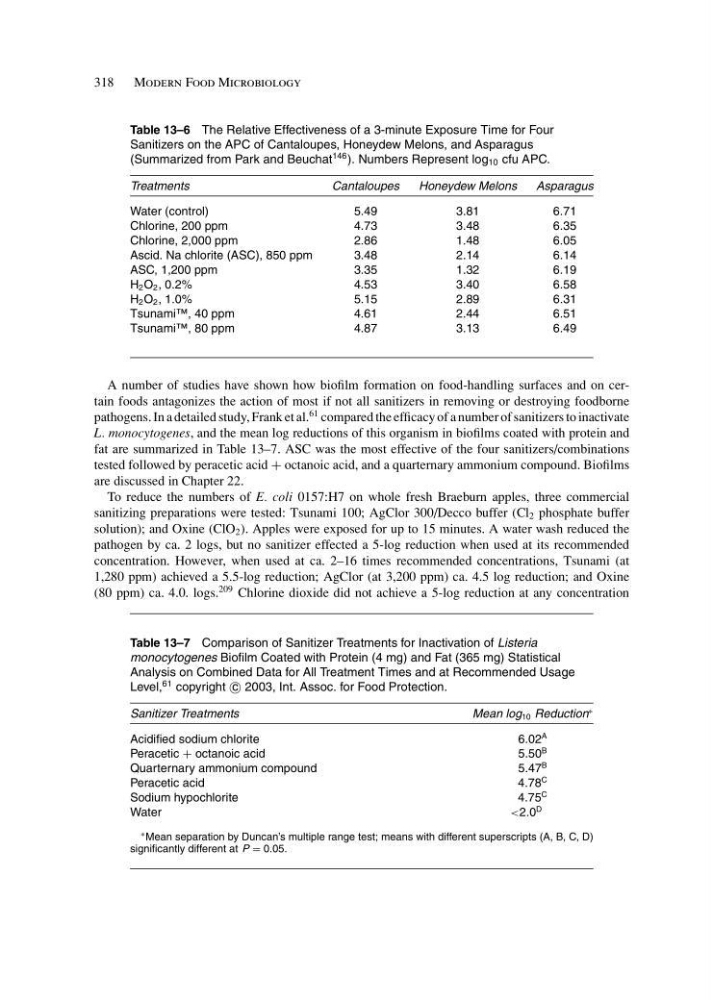
A number of studies have shown how biofilm formation on food-handling surfaces and on certain foods antagonizes the action of most if not all sanitizers in removing or destroying foodborne
pathogens. In a detailed study, Frank et al.
61 compared the efficacy of a number of sanitizers to inactivate
L. monocytogenes, and the mean log reductions of this organism in biofilms coated with protein and
fat are summarized in Table 13–7. ASC was the most effective of the four sanitizers/combinations
tested followed by peracetic acid + octanoic acid, and a quarternary ammonium compound. Biofilms
are discussed in Chapter 22.
To reduce the numbers of E. coli 0157:H7 on whole fresh Braeburn apples, three commercial
sanitizing preparations were tested: Tsunami 100; AgClor 300/Decco buffer (Cl 2 phosphate buffer
solution); and Oxine (ClO 2 ). Apples were exposed for up to 15 minutes. A water wash reduced the
pathogen by ca. 2 logs, but no sanitizer effected a 5-log reduction when used at its recommended
concentration. However, when used at ca. 2–16 times recommended concentrations, Tsunami (at
1,280 ppm) achieved a 5.5-log reduction; AgClor (at 3,200 ppm) ca. 4.5 log reduction; and Oxine
(80 ppm) ca. 4.0. logs.
209 Chlorine dioxide did not achieve a 5-log reduction at any concentration
Table 13–7 Comparison of Sanitizer Treatments for Inactivation of Listeria
monocytogenes Biofilm Coated with Protein (4 mg) and Fat (365 mg) Statistical
Analysis on Combined Data for All Treatment Times and at Recommended Usage
Level,
61 copyright c
2003, Int. Assoc. for Food Protection.
Sanitizer Treatments
Mean log 10 Reduction
∗
Acidified sodium chlorite
6.02
A
Peracetic + octanoic acid
5.50
B
Quarternary ammonium compound
5.47
B
Peracetic acid
4.78
C
Sodium hypochlorite
4.75
C
Water
<2.0
D
∗ Mean separation by Duncan’s multiple range test; means with different superscripts (A, B, C, D)
significantly different at P = 0.05.
Table 13–6 The Relative Effectiveness of a 3-minute Exposure Time for Four
Sanitizers on the APC of Cantaloupes, Honeydew Melons, and Asparagus
(Summarized from Park and Beuchat
146 ). Numbers Represent log 10 cfu APC.
Treatments
Cantaloupes
Honeydew Melons
Asparagus
Water (control)
5.49
3.81
6.71
Chlorine, 200 ppm
4.73
3.48
6.35
Chlorine, 2,000 ppm
2.86
1.48
6.05
Ascid. Na chlorite (ASC), 850 ppm
3.48
2.14
6.14
ASC, 1,200 ppm
3.35
1.32
6.19
H 2 O 2 , 0.2%
4.53
3.40
6.58
H 2 O 2 , 1.0%
5.15
2.89
6.31
Tsunami™, 40 ppm
4.61
2.44
6.51
Tsunami™, 80 ppm
4.87
3.13
6.49
A number of studies have shown how biofilm formation on food-handling surfaces and on certain foods antagonizes the action of most if not all sanitizers in removing or destroying foodborne
pathogens. In a detailed study, Frank et al.
61 compared the efficacy of a number of sanitizers to inactivate
L. monocytogenes, and the mean log reductions of this organism in biofilms coated with protein and
fat are summarized in Table 13–7. ASC was the most effective of the four sanitizers/combinations
tested followed by peracetic acid + octanoic acid, and a quarternary ammonium compound. Biofilms
are discussed in Chapter 22.
To reduce the numbers of E. coli 0157:H7 on whole fresh Braeburn apples, three commercial
sanitizing preparations were tested: Tsunami 100; AgClor 300/Decco buffer (Cl 2 phosphate buffer
solution); and Oxine (ClO 2 ). Apples were exposed for up to 15 minutes. A water wash reduced the
pathogen by ca. 2 logs, but no sanitizer effected a 5-log reduction when used at its recommended
concentration. However, when used at ca. 2–16 times recommended concentrations, Tsunami (at
1,280 ppm) achieved a 5.5-log reduction; AgClor (at 3,200 ppm) ca. 4.5 log reduction; and Oxine
(80 ppm) ca. 4.0. logs.
209 Chlorine dioxide did not achieve a 5-log reduction at any concentration
Table 13–7 Comparison of Sanitizer Treatments for Inactivation of Listeria
monocytogenes Biofilm Coated with Protein (4 mg) and Fat (365 mg) Statistical
Analysis on Combined Data for All Treatment Times and at Recommended Usage
Level,
61 copyright c
2003, Int. Assoc. for Food Protection.
Sanitizer Treatments
Mean log 10 Reduction
∗
Acidified sodium chlorite
6.02
A
Peracetic + octanoic acid
5.50
B
Quarternary ammonium compound
5.47
B
Peracetic acid
4.78
C
Sodium hypochlorite
4.75
C
Water
<2.0
D
∗ Mean separation by Duncan’s multiple range test; means with different superscripts (A, B, C, D)
significantly different at P = 0.05.