

Food Protection with Chemicals, and by Biocontrol 317
When 5% H 2 O 2 was employed on apples inoculated with a nonpathogenic E. coli strain, it was
found to be only marginally effective due to attachment of the organism to inaccessible sites, and its
survival and growth in punctures.
169 The life of this compound on fresh produce may be expected to be
shortened by the presence of catalase in the produce. For a review of its use on fruits and vegetables,
see reference 168.
In regard to Cryptosporidium parvum in apple cider, orange juice, and grape juice, 0.025% reduced
infectivity by >5 logs as assessed by using a human ileocecal cell line.
110 Malic, citric, and tartaric
acids at 1–5% inhibited the protozoan by up to 88%. The treatment of lettuce leaves with 2% H 2 O 2 at
50
◦ C for 60 sec effected a ≤4-log reduction of E. coli 0157:H7 and a 3-log reduction of S. Enteritidis
without affecting sensory quality.
117
Chlorine and Other Agents
Chlorine (Cl 2 ) does not exist in this state in nature but rather in one of many combined forms such
as calcium chloride (CaCl 2 ). However, Cl 2 is the form that is needed for sanitizing purposes, and it is
supplied from compounds such as sodium chlorite (ClNaO 2 ), sodium hypochlorite (ClNaO), chlorine
dioxide (ClO 2 ), and others. It is similar in some ways to O 3 and H 2 O 2 since they, too, are strong
oxidants but not as strong as ozone. However, in contrast to Cl 2 and O 3 , H 2 O 2 affects DNA. Chlorine
is widely used to sanitize drinking and swimming pool waters, and it has a long history of use as a
sanitizing agent on food contact surfaces, work surfaces, and floor drains.
Among the other agents tested as potential food sanitizers are cetylpyridinium chloride; hydrogen
peroxide; quarternary ammonium compounds (various); peracetic (peroxyacetic) acid; Fit (an alkaline
produce wash product that contains seven GRAS ingredients); Tsunami
TM (solution of peroxyacetic
acid); Avgard
TM (contains phosphate); and calcinated calcium (natural product of oyster shells that are
ground, and the pearl layer treated electrically with ohmic heating at 220 V for 10–50 minutes). Shells
are crushed into a powder and used as a food supplement in Japan.
11 Summaries of the comparative
effects of some of these agents as food sanitizers are presented in the next three tables.
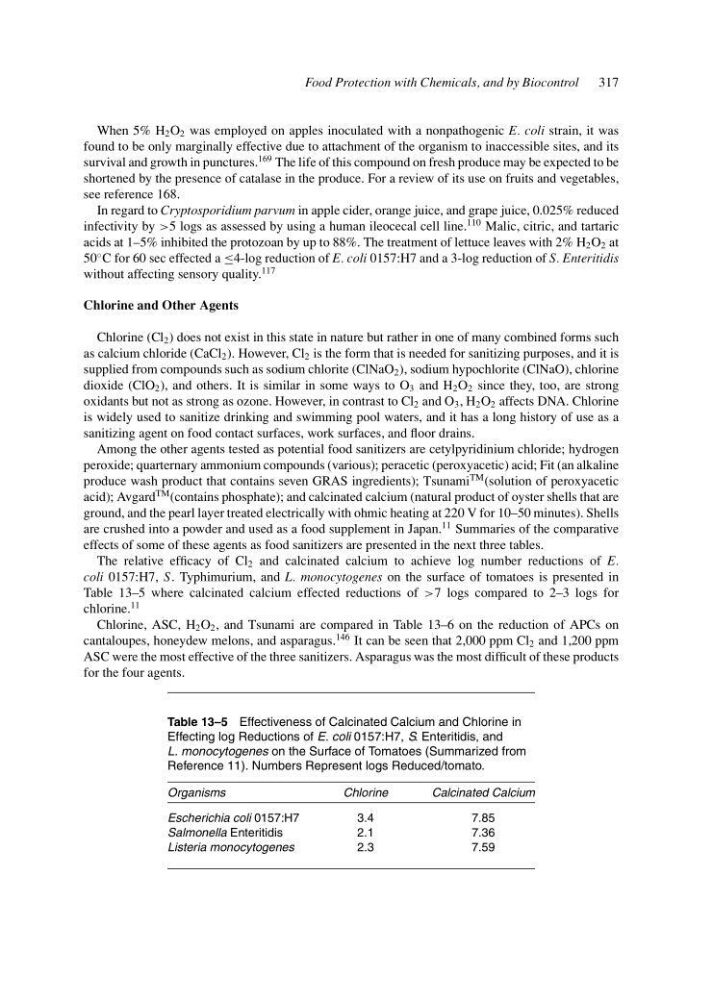
The relative efficacy of Cl 2 and calcinated calcium to achieve log number reductions of E.
coli 0157:H7, S. Typhimurium, and L. monocytogenes on the surface of tomatoes is presented in
Table 13–5 where calcinated calcium effected reductions of >7 logs compared to 2–3 logs for
chlorine.
11
Chlorine, ASC, H 2 O 2 , and Tsunami are compared in Table 13–6 on the reduction of APCs on
cantaloupes, honeydew melons, and asparagus.
146 It can be seen that 2,000 ppm Cl 2 and 1,200 ppm
ASC were the most effective of the three sanitizers. Asparagus was the most difficult of these products
for the four agents.
Table 13–5 Effectiveness of Calcinated Calcium and Chlorine in
Effecting log Reductions of E. coli 0157:H7, S. Enteritidis, and
L. monocytogenes on the Surface of Tomatoes (Summarized from
Reference 11). Numbers Represent logs Reduced/tomato.
Organisms
Chlorine
Calcinated Calcium
Escherichia coli 0157:H7
3.4
7.85
Salmonella Enteritidis
2.1
7.36
Listeria monocytogenes
2.3
7.59
When 5% H 2 O 2 was employed on apples inoculated with a nonpathogenic E. coli strain, it was
found to be only marginally effective due to attachment of the organism to inaccessible sites, and its
survival and growth in punctures.
169 The life of this compound on fresh produce may be expected to be
shortened by the presence of catalase in the produce. For a review of its use on fruits and vegetables,
see reference 168.
In regard to Cryptosporidium parvum in apple cider, orange juice, and grape juice, 0.025% reduced
infectivity by >5 logs as assessed by using a human ileocecal cell line.
110 Malic, citric, and tartaric
acids at 1–5% inhibited the protozoan by up to 88%. The treatment of lettuce leaves with 2% H 2 O 2 at
50
◦ C for 60 sec effected a ≤4-log reduction of E. coli 0157:H7 and a 3-log reduction of S. Enteritidis
without affecting sensory quality.
117
Chlorine and Other Agents
Chlorine (Cl 2 ) does not exist in this state in nature but rather in one of many combined forms such
as calcium chloride (CaCl 2 ). However, Cl 2 is the form that is needed for sanitizing purposes, and it is
supplied from compounds such as sodium chlorite (ClNaO 2 ), sodium hypochlorite (ClNaO), chlorine
dioxide (ClO 2 ), and others. It is similar in some ways to O 3 and H 2 O 2 since they, too, are strong
oxidants but not as strong as ozone. However, in contrast to Cl 2 and O 3 , H 2 O 2 affects DNA. Chlorine
is widely used to sanitize drinking and swimming pool waters, and it has a long history of use as a
sanitizing agent on food contact surfaces, work surfaces, and floor drains.
Among the other agents tested as potential food sanitizers are cetylpyridinium chloride; hydrogen
peroxide; quarternary ammonium compounds (various); peracetic (peroxyacetic) acid; Fit (an alkaline
produce wash product that contains seven GRAS ingredients); Tsunami
TM (solution of peroxyacetic
acid); Avgard
TM (contains phosphate); and calcinated calcium (natural product of oyster shells that are
ground, and the pearl layer treated electrically with ohmic heating at 220 V for 10–50 minutes). Shells
are crushed into a powder and used as a food supplement in Japan.
11 Summaries of the comparative
effects of some of these agents as food sanitizers are presented in the next three tables.
The relative efficacy of Cl 2 and calcinated calcium to achieve log number reductions of E.
coli 0157:H7, S. Typhimurium, and L. monocytogenes on the surface of tomatoes is presented in
Table 13–5 where calcinated calcium effected reductions of >7 logs compared to 2–3 logs for
chlorine.
11
Chlorine, ASC, H 2 O 2 , and Tsunami are compared in Table 13–6 on the reduction of APCs on
cantaloupes, honeydew melons, and asparagus.
146 It can be seen that 2,000 ppm Cl 2 and 1,200 ppm
ASC were the most effective of the three sanitizers. Asparagus was the most difficult of these products
for the four agents.
Table 13–5 Effectiveness of Calcinated Calcium and Chlorine in
Effecting log Reductions of E. coli 0157:H7, S. Enteritidis, and
L. monocytogenes on the Surface of Tomatoes (Summarized from
Reference 11). Numbers Represent logs Reduced/tomato.
Organisms
Chlorine
Calcinated Calcium
Escherichia coli 0157:H7
3.4
7.85
Salmonella Enteritidis
2.1
7.36
Listeria monocytogenes
2.3
7.59