

Food Protection with Chemicals, and by Biocontrol 319
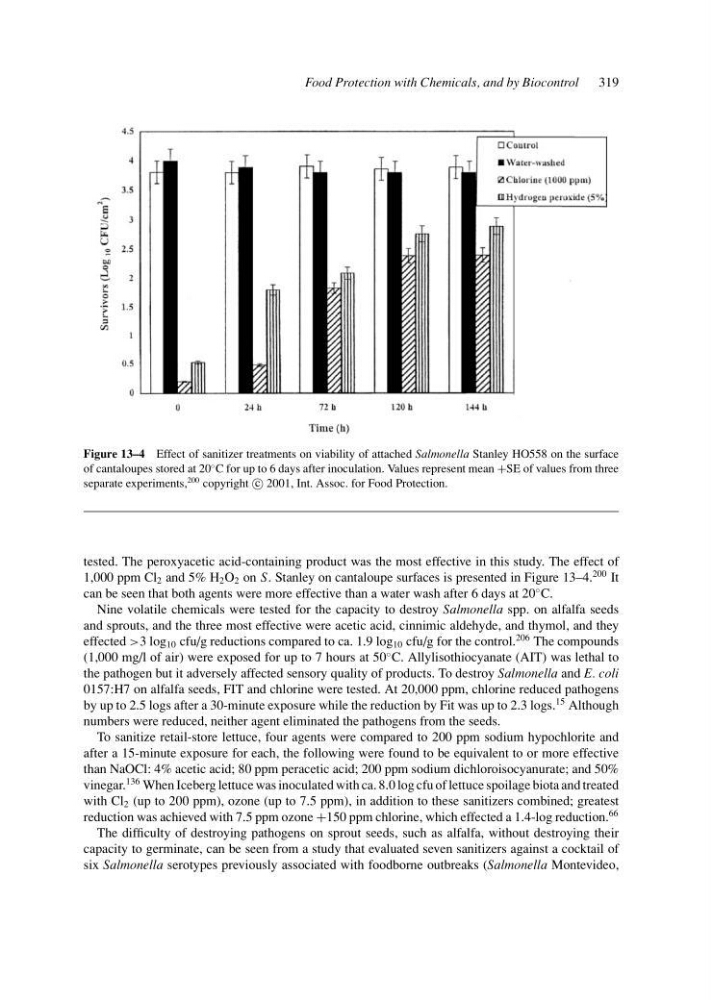
Figure 13–4 Effect of sanitizer treatments on viability of attached Salmonella Stanley HO558 on the surface
of cantaloupes stored at 20
◦ C for up to 6 days after inoculation. Values represent mean +SE of values from three
separate experiments,
200 copyright c
2001, Int. Assoc. for Food Protection.
tested. The peroxyacetic acid-containing product was the most effective in this study. The effect of
1,000 ppm Cl 2 and 5% H 2 O 2 on S. Stanley on cantaloupe surfaces is presented in Figure 13–4.
200 It
can be seen that both agents were more effective than a water wash after 6 days at 20
◦ C.
Nine volatile chemicals were tested for the capacity to destroy Salmonella spp. on alfalfa seeds
and sprouts, and the three most effective were acetic acid, cinnimic aldehyde, and thymol, and they
effected >3 log 10 cfu/g reductions compared to ca. 1.9 log 10 cfu/g for the control.
206 The compounds
(1,000 mg/l of air) were exposed for up to 7 hours at 50
◦ C. Allylisothiocyanate (AIT) was lethal to
the pathogen but it adversely affected sensory quality of products. To destroy Salmonella and E. coli
0157:H7 on alfalfa seeds, FIT and chlorine were tested. At 20,000 ppm, chlorine reduced pathogens
by up to 2.5 logs after a 30-minute exposure while the reduction by Fit was up to 2.3 logs.
15 Although
numbers were reduced, neither agent eliminated the pathogens from the seeds.
To sanitize retail-store lettuce, four agents were compared to 200 ppm sodium hypochlorite and
after a 15-minute exposure for each, the following were found to be equivalent to or more effective
than NaOCl: 4% acetic acid; 80 ppm peracetic acid; 200 ppm sodium dichloroisocyanurate; and 50%
vinegar.
136 When Iceberg lettuce was inoculated with ca. 8.0 log cfu of lettuce spoilage biota and treated
with Cl 2 (up to 200 ppm), ozone (up to 7.5 ppm), in addition to these sanitizers combined; greatest
reduction was achieved with 7.5 ppm ozone +150 ppm chlorine, which effected a 1.4-log reduction.
66
The difficulty of destroying pathogens on sprout seeds, such as alfalfa, without destroying their
capacity to germinate, can be seen from a study that evaluated seven sanitizers against a cocktail of
six Salmonella serotypes previously associated with foodborne outbreaks (Salmonella Montevideo,
Figure 13–4 Effect of sanitizer treatments on viability of attached Salmonella Stanley HO558 on the surface
of cantaloupes stored at 20
◦ C for up to 6 days after inoculation. Values represent mean +SE of values from three
separate experiments,
200 copyright c
2001, Int. Assoc. for Food Protection.
tested. The peroxyacetic acid-containing product was the most effective in this study. The effect of
1,000 ppm Cl 2 and 5% H 2 O 2 on S. Stanley on cantaloupe surfaces is presented in Figure 13–4.
200 It
can be seen that both agents were more effective than a water wash after 6 days at 20
◦ C.
Nine volatile chemicals were tested for the capacity to destroy Salmonella spp. on alfalfa seeds
and sprouts, and the three most effective were acetic acid, cinnimic aldehyde, and thymol, and they
effected >3 log 10 cfu/g reductions compared to ca. 1.9 log 10 cfu/g for the control.
206 The compounds
(1,000 mg/l of air) were exposed for up to 7 hours at 50
◦ C. Allylisothiocyanate (AIT) was lethal to
the pathogen but it adversely affected sensory quality of products. To destroy Salmonella and E. coli
0157:H7 on alfalfa seeds, FIT and chlorine were tested. At 20,000 ppm, chlorine reduced pathogens
by up to 2.5 logs after a 30-minute exposure while the reduction by Fit was up to 2.3 logs.
15 Although
numbers were reduced, neither agent eliminated the pathogens from the seeds.
To sanitize retail-store lettuce, four agents were compared to 200 ppm sodium hypochlorite and
after a 15-minute exposure for each, the following were found to be equivalent to or more effective
than NaOCl: 4% acetic acid; 80 ppm peracetic acid; 200 ppm sodium dichloroisocyanurate; and 50%
vinegar.
136 When Iceberg lettuce was inoculated with ca. 8.0 log cfu of lettuce spoilage biota and treated
with Cl 2 (up to 200 ppm), ozone (up to 7.5 ppm), in addition to these sanitizers combined; greatest
reduction was achieved with 7.5 ppm ozone +150 ppm chlorine, which effected a 1.4-log reduction.
66
The difficulty of destroying pathogens on sprout seeds, such as alfalfa, without destroying their
capacity to germinate, can be seen from a study that evaluated seven sanitizers against a cocktail of
six Salmonella serotypes previously associated with foodborne outbreaks (Salmonella Montevideo,