

Milk, Fermentation, and Fermented and Nonfermented Dairy Products 155
heterolactics, on the other hand, have phosphoketolase but do not possess aldolase and hexose isomerase, and instead of the EMP pathway for glucose degradation, these organisms use the hexose
monophosphate or pentose pathway (Figure 7–1(B)).
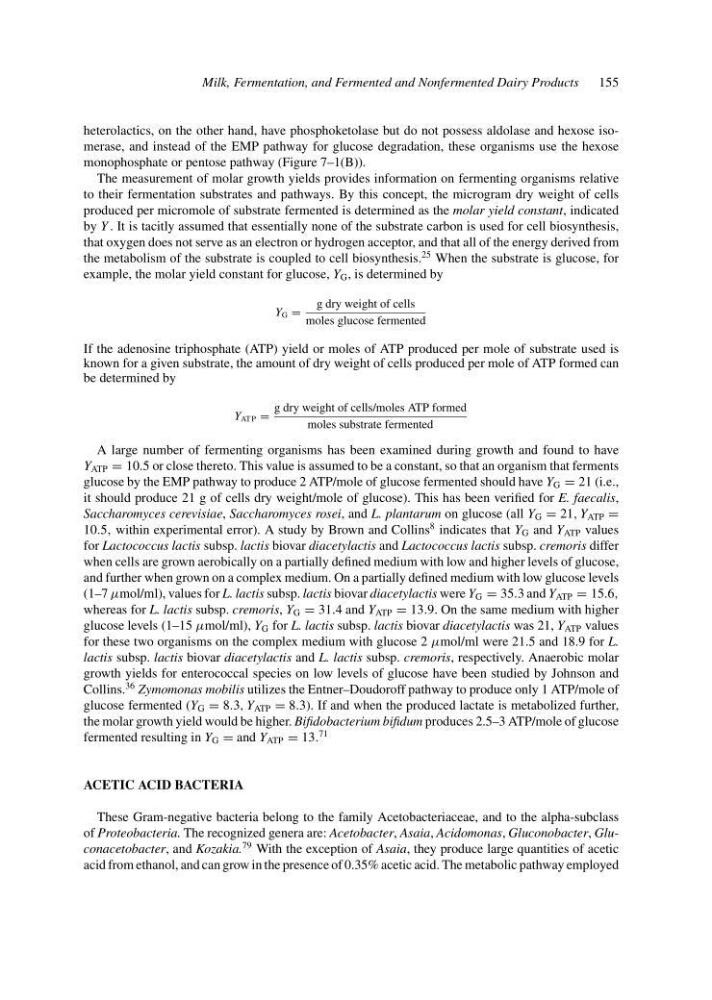
The measurement of molar growth yields provides information on fermenting organisms relative
to their fermentation substrates and pathways. By this concept, the microgram dry weight of cells
produced per micromole of substrate fermented is determined as the molar yield constant, indicated
by Y . It is tacitly assumed that essentially none of the substrate carbon is used for cell biosynthesis,
that oxygen does not serve as an electron or hydrogen acceptor, and that all of the energy derived from
the metabolism of the substrate is coupled to cell biosynthesis.
25 When the substrate is glucose, for
example, the molar yield constant for glucose, Y G , is determined by
Y G =
g dry weight of cells
moles glucose fermented
If the adenosine triphosphate (ATP) yield or moles of ATP produced per mole of substrate used is
known for a given substrate, the amount of dry weight of cells produced per mole of ATP formed can
be determined by
Y AT P =
g dry weight of cells/moles ATP formed
moles substrate fermented
A large number of fermenting organisms has been examined during growth and found to have
Y ATP = 10.5 or close thereto. This value is assumed to be a constant, so that an organism that ferments
glucose by the EMP pathway to produce 2 ATP/mole of glucose fermented should have Y G = 21 (i.e.,
it should produce 21 g of cells dry weight/mole of glucose). This has been verified for E. faecalis,
Saccharomyces cerevisiae, Saccharomyces rosei, and L. plantarum on glucose (all Y G = 21, Y ATP =
10.5, within experimental error). A study by Brown and Collins
8 indicates that Y G and Y ATP values
for Lactococcus lactis subsp. lactis biovar diacetylactis and Lactococcus lactis subsp. cremoris differ
when cells are grown aerobically on a partially defined medium with low and higher levels of glucose,
and further when grown on a complex medium. On a partially defined medium with low glucose levels
(1–7 µmol/ml), values for L. lactis subsp. lactis biovar diacetylactis were Y G = 35.3 and Y ATP = 15.6,
whereas for L. lactis subsp. cremoris, Y G = 31.4 and Y ATP = 13.9. On the same medium with higher
glucose levels (1–15 µmol/ml), Y G for L. lactis subsp. lactis biovar diacetylactis was 21, Y ATP values
for these two organisms on the complex medium with glucose 2 µmol/ml were 21.5 and 18.9 for L.
lactis subsp. lactis biovar diacetylactis and L. lactis subsp. cremoris, respectively. Anaerobic molar
growth yields for enterococcal species on low levels of glucose have been studied by Johnson and
Collins.
36 Zymomonas mobilis utilizes the Entner–Doudoroff pathway to produce only 1 ATP/mole of
glucose fermented (Y G = 8.3, Y ATP = 8.3). If and when the produced lactate is metabolized further,
the molar growth yield would be higher. Bifidobacterium bifidum produces 2.5–3 ATP/mole of glucose
fermented resulting in Y G = and Y ATP = 13.
71
ACETIC ACID BACTERIA
These Gram-negative bacteria belong to the family Acetobacteriaceae, and to the alpha-subclass
of Proteobacteria. The recognized genera are: Acetobacter, Asaia, Acidomonas, Gluconobacter, Gluconacetobacter, and Kozakia.
79 With the exception of Asaia, they produce large quantities of acetic
acid from ethanol, and can grow in the presence of 0.35% acetic acid. The metabolic pathway employed
heterolactics, on the other hand, have phosphoketolase but do not possess aldolase and hexose isomerase, and instead of the EMP pathway for glucose degradation, these organisms use the hexose
monophosphate or pentose pathway (Figure 7–1(B)).
The measurement of molar growth yields provides information on fermenting organisms relative
to their fermentation substrates and pathways. By this concept, the microgram dry weight of cells
produced per micromole of substrate fermented is determined as the molar yield constant, indicated
by Y . It is tacitly assumed that essentially none of the substrate carbon is used for cell biosynthesis,
that oxygen does not serve as an electron or hydrogen acceptor, and that all of the energy derived from
the metabolism of the substrate is coupled to cell biosynthesis.
25 When the substrate is glucose, for
example, the molar yield constant for glucose, Y G , is determined by
Y G =
g dry weight of cells
moles glucose fermented
If the adenosine triphosphate (ATP) yield or moles of ATP produced per mole of substrate used is
known for a given substrate, the amount of dry weight of cells produced per mole of ATP formed can
be determined by
Y AT P =
g dry weight of cells/moles ATP formed
moles substrate fermented
A large number of fermenting organisms has been examined during growth and found to have
Y ATP = 10.5 or close thereto. This value is assumed to be a constant, so that an organism that ferments
glucose by the EMP pathway to produce 2 ATP/mole of glucose fermented should have Y G = 21 (i.e.,
it should produce 21 g of cells dry weight/mole of glucose). This has been verified for E. faecalis,
Saccharomyces cerevisiae, Saccharomyces rosei, and L. plantarum on glucose (all Y G = 21, Y ATP =
10.5, within experimental error). A study by Brown and Collins
8 indicates that Y G and Y ATP values
for Lactococcus lactis subsp. lactis biovar diacetylactis and Lactococcus lactis subsp. cremoris differ
when cells are grown aerobically on a partially defined medium with low and higher levels of glucose,
and further when grown on a complex medium. On a partially defined medium with low glucose levels
(1–7 µmol/ml), values for L. lactis subsp. lactis biovar diacetylactis were Y G = 35.3 and Y ATP = 15.6,
whereas for L. lactis subsp. cremoris, Y G = 31.4 and Y ATP = 13.9. On the same medium with higher
glucose levels (1–15 µmol/ml), Y G for L. lactis subsp. lactis biovar diacetylactis was 21, Y ATP values
for these two organisms on the complex medium with glucose 2 µmol/ml were 21.5 and 18.9 for L.
lactis subsp. lactis biovar diacetylactis and L. lactis subsp. cremoris, respectively. Anaerobic molar
growth yields for enterococcal species on low levels of glucose have been studied by Johnson and
Collins.
36 Zymomonas mobilis utilizes the Entner–Doudoroff pathway to produce only 1 ATP/mole of
glucose fermented (Y G = 8.3, Y ATP = 8.3). If and when the produced lactate is metabolized further,
the molar growth yield would be higher. Bifidobacterium bifidum produces 2.5–3 ATP/mole of glucose
fermented resulting in Y G = and Y ATP = 13.
71
ACETIC ACID BACTERIA
These Gram-negative bacteria belong to the family Acetobacteriaceae, and to the alpha-subclass
of Proteobacteria. The recognized genera are: Acetobacter, Asaia, Acidomonas, Gluconobacter, Gluconacetobacter, and Kozakia.
79 With the exception of Asaia, they produce large quantities of acetic
acid from ethanol, and can grow in the presence of 0.35% acetic acid. The metabolic pathway employed