

156 Modern Food Microbiology
by the acetic acid producing strains is shown in Figure 7–1(F) and (G). Asaia, on the other hand, produces little or no acetic acid from ethanol, and its species do not grow in the presence of 0.35% acetic
acid.
79 The three recognized species oxidize acetate and lactate to CO 2 and water.
DAIRY PRODUCTS
Milk
Milk is used throughout the world as a human food in at least one form, and from at least one
of a number of different mammals. Bovine milk is typical of other milk types and it is the basis of
the discussion that follows. Many of the aspects of milk microbiology not covered below have been
presented or reviewed by Frank
17 and Murphy and Boor.
50
Composition
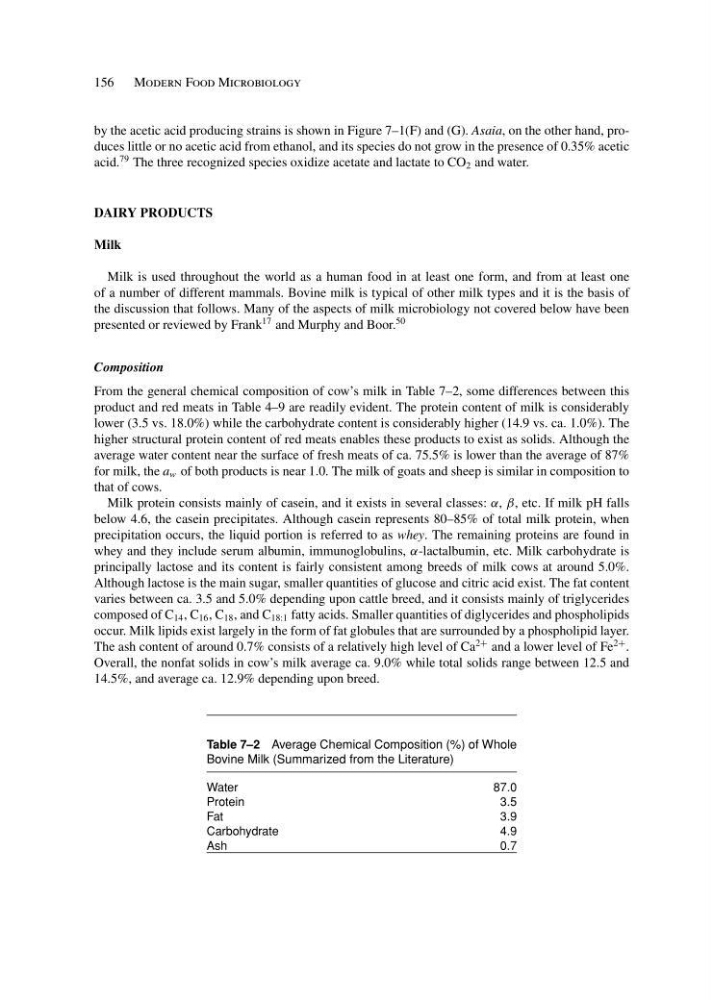
From the general chemical composition of cow’s milk in Table 7–2, some differences between this
product and red meats in Table 4–9 are readily evident. The protein content of milk is considerably
lower (3.5 vs. 18.0%) while the carbohydrate content is considerably higher (14.9 vs. ca. 1.0%). The
higher structural protein content of red meats enables these products to exist as solids. Although the
average water content near the surface of fresh meats of ca. 75.5% is lower than the average of 87%
for milk, the a w of both products is near 1.0. The milk of goats and sheep is similar in composition to
that of cows.
Milk protein consists mainly of casein, and it exists in several classes: α, β, etc. If milk pH falls
below 4.6, the casein precipitates. Although casein represents 80–85% of total milk protein, when
precipitation occurs, the liquid portion is referred to as whey. The remaining proteins are found in
whey and they include serum albumin, immunoglobulins, α-lactalbumin, etc. Milk carbohydrate is
principally lactose and its content is fairly consistent among breeds of milk cows at around 5.0%.
Although lactose is the main sugar, smaller quantities of glucose and citric acid exist. The fat content
varies between ca. 3.5 and 5.0% depending upon cattle breed, and it consists mainly of triglycerides
composed of C 14 , C 16 , C 18 , and C 18:1 fatty acids. Smaller quantities of diglycerides and phospholipids
occur. Milk lipids exist largely in the form of fat globules that are surrounded by a phospholipid layer.
The ash content of around 0.7% consists of a relatively high level of Ca
2+ and a lower level of Fe
2+ .
Overall, the nonfat solids in cow’s milk average ca. 9.0% while total solids range between 12.5 and
14.5%, and average ca. 12.9% depending upon breed.
Table 7–2 Average Chemical Composition (%) of Whole
Bovine Milk (Summarized from the Literature)
Water
87.0
Protein
3.5
Fat
3.9
Carbohydrate
4.9
Ash
0.7
by the acetic acid producing strains is shown in Figure 7–1(F) and (G). Asaia, on the other hand, produces little or no acetic acid from ethanol, and its species do not grow in the presence of 0.35% acetic
acid.
79 The three recognized species oxidize acetate and lactate to CO 2 and water.
DAIRY PRODUCTS
Milk
Milk is used throughout the world as a human food in at least one form, and from at least one
of a number of different mammals. Bovine milk is typical of other milk types and it is the basis of
the discussion that follows. Many of the aspects of milk microbiology not covered below have been
presented or reviewed by Frank
17 and Murphy and Boor.
50
Composition
From the general chemical composition of cow’s milk in Table 7–2, some differences between this
product and red meats in Table 4–9 are readily evident. The protein content of milk is considerably
lower (3.5 vs. 18.0%) while the carbohydrate content is considerably higher (14.9 vs. ca. 1.0%). The
higher structural protein content of red meats enables these products to exist as solids. Although the
average water content near the surface of fresh meats of ca. 75.5% is lower than the average of 87%
for milk, the a w of both products is near 1.0. The milk of goats and sheep is similar in composition to
that of cows.
Milk protein consists mainly of casein, and it exists in several classes: α, β, etc. If milk pH falls
below 4.6, the casein precipitates. Although casein represents 80–85% of total milk protein, when
precipitation occurs, the liquid portion is referred to as whey. The remaining proteins are found in
whey and they include serum albumin, immunoglobulins, α-lactalbumin, etc. Milk carbohydrate is
principally lactose and its content is fairly consistent among breeds of milk cows at around 5.0%.
Although lactose is the main sugar, smaller quantities of glucose and citric acid exist. The fat content
varies between ca. 3.5 and 5.0% depending upon cattle breed, and it consists mainly of triglycerides
composed of C 14 , C 16 , C 18 , and C 18:1 fatty acids. Smaller quantities of diglycerides and phospholipids
occur. Milk lipids exist largely in the form of fat globules that are surrounded by a phospholipid layer.
The ash content of around 0.7% consists of a relatively high level of Ca
2+ and a lower level of Fe
2+ .
Overall, the nonfat solids in cow’s milk average ca. 9.0% while total solids range between 12.5 and
14.5%, and average ca. 12.9% depending upon breed.
Table 7–2 Average Chemical Composition (%) of Whole
Bovine Milk (Summarized from the Literature)
Water
87.0
Protein
3.5
Fat
3.9
Carbohydrate
4.9
Ash
0.7