

154 Modern Food Microbiology
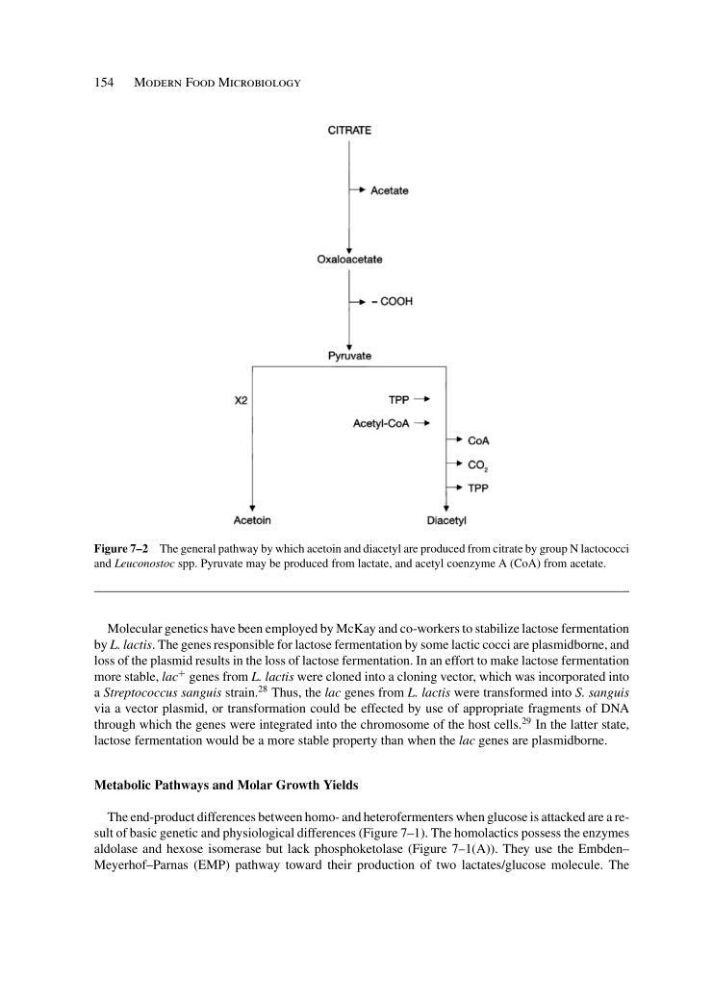
Figure 7–2 The general pathway by which acetoin and diacetyl are produced from citrate by group N lactococci
and Leuconostoc spp. Pyruvate may be produced from lactate, and acetyl coenzyme A (CoA) from acetate.
Molecular genetics have been employed by McKay and co-workers to stabilize lactose fermentation
by L. lactis. The genes responsible for lactose fermentation by some lactic cocci are plasmidborne, and
loss of the plasmid results in the loss of lactose fermentation. In an effort to make lactose fermentation
more stable, lac
+ genes from L. lactis were cloned into a cloning vector, which was incorporated into
a Streptococcus sanguis strain.
28 Thus, the lac genes from L. lactis were transformed into S. sanguis
via a vector plasmid, or transformation could be effected by use of appropriate fragments of DNA
through which the genes were integrated into the chromosome of the host cells.
29 In the latter state,
lactose fermentation would be a more stable property than when the lac genes are plasmidborne.
Metabolic Pathways and Molar Growth Yields
The end-product differences between homo- and heterofermenters when glucose is attacked are a result of basic genetic and physiological differences (Figure 7–1). The homolactics possess the enzymes
aldolase and hexose isomerase but lack phosphoketolase (Figure 7–1(A)). They use the Embden–
Meyerhof–Parnas (EMP) pathway toward their production of two lactates/glucose molecule. The
Figure 7–2 The general pathway by which acetoin and diacetyl are produced from citrate by group N lactococci
and Leuconostoc spp. Pyruvate may be produced from lactate, and acetyl coenzyme A (CoA) from acetate.
Molecular genetics have been employed by McKay and co-workers to stabilize lactose fermentation
by L. lactis. The genes responsible for lactose fermentation by some lactic cocci are plasmidborne, and
loss of the plasmid results in the loss of lactose fermentation. In an effort to make lactose fermentation
more stable, lac
+ genes from L. lactis were cloned into a cloning vector, which was incorporated into
a Streptococcus sanguis strain.
28 Thus, the lac genes from L. lactis were transformed into S. sanguis
via a vector plasmid, or transformation could be effected by use of appropriate fragments of DNA
through which the genes were integrated into the chromosome of the host cells.
29 In the latter state,
lactose fermentation would be a more stable property than when the lac genes are plasmidborne.
Metabolic Pathways and Molar Growth Yields
The end-product differences between homo- and heterofermenters when glucose is attacked are a result of basic genetic and physiological differences (Figure 7–1). The homolactics possess the enzymes
aldolase and hexose isomerase but lack phosphoketolase (Figure 7–1(A)). They use the Embden–
Meyerhof–Parnas (EMP) pathway toward their production of two lactates/glucose molecule. The