

Milk, Fermentation, and Fermented and Nonfermented Dairy Products 153
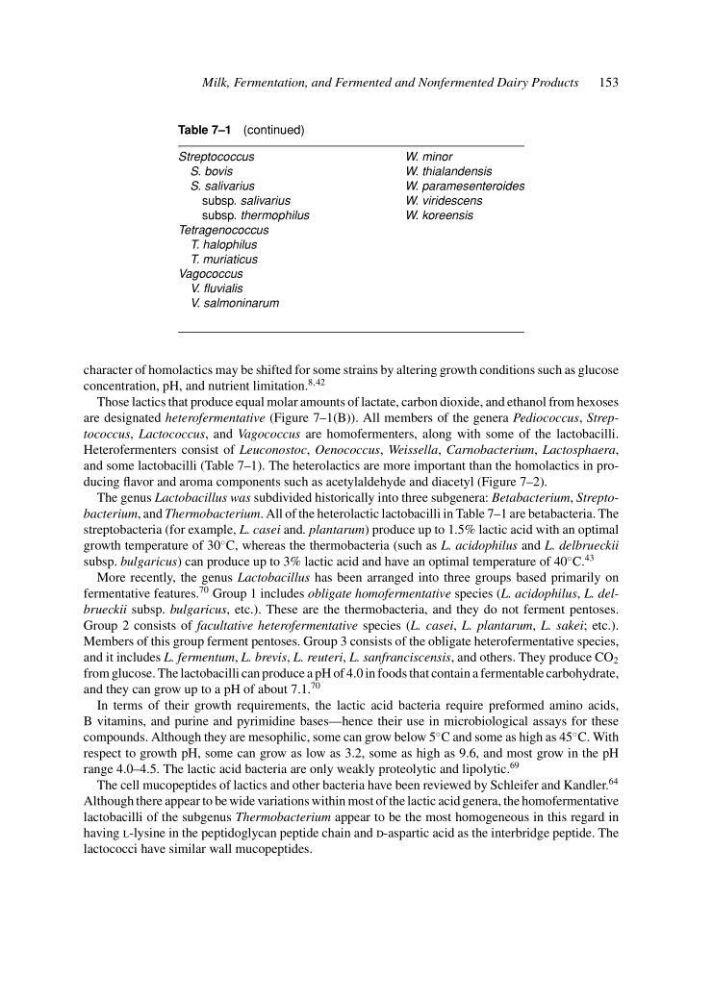
Table 7–1 (continued)
Streptococcus
W. minor
S. bovis
W. thialandensis
S. salivarius
W. paramesenteroides
subsp. salivarius
W. viridescens
subsp. thermophilus
W. koreensis
Tetragenococcus
T. halophilus
T. muriaticus
Vagococcus
V. fluvialis
V. salmoninarum
character of homolactics may be shifted for some strains by altering growth conditions such as glucose
concentration, pH, and nutrient limitation.
8,42
Those lactics that produce equal molar amounts of lactate, carbon dioxide, and ethanol from hexoses
are designated heterofermentative (Figure 7–1(B)). All members of the genera Pediococcus, Streptococcus, Lactococcus, and Vagococcus are homofermenters, along with some of the lactobacilli.
Heterofermenters consist of Leuconostoc, Oenococcus, Weissella, Carnobacterium, Lactosphaera,
and some lactobacilli (Table 7–1). The heterolactics are more important than the homolactics in producing flavor and aroma components such as acetylaldehyde and diacetyl (Figure 7–2).
The genus Lactobacillus was subdivided historically into three subgenera: Betabacterium, Streptobacterium, and Thermobacterium. All of the heterolactic lactobacilli in Table 7–1 are betabacteria. The
streptobacteria (for example, L. casei and. plantarum) produce up to 1.5% lactic acid with an optimal
growth temperature of 30
◦ C, whereas the thermobacteria (such as L. acidophilus and L. delbrueckii
subsp. bulgaricus) can produce up to 3% lactic acid and have an optimal temperature of 40
◦ C.
43
More recently, the genus Lactobacillus has been arranged into three groups based primarily on
fermentative features.
70 Group 1 includes obligate homofermentative species (L. acidophilus, L. delbrueckii subsp. bulgaricus, etc.). These are the thermobacteria, and they do not ferment pentoses.
Group 2 consists of facultative heterofermentative species (L. casei, L. plantarum, L. sakei; etc.).
Members of this group ferment pentoses. Group 3 consists of the obligate heterofermentative species,
and it includes L. fermentum, L. brevis, L. reuteri, L. sanfranciscensis, and others. They produce CO 2
from glucose. The lactobacilli can produce a pH of 4.0 in foods that contain a fermentable carbohydrate,
and they can grow up to a pH of about 7.1.
70
In terms of their growth requirements, the lactic acid bacteria require preformed amino acids,
B vitamins, and purine and pyrimidine bases—hence their use in microbiological assays for these
compounds. Although they are mesophilic, some can grow below 5
◦ C and some as high as 45
◦ C. With
respect to growth pH, some can grow as low as 3.2, some as high as 9.6, and most grow in the pH
range 4.0–4.5. The lactic acid bacteria are only weakly proteolytic and lipolytic.
69
The cell mucopeptides of lactics and other bacteria have been reviewed by Schleifer and Kandler.
64
Although there appear to be wide variations within most of the lactic acid genera, the homofermentative
lactobacilli of the subgenus Thermobacterium appear to be the most homogeneous in this regard in
having l-lysine in the peptidoglycan peptide chain and d-aspartic acid as the interbridge peptide. The
lactococci have similar wall mucopeptides.
Table 7–1 (continued)
Streptococcus
W. minor
S. bovis
W. thialandensis
S. salivarius
W. paramesenteroides
subsp. salivarius
W. viridescens
subsp. thermophilus
W. koreensis
Tetragenococcus
T. halophilus
T. muriaticus
Vagococcus
V. fluvialis
V. salmoninarum
character of homolactics may be shifted for some strains by altering growth conditions such as glucose
concentration, pH, and nutrient limitation.
8,42
Those lactics that produce equal molar amounts of lactate, carbon dioxide, and ethanol from hexoses
are designated heterofermentative (Figure 7–1(B)). All members of the genera Pediococcus, Streptococcus, Lactococcus, and Vagococcus are homofermenters, along with some of the lactobacilli.
Heterofermenters consist of Leuconostoc, Oenococcus, Weissella, Carnobacterium, Lactosphaera,
and some lactobacilli (Table 7–1). The heterolactics are more important than the homolactics in producing flavor and aroma components such as acetylaldehyde and diacetyl (Figure 7–2).
The genus Lactobacillus was subdivided historically into three subgenera: Betabacterium, Streptobacterium, and Thermobacterium. All of the heterolactic lactobacilli in Table 7–1 are betabacteria. The
streptobacteria (for example, L. casei and. plantarum) produce up to 1.5% lactic acid with an optimal
growth temperature of 30
◦ C, whereas the thermobacteria (such as L. acidophilus and L. delbrueckii
subsp. bulgaricus) can produce up to 3% lactic acid and have an optimal temperature of 40
◦ C.
43
More recently, the genus Lactobacillus has been arranged into three groups based primarily on
fermentative features.
70 Group 1 includes obligate homofermentative species (L. acidophilus, L. delbrueckii subsp. bulgaricus, etc.). These are the thermobacteria, and they do not ferment pentoses.
Group 2 consists of facultative heterofermentative species (L. casei, L. plantarum, L. sakei; etc.).
Members of this group ferment pentoses. Group 3 consists of the obligate heterofermentative species,
and it includes L. fermentum, L. brevis, L. reuteri, L. sanfranciscensis, and others. They produce CO 2
from glucose. The lactobacilli can produce a pH of 4.0 in foods that contain a fermentable carbohydrate,
and they can grow up to a pH of about 7.1.
70
In terms of their growth requirements, the lactic acid bacteria require preformed amino acids,
B vitamins, and purine and pyrimidine bases—hence their use in microbiological assays for these
compounds. Although they are mesophilic, some can grow below 5
◦ C and some as high as 45
◦ C. With
respect to growth pH, some can grow as low as 3.2, some as high as 9.6, and most grow in the pH
range 4.0–4.5. The lactic acid bacteria are only weakly proteolytic and lipolytic.
69
The cell mucopeptides of lactics and other bacteria have been reviewed by Schleifer and Kandler.
64
Although there appear to be wide variations within most of the lactic acid genera, the homofermentative
lactobacilli of the subgenus Thermobacterium appear to be the most homogeneous in this regard in
having l-lysine in the peptidoglycan peptide chain and d-aspartic acid as the interbridge peptide. The
lactococci have similar wall mucopeptides.