

Application of Sustainable and Low-Cost Sludge-Based Adsorbents …
77
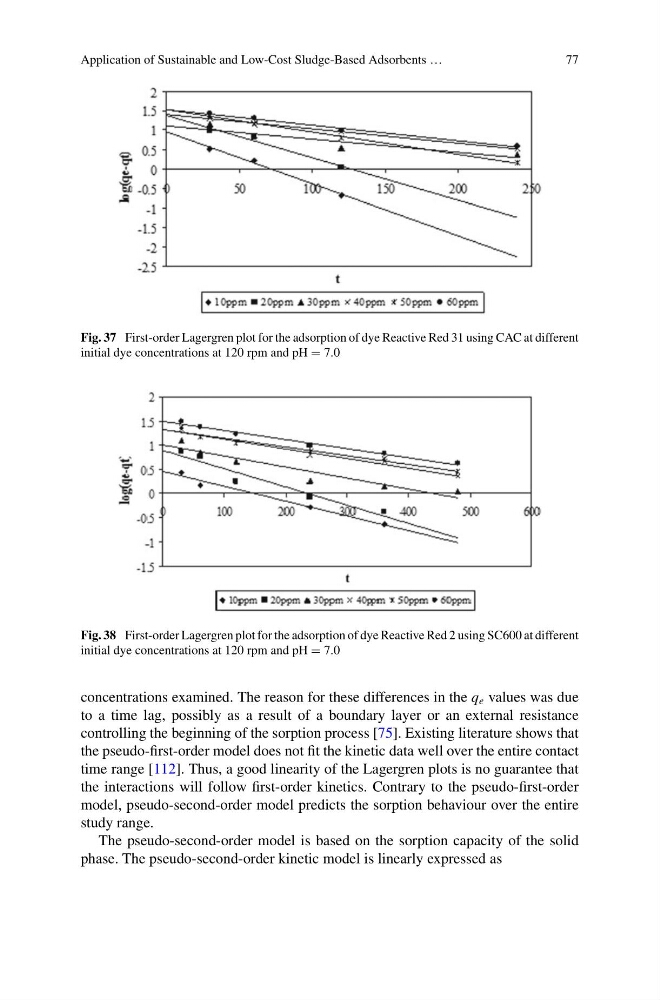
Fig. 37 First-order Lagergren plot for the adsorption of dye Reactive Red 31 using CAC at different
initial dye concentrations at 120 rpm and pH = 7.0
Fig. 38 First-order Lagergren plot for the adsorption of dye Reactive Red 2 using SC600 at different
initial dye concentrations at 120 rpm and pH = 7.0
concentrations examined. The reason for these differences in the q e values was due
to a time lag, possibly as a result of a boundary layer or an external resistance
controlling the beginning of the sorption process [75]. Existing literature shows that
the pseudo-first-order model does not fit the kinetic data well over the entire contact
time range [112]. Thus, a good linearity of the Lagergren plots is no guarantee that
the interactions will follow first-order kinetics. Contrary to the pseudo-first-order
model, pseudo-second-order model predicts the sorption behaviour over the entire
study range.
The pseudo-second-order model is based on the sorption capacity of the solid
phase. The pseudo-second-order kinetic model is linearly expressed as
77
Fig. 37 First-order Lagergren plot for the adsorption of dye Reactive Red 31 using CAC at different
initial dye concentrations at 120 rpm and pH = 7.0
Fig. 38 First-order Lagergren plot for the adsorption of dye Reactive Red 2 using SC600 at different
initial dye concentrations at 120 rpm and pH = 7.0
concentrations examined. The reason for these differences in the q e values was due
to a time lag, possibly as a result of a boundary layer or an external resistance
controlling the beginning of the sorption process [75]. Existing literature shows that
the pseudo-first-order model does not fit the kinetic data well over the entire contact
time range [112]. Thus, a good linearity of the Lagergren plots is no guarantee that
the interactions will follow first-order kinetics. Contrary to the pseudo-first-order
model, pseudo-second-order model predicts the sorption behaviour over the entire
study range.
The pseudo-second-order model is based on the sorption capacity of the solid
phase. The pseudo-second-order kinetic model is linearly expressed as