

76
A. Geethakarthi
5.4 Adsorption Kinetics
The prediction of batch sorption kinetics gives the most important information for
designing batch sorption systems. Adsorption kinetics explains how fast the sorption process occurs and also the factors affecting the reaction rate. It is important to
establish the time dependence of adsorption systems under various process conditions. The principle behind the adsorption kinetics involves the search for a best
model that well represents the experimental data. Numerous kinetic models have
been used for describing the reaction order of the system and to express the mechanism of solute sorption onto a sorbent. In order to investigate the mechanism of
sorption, characteristic constants of sorption were determined using two simplest
kinetic models, a pseudo-first-order equation of Lagergren based on solid capacity
and a pseudo-second-order equation based on solid phase sorption [46, 45].
A linear form of pseudo-first-order model Eq. (5.8) is:
log(q e − q) = log(q e ) −
k 1,ad
2.303
t
(5.8)
where q e is the amount of adsorbed dye at equilibrium (mg/g), q is the amount of dye
adsorbed at time t (min) (mgg
−1 ) and k 1,ad is the rate constant of first-order sorption
(min
−1 ). A linear plot of log (q e − q) against time (t) allows obtaining the rate
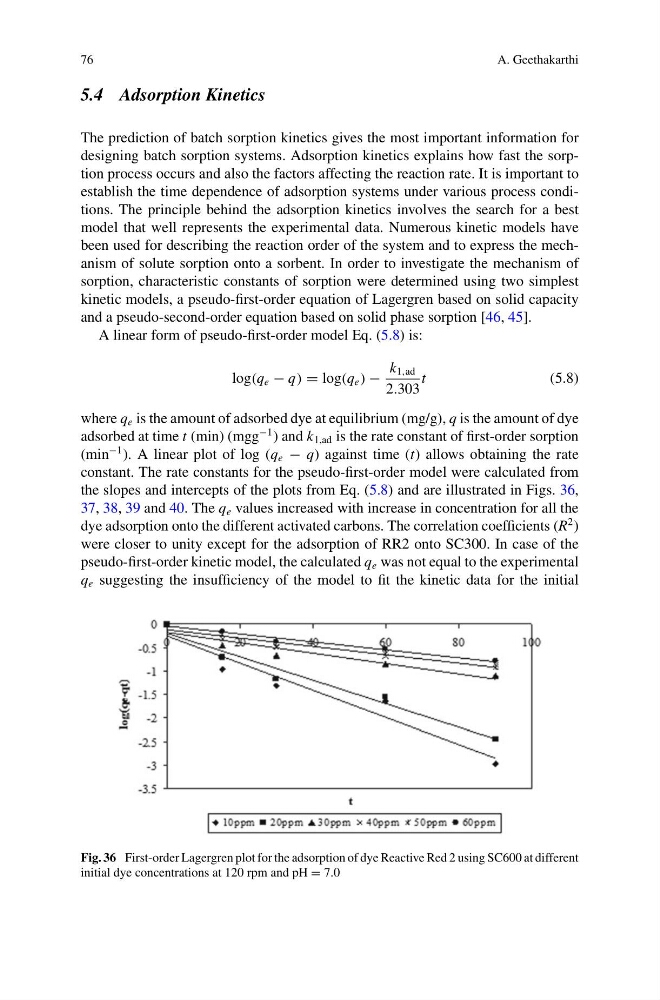
constant. The rate constants for the pseudo-first-order model were calculated from
the slopes and intercepts of the plots from Eq. (5.8) and are illustrated in Figs. 36,
37, 38, 39 and 40. The q e values increased with increase in concentration for all the
dye adsorption onto the different activated carbons. The correlation coefficients (R
2 )
were closer to unity except for the adsorption of RR2 onto SC300. In case of the
pseudo-first-order kinetic model, the calculated q e was not equal to the experimental
q e suggesting the insufficiency of the model to fit the kinetic data for the initial
Fig. 36 First-order Lagergren plot for the adsorption of dye Reactive Red 2 using SC600 at different
initial dye concentrations at 120 rpm and pH = 7.0
A. Geethakarthi
5.4 Adsorption Kinetics
The prediction of batch sorption kinetics gives the most important information for
designing batch sorption systems. Adsorption kinetics explains how fast the sorption process occurs and also the factors affecting the reaction rate. It is important to
establish the time dependence of adsorption systems under various process conditions. The principle behind the adsorption kinetics involves the search for a best
model that well represents the experimental data. Numerous kinetic models have
been used for describing the reaction order of the system and to express the mechanism of solute sorption onto a sorbent. In order to investigate the mechanism of
sorption, characteristic constants of sorption were determined using two simplest
kinetic models, a pseudo-first-order equation of Lagergren based on solid capacity
and a pseudo-second-order equation based on solid phase sorption [46, 45].
A linear form of pseudo-first-order model Eq. (5.8) is:
log(q e − q) = log(q e ) −
k 1,ad
2.303
t
(5.8)
where q e is the amount of adsorbed dye at equilibrium (mg/g), q is the amount of dye
adsorbed at time t (min) (mgg
−1 ) and k 1,ad is the rate constant of first-order sorption
(min
−1 ). A linear plot of log (q e − q) against time (t) allows obtaining the rate
constant. The rate constants for the pseudo-first-order model were calculated from
the slopes and intercepts of the plots from Eq. (5.8) and are illustrated in Figs. 36,
37, 38, 39 and 40. The q e values increased with increase in concentration for all the
dye adsorption onto the different activated carbons. The correlation coefficients (R
2 )
were closer to unity except for the adsorption of RR2 onto SC300. In case of the
pseudo-first-order kinetic model, the calculated q e was not equal to the experimental
q e suggesting the insufficiency of the model to fit the kinetic data for the initial
Fig. 36 First-order Lagergren plot for the adsorption of dye Reactive Red 2 using SC600 at different
initial dye concentrations at 120 rpm and pH = 7.0