

34
A. Geethakarthi
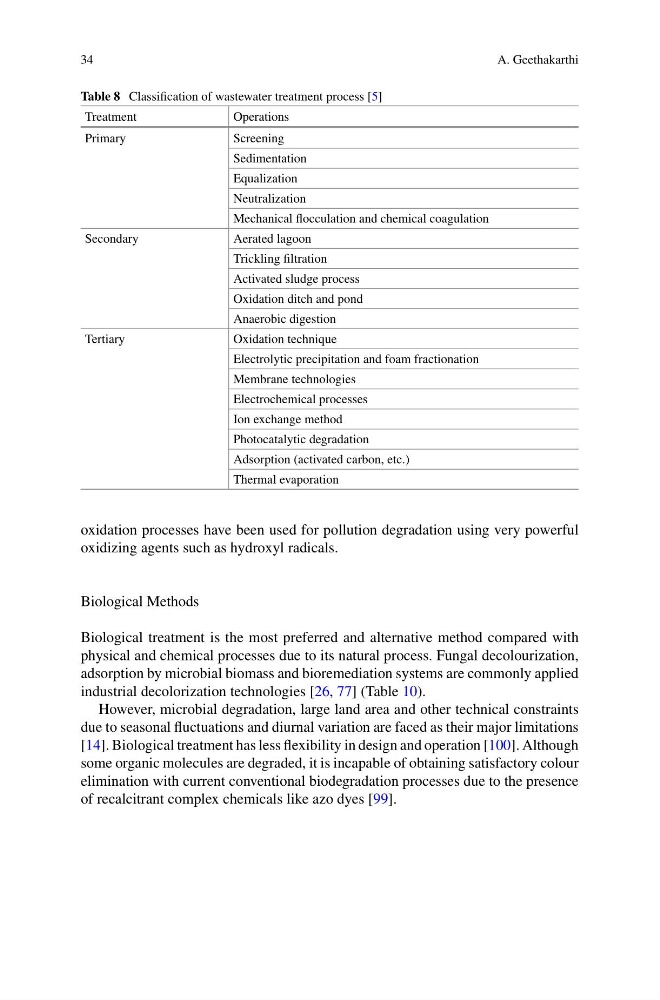
Table 8 Classification of wastewater treatment process [5]
Treatment
Operations
Primary
Screening
Sedimentation
Equalization
Neutralization
Mechanical flocculation and chemical coagulation
Secondary
Aerated lagoon
Trickling filtration
Activated sludge process
Oxidation ditch and pond
Anaerobic digestion
Tertiary
Oxidation technique
Electrolytic precipitation and foam fractionation
Membrane technologies
Electrochemical processes
Ion exchange method
Photocatalytic degradation
Adsorption (activated carbon, etc.)
Thermal evaporation
oxidation processes have been used for pollution degradation using very powerful
oxidizing agents such as hydroxyl radicals.
Biological Methods
Biological treatment is the most preferred and alternative method compared with
physical and chemical processes due to its natural process. Fungal decolourization,
adsorption by microbial biomass and bioremediation systems are commonly applied
industrial decolorization technologies [26, 77] (Table 10).
However, microbial degradation, large land area and other technical constraints
due to seasonal fluctuations and diurnal variation are faced as their major limitations
[14]. Biological treatment has less flexibility in design and operation [100]. Although
some organic molecules are degraded, it is incapable of obtaining satisfactory colour
elimination with current conventional biodegradation processes due to the presence
of recalcitrant complex chemicals like azo dyes [99].
A. Geethakarthi
Table 8 Classification of wastewater treatment process [5]
Treatment
Operations
Primary
Screening
Sedimentation
Equalization
Neutralization
Mechanical flocculation and chemical coagulation
Secondary
Aerated lagoon
Trickling filtration
Activated sludge process
Oxidation ditch and pond
Anaerobic digestion
Tertiary
Oxidation technique
Electrolytic precipitation and foam fractionation
Membrane technologies
Electrochemical processes
Ion exchange method
Photocatalytic degradation
Adsorption (activated carbon, etc.)
Thermal evaporation
oxidation processes have been used for pollution degradation using very powerful
oxidizing agents such as hydroxyl radicals.
Biological Methods
Biological treatment is the most preferred and alternative method compared with
physical and chemical processes due to its natural process. Fungal decolourization,
adsorption by microbial biomass and bioremediation systems are commonly applied
industrial decolorization technologies [26, 77] (Table 10).
However, microbial degradation, large land area and other technical constraints
due to seasonal fluctuations and diurnal variation are faced as their major limitations
[14]. Biological treatment has less flexibility in design and operation [100]. Although
some organic molecules are degraded, it is incapable of obtaining satisfactory colour
elimination with current conventional biodegradation processes due to the presence
of recalcitrant complex chemicals like azo dyes [99].