

32
A. Geethakarthi
due to leaching in long time period. Every year, 4000–6000 tons of basic chromium
is used in tanning process and a discharge of 20–40% is disposed as waste [106]. As
buffing dust, shaving is also disposed by means of incineration, pyrolysis and land
co-disposal.
1.4 Development of Indian Textile Industries
Indian textile industry contributes about 14% to industrial production, 4% to the
nation’s GDP and 17% to the country’s exports. The existence of textiles in ancient
Indian period is recorded and well understood from ancient literature and sculpture.
The Harappa and Mohenjo-daro civilization has greater evolution in the evolution of
cotton textile industry. The intervention of British era during the eighteenth century
has augmented with automation in most of the cottage textile industrial process
including carding, spinning and weaving.
1.4.1 Textile Effluent Flow from Manufacturing Process
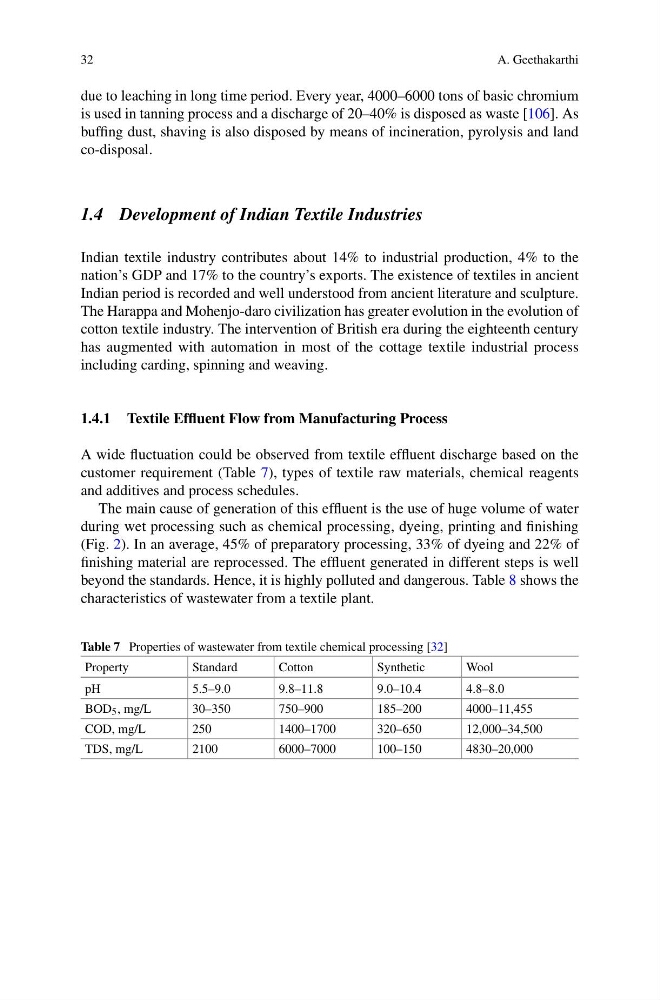
A wide fluctuation could be observed from textile effluent discharge based on the
customer requirement (Table 7), types of textile raw materials, chemical reagents
and additives and process schedules.
The main cause of generation of this effluent is the use of huge volume of water
during wet processing such as chemical processing, dyeing, printing and finishing
(Fig. 2). In an average, 45% of preparatory processing, 33% of dyeing and 22% of
finishing material are reprocessed. The effluent generated in different steps is well
beyond the standards. Hence, it is highly polluted and dangerous. Table 8 shows the
characteristics of wastewater from a textile plant.
Table 7 Properties of wastewater from textile chemical processing [32]
Property
Standard
Cotton
Synthetic
Wool
pH
5.5–9.0
9.8–11.8
9.0–10.4
4.8–8.0
BOD 5 , mg/L
30–350
750–900
185–200
4000–11,455
COD, mg/L
250
1400–1700
320–650
12,000–34,500
TDS, mg/L
2100
6000–7000
100–150
4830–20,000
A. Geethakarthi
due to leaching in long time period. Every year, 4000–6000 tons of basic chromium
is used in tanning process and a discharge of 20–40% is disposed as waste [106]. As
buffing dust, shaving is also disposed by means of incineration, pyrolysis and land
co-disposal.
1.4 Development of Indian Textile Industries
Indian textile industry contributes about 14% to industrial production, 4% to the
nation’s GDP and 17% to the country’s exports. The existence of textiles in ancient
Indian period is recorded and well understood from ancient literature and sculpture.
The Harappa and Mohenjo-daro civilization has greater evolution in the evolution of
cotton textile industry. The intervention of British era during the eighteenth century
has augmented with automation in most of the cottage textile industrial process
including carding, spinning and weaving.
1.4.1 Textile Effluent Flow from Manufacturing Process
A wide fluctuation could be observed from textile effluent discharge based on the
customer requirement (Table 7), types of textile raw materials, chemical reagents
and additives and process schedules.
The main cause of generation of this effluent is the use of huge volume of water
during wet processing such as chemical processing, dyeing, printing and finishing
(Fig. 2). In an average, 45% of preparatory processing, 33% of dyeing and 22% of
finishing material are reprocessed. The effluent generated in different steps is well
beyond the standards. Hence, it is highly polluted and dangerous. Table 8 shows the
characteristics of wastewater from a textile plant.
Table 7 Properties of wastewater from textile chemical processing [32]
Property
Standard
Cotton
Synthetic
Wool
pH
5.5–9.0
9.8–11.8
9.0–10.4
4.8–8.0
BOD 5 , mg/L
30–350
750–900
185–200
4000–11,455
COD, mg/L
250
1400–1700
320–650
12,000–34,500
TDS, mg/L
2100
6000–7000
100–150
4830–20,000