

142
K. Amutha
Table 2 Application of magnetic nanoparticle/nanocomposite in waste water treatment. Content
Source (9)
Magnetic
nanoparticle/nanocomposite
Properties
Applications
Nanomagnetite
Amphoteric surface activity,
easy dispersion ability, high
metal ion adsorption capacity
As adsorbents for removal of
• heavy metals such as arsenic,
lead, mercury, cadmium and
chromium from waste water
• azo and anthraquinone dyes
Substituted nanomagnetite
(Mn, Co and Ni)
High adsorption capacity,
catalytic nature,
ion-exchange, high pore
volume
Nanosized magnetite with
surface functionalization
Effective adsorbents,
superparamagnetic, high
metal ion adsorption capacity
Nanosized magnetite as part of
composites with inorganic
moieties (TiO 2 , SiO 2 ) or
supported magnetite on clay
and carbon
New functional hybrid
materials with the synergy of
all the components, large
uniform nanopore structures
caused a decline in decolourization activity. Among the tested quantities of orange
peel, optimum activity was observed for 0.6 g/100 mL [14].
Nanosized magnetite has emerged as an adsorbent of pollutants in water remediation. Magnetic nanoparticles and nanocomposites are used as low-cost materials
in the treatment of contaminated water. The characteristics of these nanomaterials
are related to their ability to eliminate heavy metal ions and dyes from wastewater. Different magnetic materials, from raw nanomagnetite to magnetite combined
with several compounds, have been studied. Magnetic activated carbons exhibited
high surface areas and porosities and can be easily manipulated by an external
magnetic field. Application of magnetic nanoparticle or nanocomposite in waste
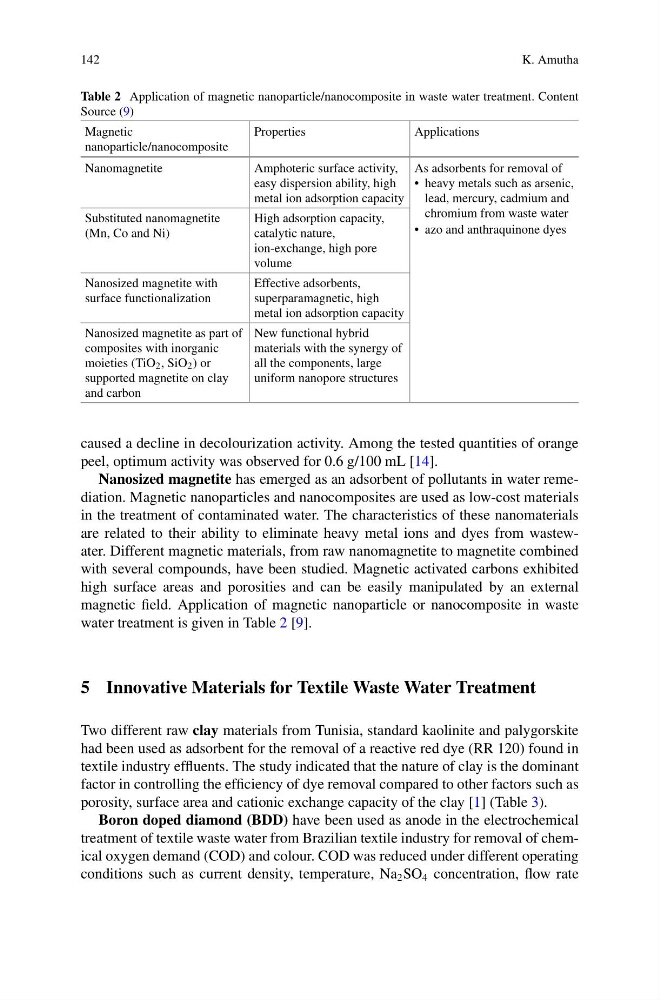
water treatment is given in Table 2 [9].
5 Innovative Materials for Textile Waste Water Treatment
Two different raw clay materials from Tunisia, standard kaolinite and palygorskite
had been used as adsorbent for the removal of a reactive red dye (RR 120) found in
textile industry effluents. The study indicated that the nature of clay is the dominant
factor in controlling the efficiency of dye removal compared to other factors such as
porosity, surface area and cationic exchange capacity of the clay [1] (Table 3).
Boron doped diamond (BDD) have been used as anode in the electrochemical
treatment of textile waste water from Brazilian textile industry for removal of chemical oxygen demand (COD) and colour. COD was reduced under different operating
conditions such as current density, temperature, Na 2 SO 4 concentration, flow rate
K. Amutha
Table 2 Application of magnetic nanoparticle/nanocomposite in waste water treatment. Content
Source (9)
Magnetic
nanoparticle/nanocomposite
Properties
Applications
Nanomagnetite
Amphoteric surface activity,
easy dispersion ability, high
metal ion adsorption capacity
As adsorbents for removal of
• heavy metals such as arsenic,
lead, mercury, cadmium and
chromium from waste water
• azo and anthraquinone dyes
Substituted nanomagnetite
(Mn, Co and Ni)
High adsorption capacity,
catalytic nature,
ion-exchange, high pore
volume
Nanosized magnetite with
surface functionalization
Effective adsorbents,
superparamagnetic, high
metal ion adsorption capacity
Nanosized magnetite as part of
composites with inorganic
moieties (TiO 2 , SiO 2 ) or
supported magnetite on clay
and carbon
New functional hybrid
materials with the synergy of
all the components, large
uniform nanopore structures
caused a decline in decolourization activity. Among the tested quantities of orange
peel, optimum activity was observed for 0.6 g/100 mL [14].
Nanosized magnetite has emerged as an adsorbent of pollutants in water remediation. Magnetic nanoparticles and nanocomposites are used as low-cost materials
in the treatment of contaminated water. The characteristics of these nanomaterials
are related to their ability to eliminate heavy metal ions and dyes from wastewater. Different magnetic materials, from raw nanomagnetite to magnetite combined
with several compounds, have been studied. Magnetic activated carbons exhibited
high surface areas and porosities and can be easily manipulated by an external
magnetic field. Application of magnetic nanoparticle or nanocomposite in waste
water treatment is given in Table 2 [9].
5 Innovative Materials for Textile Waste Water Treatment
Two different raw clay materials from Tunisia, standard kaolinite and palygorskite
had been used as adsorbent for the removal of a reactive red dye (RR 120) found in
textile industry effluents. The study indicated that the nature of clay is the dominant
factor in controlling the efficiency of dye removal compared to other factors such as
porosity, surface area and cationic exchange capacity of the clay [1] (Table 3).
Boron doped diamond (BDD) have been used as anode in the electrochemical
treatment of textile waste water from Brazilian textile industry for removal of chemical oxygen demand (COD) and colour. COD was reduced under different operating
conditions such as current density, temperature, Na 2 SO 4 concentration, flow rate