

Treatment of Textile Waste Water Using Low-Cost …
141
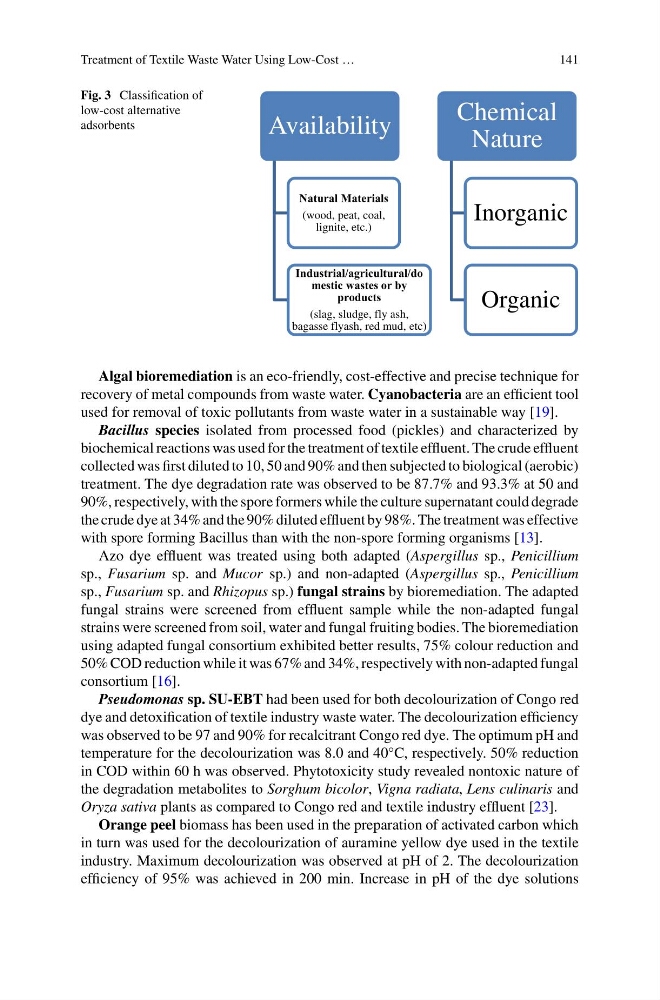
Fig. 3 Classification of
low-cost alternative
adsorbents
Availability
Natural Materials
(wood, peat, coal,
lignite, etc.)
Industrial/agricultural/do
mestic wastes or by
products
(slag, sludge, fly ash,
bagasse flyash, red mud, etc)
Chemical
Nature
Inorganic
Organic
Algal bioremediation is an eco-friendly, cost-effective and precise technique for
recovery of metal compounds from waste water. Cyanobacteria are an efficient tool
used for removal of toxic pollutants from waste water in a sustainable way [19].
Bacillus species isolated from processed food (pickles) and characterized by
biochemical reactions was used for the treatment of textile effluent. The crude effluent
collected was first diluted to 10, 50 and 90% and then subjected to biological (aerobic)
treatment. The dye degradation rate was observed to be 87.7% and 93.3% at 50 and
90%, respectively, with the spore formers while the culture supernatant could degrade
the crude dye at 34% and the 90% diluted effluent by 98%. The treatment was effective
with spore forming Bacillus than with the non-spore forming organisms [13].
Azo dye effluent was treated using both adapted (Aspergillus sp., Penicillium
sp., Fusarium sp. and Mucor sp.) and non-adapted (Aspergillus sp., Penicillium
sp., Fusarium sp. and Rhizopus sp.) fungal strains by bioremediation. The adapted
fungal strains were screened from effluent sample while the non-adapted fungal
strains were screened from soil, water and fungal fruiting bodies. The bioremediation
using adapted fungal consortium exhibited better results, 75% colour reduction and
50% COD reduction while it was 67% and 34%, respectively with non-adapted fungal
consortium [16].
Pseudomonas sp. SU-EBT had been used for both decolourization of Congo red
dye and detoxification of textile industry waste water. The decolourization efficiency
was observed to be 97 and 90% for recalcitrant Congo red dye. The optimum pH and
temperature for the decolourization was 8.0 and 40°C, respectively. 50% reduction
in COD within 60 h was observed. Phytotoxicity study revealed nontoxic nature of
the degradation metabolites to Sorghum bicolor, Vigna radiata, Lens culinaris and
Oryza sativa plants as compared to Congo red and textile industry effluent [23].
Orange peel biomass has been used in the preparation of activated carbon which
in turn was used for the decolourization of auramine yellow dye used in the textile
industry. Maximum decolourization was observed at pH of 2. The decolourization
efficiency of 95% was achieved in 200 min. Increase in pH of the dye solutions
141
Fig. 3 Classification of
low-cost alternative
adsorbents
Availability
Natural Materials
(wood, peat, coal,
lignite, etc.)
Industrial/agricultural/do
mestic wastes or by
products
(slag, sludge, fly ash,
bagasse flyash, red mud, etc)
Chemical
Nature
Inorganic
Organic
Algal bioremediation is an eco-friendly, cost-effective and precise technique for
recovery of metal compounds from waste water. Cyanobacteria are an efficient tool
used for removal of toxic pollutants from waste water in a sustainable way [19].
Bacillus species isolated from processed food (pickles) and characterized by
biochemical reactions was used for the treatment of textile effluent. The crude effluent
collected was first diluted to 10, 50 and 90% and then subjected to biological (aerobic)
treatment. The dye degradation rate was observed to be 87.7% and 93.3% at 50 and
90%, respectively, with the spore formers while the culture supernatant could degrade
the crude dye at 34% and the 90% diluted effluent by 98%. The treatment was effective
with spore forming Bacillus than with the non-spore forming organisms [13].
Azo dye effluent was treated using both adapted (Aspergillus sp., Penicillium
sp., Fusarium sp. and Mucor sp.) and non-adapted (Aspergillus sp., Penicillium
sp., Fusarium sp. and Rhizopus sp.) fungal strains by bioremediation. The adapted
fungal strains were screened from effluent sample while the non-adapted fungal
strains were screened from soil, water and fungal fruiting bodies. The bioremediation
using adapted fungal consortium exhibited better results, 75% colour reduction and
50% COD reduction while it was 67% and 34%, respectively with non-adapted fungal
consortium [16].
Pseudomonas sp. SU-EBT had been used for both decolourization of Congo red
dye and detoxification of textile industry waste water. The decolourization efficiency
was observed to be 97 and 90% for recalcitrant Congo red dye. The optimum pH and
temperature for the decolourization was 8.0 and 40°C, respectively. 50% reduction
in COD within 60 h was observed. Phytotoxicity study revealed nontoxic nature of
the degradation metabolites to Sorghum bicolor, Vigna radiata, Lens culinaris and
Oryza sativa plants as compared to Congo red and textile industry effluent [23].
Orange peel biomass has been used in the preparation of activated carbon which
in turn was used for the decolourization of auramine yellow dye used in the textile
industry. Maximum decolourization was observed at pH of 2. The decolourization
efficiency of 95% was achieved in 200 min. Increase in pH of the dye solutions