

2.2 Environmental Assessment Using a Model Ecosystem
To estimate the effect of chemical substances on the microcosm, the step-by-step test
method, consisting of three tests, was considered to be essential (Japan Sewage
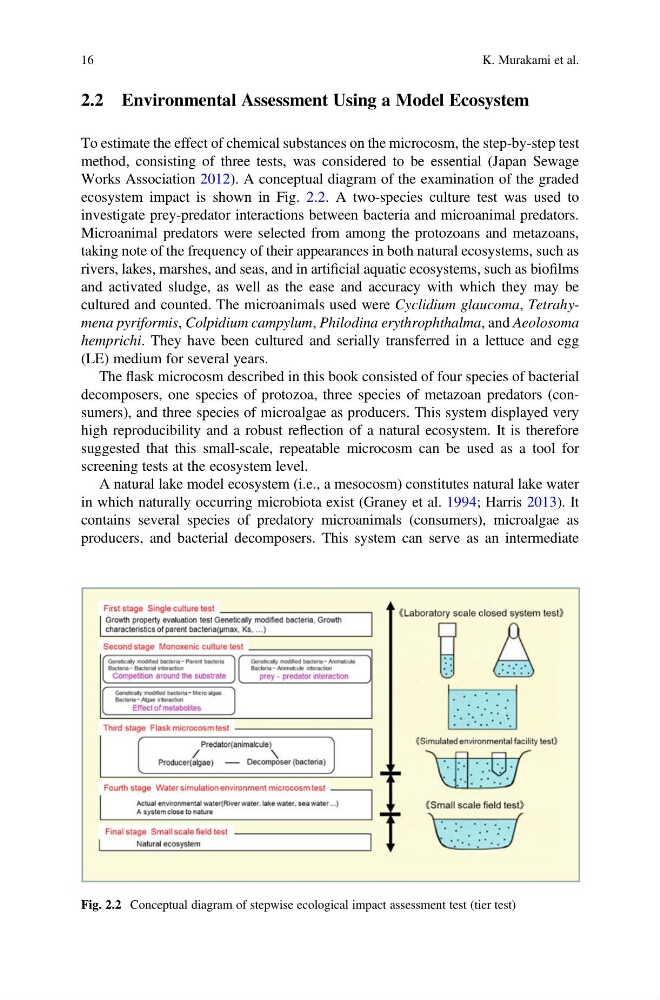
Works Association 2012). A conceptual diagram of the examination of the graded
ecosystem impact is shown in Fig. 2.2. A two-species culture test was used to
investigate prey-predator interactions between bacteria and microanimal predators.
Microanimal predators were selected from among the protozoans and metazoans,
taking note of the frequency of their appearances in both natural ecosystems, such as
rivers, lakes, marshes, and seas, and in artificial aquatic ecosystems, such as biofilms
and activated sludge, as well as the ease and accuracy with which they may be
cultured and counted. The microanimals used were Cyclidium glaucoma, Tetrahymena pyriformis, Colpidium campylum, Philodina erythrophthalma, and Aeolosoma
hemprichi. They have been cultured and serially transferred in a lettuce and egg
(LE) medium for several years.
The flask microcosm described in this book consisted of four species of bacterial
decomposers, one species of protozoa, three species of metazoan predators (consumers), and three species of microalgae as producers. This system displayed very
high reproducibility and a robust reflection of a natural ecosystem. It is therefore
suggested that this small-scale, repeatable microcosm can be used as a tool for
screening tests at the ecosystem level.
A natural lake model ecosystem (i.e., a mesocosm) constitutes natural lake water
in which naturally occurring microbiota exist (Graney et al. 1994; Harris 2013). It
contains several species of predatory microanimals (consumers), microalgae as
producers, and bacterial decomposers. This system can serve as an intermediate
Fig. 2.2 Conceptual diagram of stepwise ecological impact assessment test (tier test)
16
K. Murakami et al.
To estimate the effect of chemical substances on the microcosm, the step-by-step test
method, consisting of three tests, was considered to be essential (Japan Sewage
Works Association 2012). A conceptual diagram of the examination of the graded
ecosystem impact is shown in Fig. 2.2. A two-species culture test was used to
investigate prey-predator interactions between bacteria and microanimal predators.
Microanimal predators were selected from among the protozoans and metazoans,
taking note of the frequency of their appearances in both natural ecosystems, such as
rivers, lakes, marshes, and seas, and in artificial aquatic ecosystems, such as biofilms
and activated sludge, as well as the ease and accuracy with which they may be
cultured and counted. The microanimals used were Cyclidium glaucoma, Tetrahymena pyriformis, Colpidium campylum, Philodina erythrophthalma, and Aeolosoma
hemprichi. They have been cultured and serially transferred in a lettuce and egg
(LE) medium for several years.
The flask microcosm described in this book consisted of four species of bacterial
decomposers, one species of protozoa, three species of metazoan predators (consumers), and three species of microalgae as producers. This system displayed very
high reproducibility and a robust reflection of a natural ecosystem. It is therefore
suggested that this small-scale, repeatable microcosm can be used as a tool for
screening tests at the ecosystem level.
A natural lake model ecosystem (i.e., a mesocosm) constitutes natural lake water
in which naturally occurring microbiota exist (Graney et al. 1994; Harris 2013). It
contains several species of predatory microanimals (consumers), microalgae as
producers, and bacterial decomposers. This system can serve as an intermediate
Fig. 2.2 Conceptual diagram of stepwise ecological impact assessment test (tier test)
16
K. Murakami et al.