

2.1.7 Standard Cultivation Conditions of the Microcosm
N-System
From the experiments described in Sects. 2.1.1, 2.1.2, 2.1.3, 2.1.4, 2.1.5, and 2.1.6 of
this chapter, the standard culture conditions of the flask-sized microcosm were
determined as follows: (i) species composition involves the combination of one
species of ciliate protozoan, Cyclidium glaucoma; three species of metazoan predators, two rotifers, Lecane sp. and Philodina erythrophthalma, and one oligochaete,
Aeolosoma hemprichi; two species of chlorophytes, Chlorella sp. and Scenedesmus
quadricauda; and one species of blue-green algae, Tolypothrix sp., as producers, and
four species of bacteria, Pseudomonas putida, Bacillus cereus, Acinetobacter sp.,
and a coryneform bacterium; (ii) the culture vessel size is that of a 300 mL Erlenmeyer flask; (iii) there is no stirring; (iv) culturing occurs at 25
C and under
2400 lux, with a 12 hr/12 hr L/D cycle; (v) Taub’s basal medium is supplied with
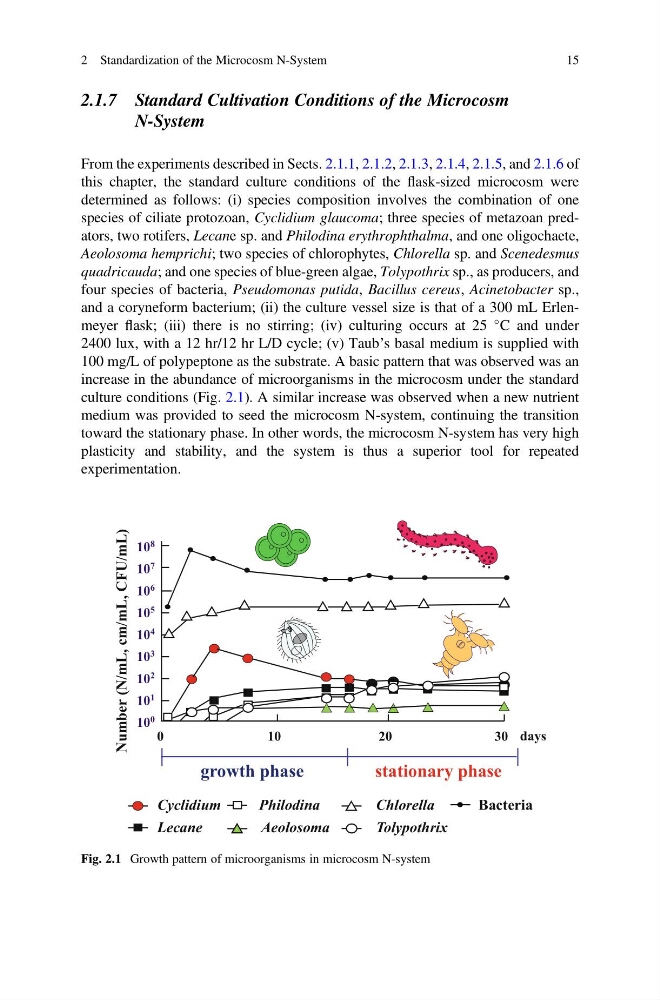
100 mg/L of polypeptone as the substrate. A basic pattern that was observed was an
increase in the abundance of microorganisms in the microcosm under the standard
culture conditions (Fig. 2.1). A similar increase was observed when a new nutrient
medium was provided to seed the microcosm N-system, continuing the transition
toward the stationary phase. In other words, the microcosm N-system has very high
plasticity and stability, and the system is thus a superior tool for repeated
experimentation.
Cyclidium
Lecane
Philodina
Aeolosoma
Chlorella
Tolypothrix
Bacteria
growth phase
stationary phase
0
1 0
2 0
3 0
10
8
10
7
10
6
10
5
10
4
10
3
10
2
10
1
10
0
days
Number (N/mL, cm/mL, CFU/mL)
Fig. 2.1 Growth pattern of microorganisms in microcosm N-system
2 Standardization of the Microcosm N-System
15
N-System
From the experiments described in Sects. 2.1.1, 2.1.2, 2.1.3, 2.1.4, 2.1.5, and 2.1.6 of
this chapter, the standard culture conditions of the flask-sized microcosm were
determined as follows: (i) species composition involves the combination of one
species of ciliate protozoan, Cyclidium glaucoma; three species of metazoan predators, two rotifers, Lecane sp. and Philodina erythrophthalma, and one oligochaete,
Aeolosoma hemprichi; two species of chlorophytes, Chlorella sp. and Scenedesmus
quadricauda; and one species of blue-green algae, Tolypothrix sp., as producers, and
four species of bacteria, Pseudomonas putida, Bacillus cereus, Acinetobacter sp.,
and a coryneform bacterium; (ii) the culture vessel size is that of a 300 mL Erlenmeyer flask; (iii) there is no stirring; (iv) culturing occurs at 25
C and under
2400 lux, with a 12 hr/12 hr L/D cycle; (v) Taub’s basal medium is supplied with
100 mg/L of polypeptone as the substrate. A basic pattern that was observed was an
increase in the abundance of microorganisms in the microcosm under the standard
culture conditions (Fig. 2.1). A similar increase was observed when a new nutrient
medium was provided to seed the microcosm N-system, continuing the transition
toward the stationary phase. In other words, the microcosm N-system has very high
plasticity and stability, and the system is thus a superior tool for repeated
experimentation.
Cyclidium
Lecane
Philodina
Aeolosoma
Chlorella
Tolypothrix
Bacteria
growth phase
stationary phase
0
1 0
2 0
3 0
10
8
10
7
10
6
10
5
10
4
10
3
10
2
10
1
10
0
days
Number (N/mL, cm/mL, CFU/mL)
Fig. 2.1 Growth pattern of microorganisms in microcosm N-system
2 Standardization of the Microcosm N-System
15