

7.14.13 Plasmid pBR325(Gene Biomanipulation)
As a form of bio-augmentation, Escherichia coli HB101/pBR325 decreased immediately after being added in the microcosm by counting CFU on the selective
medium plate, and, at the same time, the bacteriophagous ciliate, Cyclidium glaucoma, the primary predator, increased. It was indicated that the predator-prey
interaction between the introduced bacteria and the primary predatory protozoa
was influenced strongly. Furthermore, bacteriophagous metazoans, the rotifers
Lecane sp. and Philodina erythrophthalma, and the oligochaete, Aeolosoma
hemprichi, also increased slowly. From these outcomes, the proliferation and
decay of the introduced Escherichia coli HB101/pBR325 were considered to be
controlled by the predation of indigenous microorganisms.
As gene biomanipulation, in the case of the direct addition of the pBR325 plasmid
alone, there were no observed increases in heterotrophs in the microcosm, but the
CFU on the selective medium plate increased. This means the introduced nontransmissible plasmid pBR325 was taken up by indigenous bacteria and phenotypically expressed its gene information, i.e., the non-transmissible plasmid can remain
by horizontal transferring between introduced bacteria (host strain) and indigenous
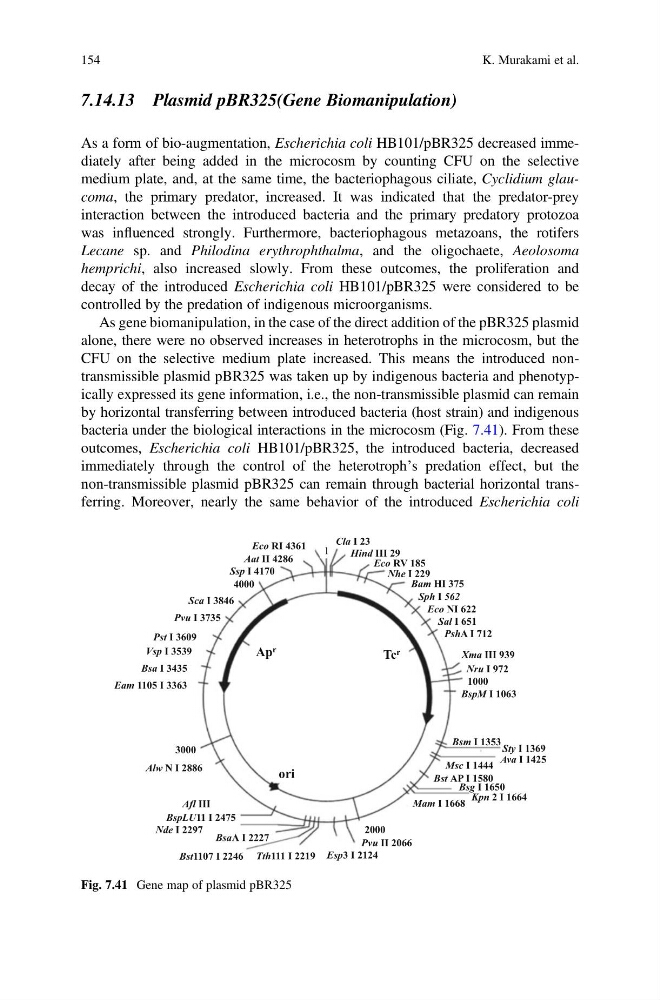
bacteria under the biological interactions in the microcosm (Fig. 7.41). From these
outcomes, Escherichia coli HB101/pBR325, the introduced bacteria, decreased
immediately through the control of the heterotroph’s predation effect, but the
non-transmissible plasmid pBR325 can remain through bacterial horizontal transferring. Moreover, nearly the same behavior of the introduced Escherichia coli
PshA I 712
Sal I 651
Eco NI 622
Sph I 562
Bam HI 375
Xma III 939
BspM I 1063
1000
Nru I 972
Bsm I 1353 Sty I 1369
Ava I 1425
Msc I 1444
Bst AP I 1580
Bsg I 1650
Mam I 1668
Kpn 2 I 1664
2000
Pvu II 2066
Esp3 I 2124
Tth111 I 2219
Bst1107 I 2246
Nde I 2297
Afl III
BsaA I 2227
BspLU11 I 2475
Alw N I 2886
3000
Eam 1105 I 3363
Bsa I 3435
Vsp I 3539
Pst I 3609
Pvu I 3735
Sca I 3846
4000
Ssp I 4170
Aat II 4286
Eco RI 4361
Cla I 23
Hind III 29
Nhe I 229
Eco RV 185
1
Ap r
Tc r
ori
Fig. 7.41 Gene map of plasmid pBR325
154
K. Murakami et al.
As a form of bio-augmentation, Escherichia coli HB101/pBR325 decreased immediately after being added in the microcosm by counting CFU on the selective
medium plate, and, at the same time, the bacteriophagous ciliate, Cyclidium glaucoma, the primary predator, increased. It was indicated that the predator-prey
interaction between the introduced bacteria and the primary predatory protozoa
was influenced strongly. Furthermore, bacteriophagous metazoans, the rotifers
Lecane sp. and Philodina erythrophthalma, and the oligochaete, Aeolosoma
hemprichi, also increased slowly. From these outcomes, the proliferation and
decay of the introduced Escherichia coli HB101/pBR325 were considered to be
controlled by the predation of indigenous microorganisms.
As gene biomanipulation, in the case of the direct addition of the pBR325 plasmid
alone, there were no observed increases in heterotrophs in the microcosm, but the
CFU on the selective medium plate increased. This means the introduced nontransmissible plasmid pBR325 was taken up by indigenous bacteria and phenotypically expressed its gene information, i.e., the non-transmissible plasmid can remain
by horizontal transferring between introduced bacteria (host strain) and indigenous
bacteria under the biological interactions in the microcosm (Fig. 7.41). From these
outcomes, Escherichia coli HB101/pBR325, the introduced bacteria, decreased
immediately through the control of the heterotroph’s predation effect, but the
non-transmissible plasmid pBR325 can remain through bacterial horizontal transferring. Moreover, nearly the same behavior of the introduced Escherichia coli
PshA I 712
Sal I 651
Eco NI 622
Sph I 562
Bam HI 375
Xma III 939
BspM I 1063
1000
Nru I 972
Bsm I 1353 Sty I 1369
Ava I 1425
Msc I 1444
Bst AP I 1580
Bsg I 1650
Mam I 1668
Kpn 2 I 1664
2000
Pvu II 2066
Esp3 I 2124
Tth111 I 2219
Bst1107 I 2246
Nde I 2297
Afl III
BsaA I 2227
BspLU11 I 2475
Alw N I 2886
3000
Eam 1105 I 3363
Bsa I 3435
Vsp I 3539
Pst I 3609
Pvu I 3735
Sca I 3846
4000
Ssp I 4170
Aat II 4286
Eco RI 4361
Cla I 23
Hind III 29
Nhe I 229
Eco RV 185
1
Ap r
Tc r
ori
Fig. 7.41 Gene map of plasmid pBR325
154
K. Murakami et al.