

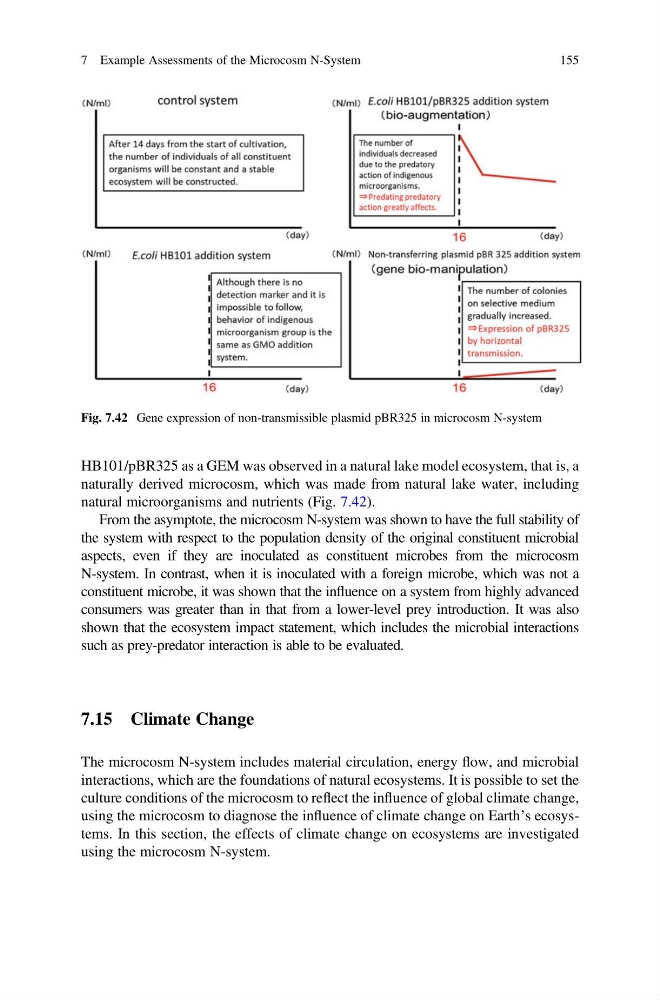
HB101/pBR325 as a GEM was observed in a natural lake model ecosystem, that is, a
naturally derived microcosm, which was made from natural lake water, including
natural microorganisms and nutrients (Fig. 7.42).
From the asymptote, the microcosm N-system was shown to have the full stability of
the system with respect to the population density of the original constituent microbial
aspects, even if they are inoculated as constituent microbes from the microcosm
N-system. In contrast, when it is inoculated with a foreign microbe, which was not a
constituent microbe, it was shown that the influence on a system from highly advanced
consumers was greater than in that from a lower-level prey introduction. It was also
shown that the ecosystem impact statement, which includes the microbial interactions
such as prey-predator interaction is able to be evaluated.
7.15 Climate Change
The microcosm N-system includes material circulation, energy flow, and microbial
interactions, which are the foundations of natural ecosystems. It is possible to set the
culture conditions of the microcosm to reflect the influence of global climate change,
using the microcosm to diagnose the influence of climate change on Earth’s ecosystems. In this section, the effects of climate change on ecosystems are investigated
using the microcosm N-system.
Fig. 7.42 Gene expression of non-transmissible plasmid pBR325 in microcosm N-system
7 Example Assessments of the Microcosm N-System
155
naturally derived microcosm, which was made from natural lake water, including
natural microorganisms and nutrients (Fig. 7.42).
From the asymptote, the microcosm N-system was shown to have the full stability of
the system with respect to the population density of the original constituent microbial
aspects, even if they are inoculated as constituent microbes from the microcosm
N-system. In contrast, when it is inoculated with a foreign microbe, which was not a
constituent microbe, it was shown that the influence on a system from highly advanced
consumers was greater than in that from a lower-level prey introduction. It was also
shown that the ecosystem impact statement, which includes the microbial interactions
such as prey-predator interaction is able to be evaluated.
7.15 Climate Change
The microcosm N-system includes material circulation, energy flow, and microbial
interactions, which are the foundations of natural ecosystems. It is possible to set the
culture conditions of the microcosm to reflect the influence of global climate change,
using the microcosm to diagnose the influence of climate change on Earth’s ecosystems. In this section, the effects of climate change on ecosystems are investigated
using the microcosm N-system.
Fig. 7.42 Gene expression of non-transmissible plasmid pBR325 in microcosm N-system
7 Example Assessments of the Microcosm N-System
155