

7.14.6 Chlorella sp. (Producer)
Chlorella sp., one of the producers in the microcosm, was introduced into the
microcosm as the introduced species for bottom-up biomanipulation. As structural
parameters, no species became extinct within a culture period. The population of
Chlorella sp. decreased in the 1-times quantity addition system from the time of
addition to the 23rd day and increased afterward on the 30th day. On the other hand,
the population of Chlorella sp. in the 10-times quantity addition system continued
decreasing slightly from the time of addition to the 30th day and decreased approximately 78% more from the time of addition in the 30th day; this remarkable
decrease in the population was confirmed. In addition, on the 30th day, the population of Lecane sp., Philodina erythrophthalma, and Aeolosoma hemprichi, which
were the predators, were shown to decrease as Chlorella sp. was added. Whereas, the
populations of Cyclidium glaucoma increased in comparison with the control system, and it followed that the quantity of existence increased. It is thought that the
feeding niche of Cyclidium glaucoma broadened by the decrease in the population of
three species above it in the food chain, which shared prey with Cyclidium glaucoma. The producers compete through the acquisition of the nutrient salts in the
microcosm, which can also conjugate. Therefore, it is thought that the population
increase in Tolypothrix sp. occurred because of the surplus nutrient salt, which was
produced by a population decrease in Scenedesmus quadricauda and Chlorella sp.
As a functional parameter, in the case of Chlorella sp. in the 1-times quantity
addition system, activity increased in comparison with the control system. This is
regarded as an effect through the improvement of the photosynthetic efficiency from
the increase in population. However, the DO just after the addition was in a state of
high activity in the 10-times addition system, but the amplitude of the wave pattern
decreased with the progression of the time, and an activity drop was shown. As for
a) 1 times
Respiration(mgO 2 /L)
Respiration(mgO 2 /L)
Respiration(mgO 2 /L)
Production(mg O
2
/L)
16
14
12
10
8
4
2
0
6
0 2 4 6 8 10
16
12 14
b) 5 times
16
14
12
10
8
4
2
0
6
0 2 4 6 8 10
16
12 14
c) 10 times
16
14
12
10
8
4
2
0
6
0 2 4 6 8 10
16
12 14
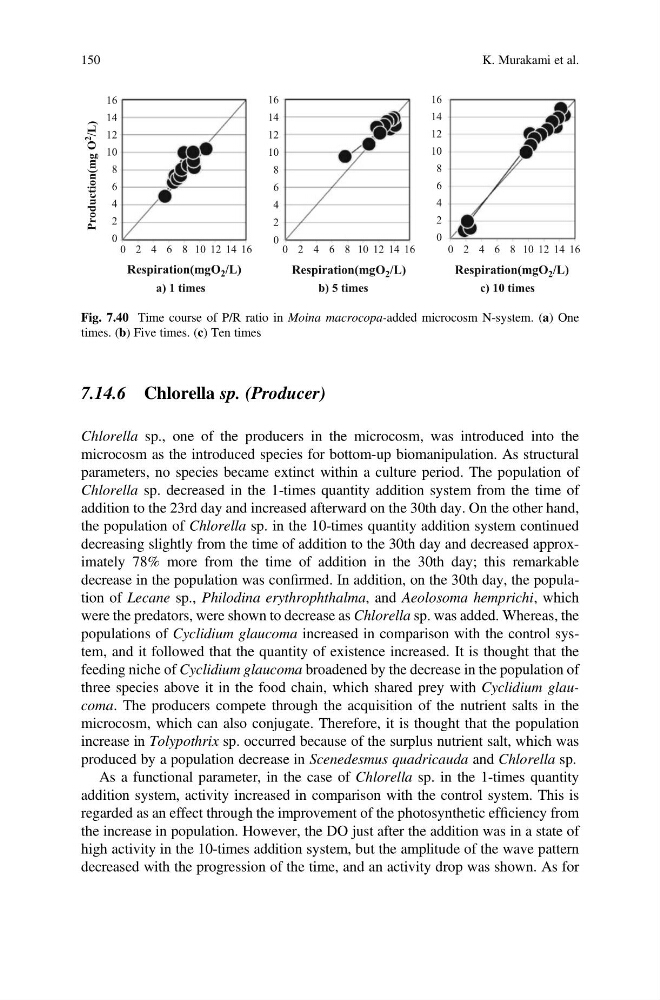
Fig. 7.40 Time course of P/R ratio in Moina macrocopa-added microcosm N-system. (a) One
times. (b) Five times. (c) Ten times
150
K. Murakami et al.
Chlorella sp., one of the producers in the microcosm, was introduced into the
microcosm as the introduced species for bottom-up biomanipulation. As structural
parameters, no species became extinct within a culture period. The population of
Chlorella sp. decreased in the 1-times quantity addition system from the time of
addition to the 23rd day and increased afterward on the 30th day. On the other hand,
the population of Chlorella sp. in the 10-times quantity addition system continued
decreasing slightly from the time of addition to the 30th day and decreased approximately 78% more from the time of addition in the 30th day; this remarkable
decrease in the population was confirmed. In addition, on the 30th day, the population of Lecane sp., Philodina erythrophthalma, and Aeolosoma hemprichi, which
were the predators, were shown to decrease as Chlorella sp. was added. Whereas, the
populations of Cyclidium glaucoma increased in comparison with the control system, and it followed that the quantity of existence increased. It is thought that the
feeding niche of Cyclidium glaucoma broadened by the decrease in the population of
three species above it in the food chain, which shared prey with Cyclidium glaucoma. The producers compete through the acquisition of the nutrient salts in the
microcosm, which can also conjugate. Therefore, it is thought that the population
increase in Tolypothrix sp. occurred because of the surplus nutrient salt, which was
produced by a population decrease in Scenedesmus quadricauda and Chlorella sp.
As a functional parameter, in the case of Chlorella sp. in the 1-times quantity
addition system, activity increased in comparison with the control system. This is
regarded as an effect through the improvement of the photosynthetic efficiency from
the increase in population. However, the DO just after the addition was in a state of
high activity in the 10-times addition system, but the amplitude of the wave pattern
decreased with the progression of the time, and an activity drop was shown. As for
a) 1 times
Respiration(mgO 2 /L)
Respiration(mgO 2 /L)
Respiration(mgO 2 /L)
Production(mg O
2
/L)
16
14
12
10
8
4
2
0
6
0 2 4 6 8 10
16
12 14
b) 5 times
16
14
12
10
8
4
2
0
6
0 2 4 6 8 10
16
12 14
c) 10 times
16
14
12
10
8
4
2
0
6
0 2 4 6 8 10
16
12 14
Fig. 7.40 Time course of P/R ratio in Moina macrocopa-added microcosm N-system. (a) One
times. (b) Five times. (c) Ten times
150
K. Murakami et al.