

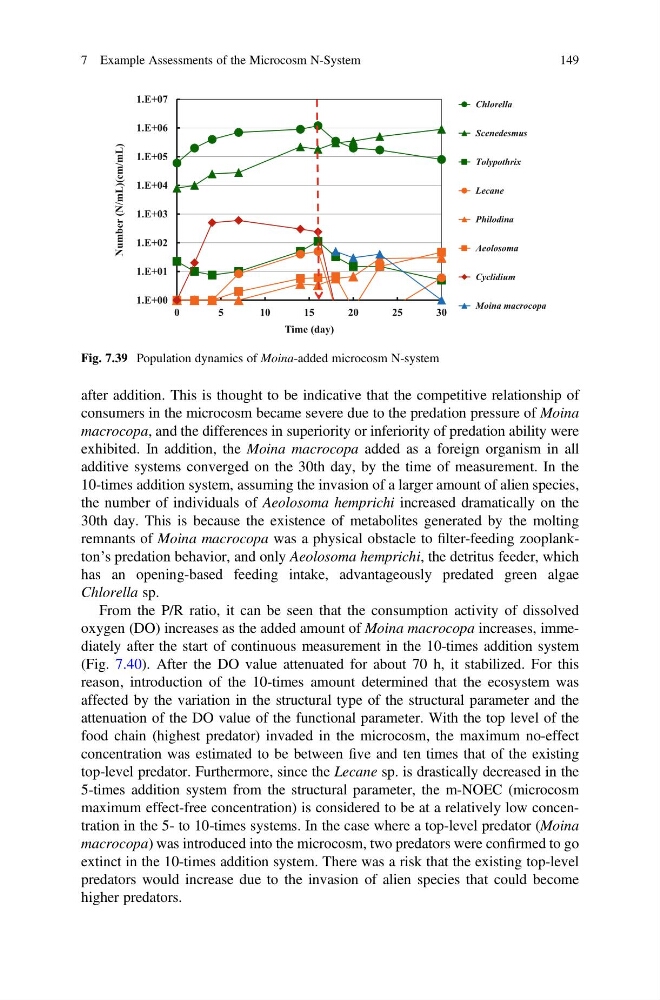
after addition. This is thought to be indicative that the competitive relationship of
consumers in the microcosm became severe due to the predation pressure of Moina
macrocopa, and the differences in superiority or inferiority of predation ability were
exhibited. In addition, the Moina macrocopa added as a foreign organism in all
additive systems converged on the 30th day, by the time of measurement. In the
10-times addition system, assuming the invasion of a larger amount of alien species,
the number of individuals of Aeolosoma hemprichi increased dramatically on the
30th day. This is because the existence of metabolites generated by the molting
remnants of Moina macrocopa was a physical obstacle to filter-feeding zooplankton’s predation behavior, and only Aeolosoma hemprichi, the detritus feeder, which
has an opening-based feeding intake, advantageously predated green algae
Chlorella sp.
From the P/R ratio, it can be seen that the consumption activity of dissolved
oxygen (DO) increases as the added amount of Moina macrocopa increases, immediately after the start of continuous measurement in the 10-times addition system
(Fig. 7.40). After the DO value attenuated for about 70 h, it stabilized. For this
reason, introduction of the 10-times amount determined that the ecosystem was
affected by the variation in the structural type of the structural parameter and the
attenuation of the DO value of the functional parameter. With the top level of the
food chain (highest predator) invaded in the microcosm, the maximum no-effect
concentration was estimated to be between five and ten times that of the existing
top-level predator. Furthermore, since the Lecane sp. is drastically decreased in the
5-times addition system from the structural parameter, the m-NOEC (microcosm
maximum effect-free concentration) is considered to be at a relatively low concentration in the 5- to 10-times systems. In the case where a top-level predator (Moina
macrocopa) was introduced into the microcosm, two predators were confirmed to go
extinct in the 10-times addition system. There was a risk that the existing top-level
predators would increase due to the invasion of alien species that could become
higher predators.
1.E+00
1.E+01
1.E+02
1.E+03
1.E+04
1.E+05
1.E+06
1.E+07
0
5
10
15
20
25
30
Number (
)
L
m
/
m
c
(
)
L
m
/
N
Time (day)
Chlorella
Scenedesmus
Tolypothrix
Lecane
Philodina
Aeolosoma
Cyclidium
Moina macrocopa
Fig. 7.39 Population dynamics of Moina-added microcosm N-system
7 Example Assessments of the Microcosm N-System
149
consumers in the microcosm became severe due to the predation pressure of Moina
macrocopa, and the differences in superiority or inferiority of predation ability were
exhibited. In addition, the Moina macrocopa added as a foreign organism in all
additive systems converged on the 30th day, by the time of measurement. In the
10-times addition system, assuming the invasion of a larger amount of alien species,
the number of individuals of Aeolosoma hemprichi increased dramatically on the
30th day. This is because the existence of metabolites generated by the molting
remnants of Moina macrocopa was a physical obstacle to filter-feeding zooplankton’s predation behavior, and only Aeolosoma hemprichi, the detritus feeder, which
has an opening-based feeding intake, advantageously predated green algae
Chlorella sp.
From the P/R ratio, it can be seen that the consumption activity of dissolved
oxygen (DO) increases as the added amount of Moina macrocopa increases, immediately after the start of continuous measurement in the 10-times addition system
(Fig. 7.40). After the DO value attenuated for about 70 h, it stabilized. For this
reason, introduction of the 10-times amount determined that the ecosystem was
affected by the variation in the structural type of the structural parameter and the
attenuation of the DO value of the functional parameter. With the top level of the
food chain (highest predator) invaded in the microcosm, the maximum no-effect
concentration was estimated to be between five and ten times that of the existing
top-level predator. Furthermore, since the Lecane sp. is drastically decreased in the
5-times addition system from the structural parameter, the m-NOEC (microcosm
maximum effect-free concentration) is considered to be at a relatively low concentration in the 5- to 10-times systems. In the case where a top-level predator (Moina
macrocopa) was introduced into the microcosm, two predators were confirmed to go
extinct in the 10-times addition system. There was a risk that the existing top-level
predators would increase due to the invasion of alien species that could become
higher predators.
1.E+00
1.E+01
1.E+02
1.E+03
1.E+04
1.E+05
1.E+06
1.E+07
0
5
10
15
20
25
30
Number (
)
L
m
/
m
c
(
)
L
m
/
N
Time (day)
Chlorella
Scenedesmus
Tolypothrix
Lecane
Philodina
Aeolosoma
Cyclidium
Moina macrocopa
Fig. 7.39 Population dynamics of Moina-added microcosm N-system
7 Example Assessments of the Microcosm N-System
149