

of AgNP, and a large influence was produced in the microcosm. To focus on the P/R
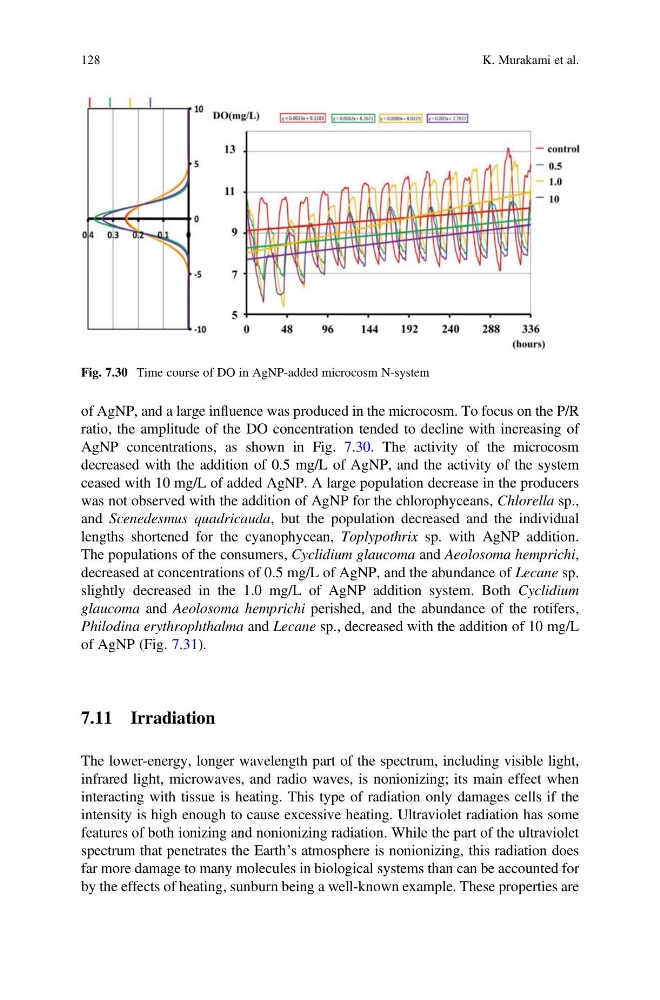
ratio, the amplitude of the DO concentration tended to decline with increasing of
AgNP concentrations, as shown in Fig. 7.30. The activity of the microcosm
decreased with the addition of 0.5 mg/L of AgNP, and the activity of the system
ceased with 10 mg/L of added AgNP. A large population decrease in the producers
was not observed with the addition of AgNP for the chlorophyceans, Chlorella sp.,
and Scenedesmus quadricauda, but the population decreased and the individual
lengths shortened for the cyanophycean, Toplypothrix sp. with AgNP addition.
The populations of the consumers, Cyclidium glaucoma and Aeolosoma hemprichi,
decreased at concentrations of 0.5 mg/L of AgNP, and the abundance of Lecane sp.
slightly decreased in the 1.0 mg/L of AgNP addition system. Both Cyclidium
glaucoma and Aeolosoma hemprichi perished, and the abundance of the rotifers,
Philodina erythrophthalma and Lecane sp., decreased with the addition of 10 mg/L
of AgNP (Fig. 7.31).
7.11 Irradiation
The lower-energy, longer wavelength part of the spectrum, including visible light,
infrared light, microwaves, and radio waves, is nonionizing; its main effect when
interacting with tissue is heating. This type of radiation only damages cells if the
intensity is high enough to cause excessive heating. Ultraviolet radiation has some
features of both ionizing and nonionizing radiation. While the part of the ultraviolet
spectrum that penetrates the Earth’s atmosphere is nonionizing, this radiation does
far more damage to many molecules in biological systems than can be accounted for
by the effects of heating, sunburn being a well-known example. These properties are
Fig. 7.30 Time course of DO in AgNP-added microcosm N-system
128
K. Murakami et al.
ratio, the amplitude of the DO concentration tended to decline with increasing of
AgNP concentrations, as shown in Fig. 7.30. The activity of the microcosm
decreased with the addition of 0.5 mg/L of AgNP, and the activity of the system
ceased with 10 mg/L of added AgNP. A large population decrease in the producers
was not observed with the addition of AgNP for the chlorophyceans, Chlorella sp.,
and Scenedesmus quadricauda, but the population decreased and the individual
lengths shortened for the cyanophycean, Toplypothrix sp. with AgNP addition.
The populations of the consumers, Cyclidium glaucoma and Aeolosoma hemprichi,
decreased at concentrations of 0.5 mg/L of AgNP, and the abundance of Lecane sp.
slightly decreased in the 1.0 mg/L of AgNP addition system. Both Cyclidium
glaucoma and Aeolosoma hemprichi perished, and the abundance of the rotifers,
Philodina erythrophthalma and Lecane sp., decreased with the addition of 10 mg/L
of AgNP (Fig. 7.31).
7.11 Irradiation
The lower-energy, longer wavelength part of the spectrum, including visible light,
infrared light, microwaves, and radio waves, is nonionizing; its main effect when
interacting with tissue is heating. This type of radiation only damages cells if the
intensity is high enough to cause excessive heating. Ultraviolet radiation has some
features of both ionizing and nonionizing radiation. While the part of the ultraviolet
spectrum that penetrates the Earth’s atmosphere is nonionizing, this radiation does
far more damage to many molecules in biological systems than can be accounted for
by the effects of heating, sunburn being a well-known example. These properties are
Fig. 7.30 Time course of DO in AgNP-added microcosm N-system
128
K. Murakami et al.